Next-Generation Ceramics: Unlocking Superior Properties for Industry

For general-purpose engineering applications, aluminum oxide ceramic offers the best balance of performance and affordability. When you need a material that resists wear, handles high temperatures, and insulates electricity all at a reasonable cost, alumina is often the default winner. But the real challenge lies in knowing when it’s *not* the right choice.
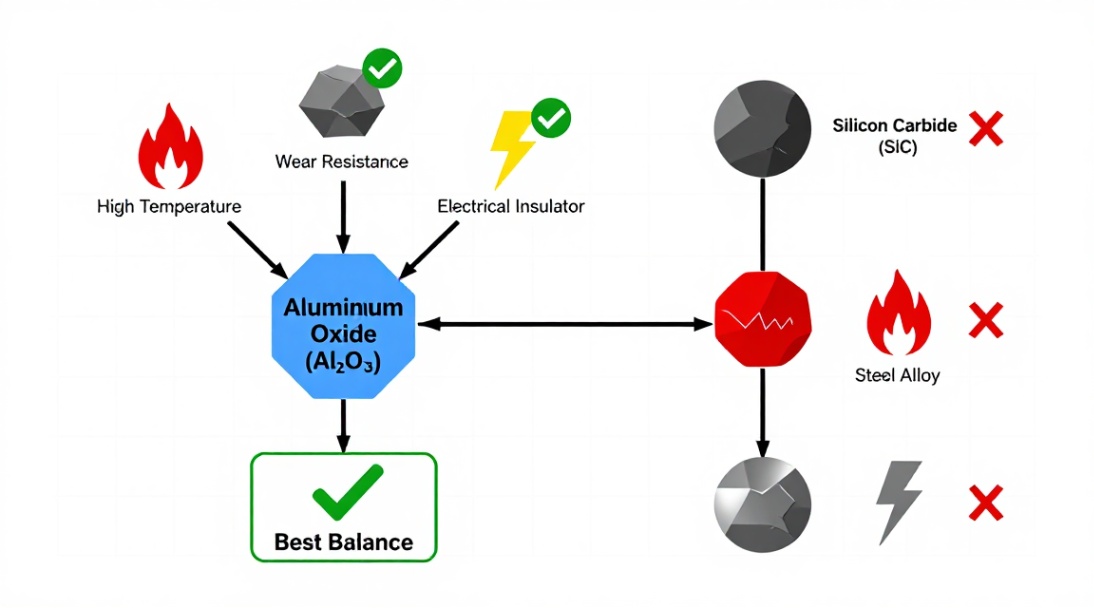
Aluminium Oxide Ceramic: The Workhorse Defined
Aluminum oxide (Al₂O₃), or alumina, is a sintered ceramic formed by fusing fine oxide powders at extremely high temperatures. This process creates a dense, polycrystalline material that is fundamentally different from its metallic counterparts. Its properties are not a happy accident. They result directly from strong ionic bonds and a stable crystal structure.
Core Strengths That Make It a Standard
- Exceptional Hardness & Wear Resistance: It ranks just below diamond and boron carbide, making it superb for liners, guides, and seal faces that face constant abrasion.
- High Temperature Stability: Alumina maintains its shape and strength up to 1700°C, perfect for furnace components and thermal insulators.
- Superb Electrical Insulation: Its high resistivity and dielectric strength make it the dominant choice for circuit substrates and insulating housings.
- Chemical Inertness: It resists attack from most acids, alkalis, and molten metals, ensuring long service life in corrosive environments.
Critical Comparison: Alumina vs. The Field
Choosing the right ceramic is about trade-offs. Let’s break down how alumina stacks up against common alternatives.
1. Aluminum Oxide Ceramic vs. Silicon Carbide Ceramic
- Thermal Conductivity: Silicon carbide ceramic is the clear winner. It dissipates heat 4-5 times better than alumina, making it ideal for heat sinks and kiln furniture.
- Mechanical Strength: Silicon carbide offers higher strength at temperatures exceeding 1400°C.
- Cost & Machinability: Here, alumina excels. It is less expensive and significantly easier to machine into complex shapes before firing.
- Verdict: Choose silicon carbide for extreme thermal management. Stick with alumina for cost-effective, electrically insulating wear parts.
2. Aluminium Oxide Ceramic vs. Zirconia (Zirconium Oxide)
- Fracture Toughness: Zirconia is far superior. It resists crack propagation, where standard alumina can be brittle. This is crucial for biomedical implants and high-impact parts.
- Hardness & Wear: Alumina is harder and provides better abrasion resistance in pure sliding wear.
- Thermal Conductivity: Alumina conducts heat better, which can be an asset or a liability.
- Verdict: Use zirconia where mechanical shock is a concern. Use alumina for superior pure-wear performance and electrical insulation.
3. Aluminium Oxide Ceramic vs. Aluminum Nitride Ceramic
- Thermal Conductivity: Aluminum nitride ceramic matches beryllium oxide, offering thermal conductivity nearly 10 times that of alumina. It’s the top choice for high-power electronic substrates.
- Electrical Properties: Both are excellent insulators, but AlN’s thermal performance is its defining trait.
- Cost & Processing: Alumina wins decisively. Aluminum nitride is more expensive and sensitive to processing conditions.
- Verdict: For cutting-edge power electronics, AlN is necessary. For 90% of standard substrate needs, alumina provides ample performance at a fraction of the cost.
Making the Right Choice: A Practical Selection Guide
Follow this logic to narrow your options quickly.
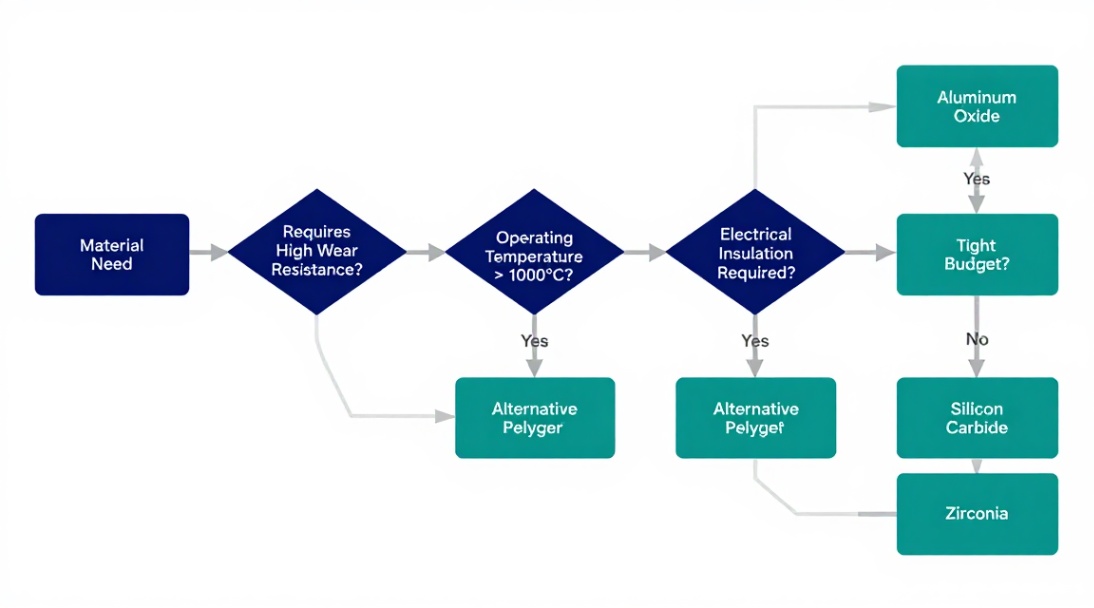
Step 1: Define Your Primary Driver
- Is it extreme wear? Start with alumina or boron carbide ceramic.
- Is it thermal management? Compare silicon carbide, aluminum nitride, and boron nitride ceramic.
- Is it electrical insulation? Alumina is the default; consider aluminium nitride if heat is also critical.
- Is it impact resistance? Look immediately at zirconia or silicon nitride ceramic.
Step 2: Understand Alumina’s Own Grades
Not all alumina is equal. Purity dictates performance.
- 96% Alumina: The industry workhorse. Offers an excellent balance of properties for most mechanical and industrial applications. More cost-effective.
- 99.5%+ Alumina (High-Purity): Provides better mechanical strength, higher temperature capability, and superior corrosion resistance. Used in semiconductor processing, advanced armor, and critical labware.
- Specialist Grades: Variants with controlled porosity or specific grain structures exist for filtration, catalysis, and specialized coatings like those used on boron nitride ceramic crucibles.
Step 3: Acknowledge the Limits
Do not select alumina if:
- Your part faces severe thermal shock (quartz ceramic or cordierite may be better).
- You require the ultimate in toughness for a structural component (silicon nitride ceramic or zirconia composites are superior).
- Your application involves very high-velocity abrasives (boron carbide or reaction-sintered silicon carbide ceramics are harder).
- The environment is hot, oxidizing, and under extreme mechanical load (this is where next-gen materials like high-entropy oxides and ultra-high temperature ceramic matrix composites enter the research frontier).
Conclusion and Your Path Forward
Aluminum oxide ceramic remains the most versatile and widely adopted advanced ceramic for good reason. Its combination of properties is unmatched for the price. My advice is straightforward. Start your design with alumina as the baseline. Its manufacturing processes are mature, and suppliers are plentiful. Only move to a more exotic (and expensive) ceramic like silicon carbide, aluminum nitride, or zirconia when you have clear, quantifiable data that alumina falls short in a critical area-be it thermal conductivity, toughness, or extreme temperature strength. If you’re prototyping, many suppliers offer standard alumina blanks or custom sintered parts to test your concept. Getting a sample in your hand to test against your specific operating conditions is the final, and most important, step in making a confident material decision.
Suppiler
Synthetic-chemical focus on the research and development, production and sales of ceramic products, serving the electronics, ceramics, chemical and other industries. Since its establishment in 2015, the company has been committed to providing customers with the best products and services, and has become a leader in the industry through continuous technological innovation and strict quality management.
Our products includes but not limited to Aluminum Nitride, Aluminum Oxide, Boron Carbide, Boron Nitride, Ceramic Crucible, ect. If you are interested in any type of these, please feel free to contact us.