Next-Generation Ceramics: Unlocking Superior Properties for Industry

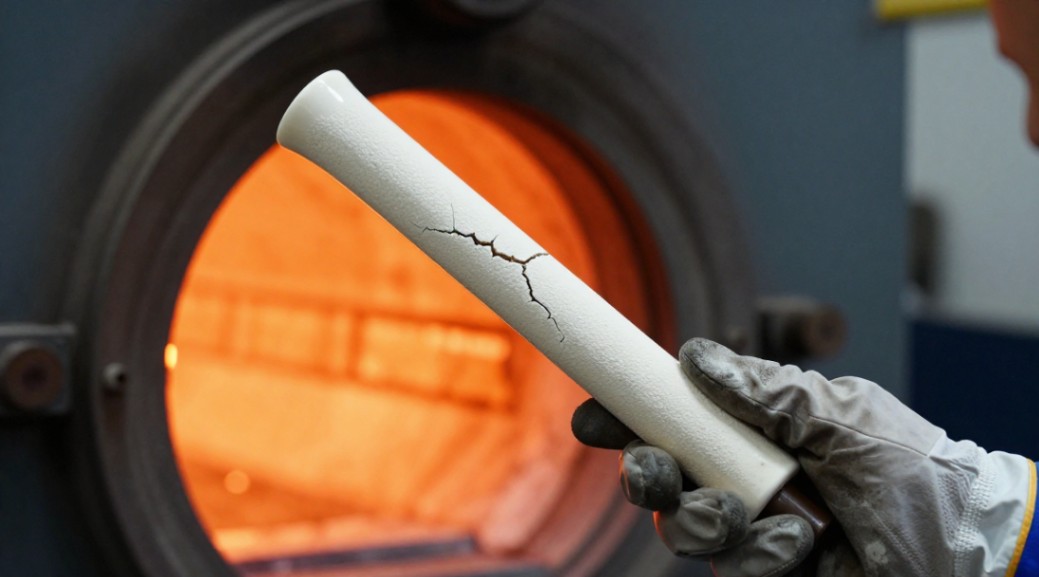
Early in my career, I watched a $50,000 assembly fail in a high-temperature furnace. The culprit? A set of newly installed aluminium oxide ceramic thermocouple tubes. The material spec seemed correct-99.5% alumina, excellent thermal stability. Yet, after three thermal cycles, they catastrophically cracked. The investigation revealed a subtle but critical error: the design didn’t account for the anisotropic thermal expansion in the specific crystal structure of that pressureless sintered grade. The client lost production time. We learned a hard lesson. That experience, echoed by many in technical forums, forms the basis of this guide. Here are the mistakes you cannot afford to make.
1. Treating All Grades as Equal: The Purity Trap
Aluminum oxide ceramic is not a single material. Its properties shift dramatically with purity, which ranges from 85% to over 99.9% Al2O3. Selecting the wrong grade guarantees performance issues.
What You Must Know
- 85%-94% Alumina: Contains glassy silicate phases. It offers good mechanical strength and lower cost but suffers in high-temperature and corrosive environments. The glass phase softens above 1000°C.
- 96%-99.5% Alumina: The workhorse for most industrial applications. Excellent wear resistance, good electrical insulation, and stable up to 1500°C. This is your default for seals, wear plates, and cutting tools.
- 99.9%+ Alumina: Ultra-high purity. Offers superior corrosion resistance, maximum electrical dielectric strength, and optical transparency in certain forms. Essential for semiconductor wafer processing and high-power laser tubes.
Mistake: Using a 90% alumina part in a caustic chemical bath because the datasheet only listed ‘alumina’. The glass phase will leach out, causing rapid degradation.
2. Ignoring Thermal Shock Limitations
While aluminum oxide ceramic has high-temperature stability, its thermal shock resistance is moderate. It’s inferior to materials like silicon nitride or certain silicon carbide ceramics.
- Critical Factor: The coefficient of thermal expansion (CTE) and thermal conductivity. Alumina has a relatively high CTE and moderate conductivity. Rapid temperature changes create internal stresses.
- User Feedback: On Reddit, a mechanical engineer shared how alumina heater bases failed in a cyclic heating application where mullite ceramic or boron nitride ceramic would have succeeded. The thread was full of similar stories.
Solution: For rapid cycling above 200°C differentials, analyze silicon nitride ceramic or aluminum nitride ceramic (for high thermal conductivity). For furnace linings with slower cycles, alumina is often perfect.
3. Overlooking Machining and Tolerancing Realities
You cannot machine alumina like metal. It is hard and brittle. Post-sintering machining (grinding, lapping) is expensive and design-limited.
Design Rules to Follow
- Avoid Thin Walls & Sharp Corners: These are stress concentrators and fracture initiators. Specify generous radii.
- Understand ‘As-Fired’ vs. ‘Ground’ Finish: ‘As-fired’ surfaces are cheaper but have wider dimensional tolerances. Precision-ground features add significant cost.
- Do Not Assume Metal-like Threads: Threads in alumina are fragile. Use embedded metal inserts or alternative fastening methods.
4. Misapplying It in Extreme Wear or Impact Scenarios
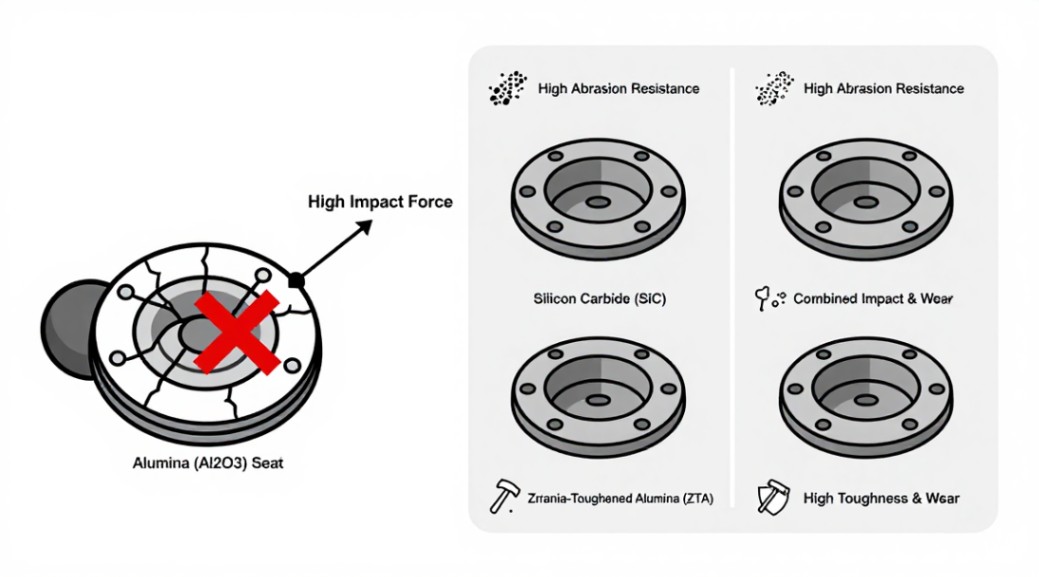
Alumina is hard (9 on the Mohs scale). It excels in abrasive wear. But its fracture toughness is low.
Comparison: For sheer abrasion resistance, boron carbide ceramic is harder. For combined impact and wear, silicon carbide ceramic or zirconia-toughened alumina are superior. Using standard alumina in a high-impact ball check valve is a common, expensive error.
5. Neglecting the Electrical Insulation Context
Alumina is a superb insulator. However, at very high temperatures or frequencies, properties change.
- Dielectric Loss: Increases with temperature. For high-frequency electronics substrates, ensure your grade’s loss tangent is specified for the operating range.
- Surface Finish Matters: A rough surface can create paths for tracking and reduced breakdown voltage. Specify the required surface roughness for high-voltage parts.
6. Assuming Biocompatibility Equals Implant Suitability
High-purity alumina is bioinert, making it historically valuable for hip joint bearings. However, modern medical implant applications demand more.
Reality: Its low fracture toughness has led to rare but catastrophic implant failures. Today, silicon nitride ceramic and advanced zirconia composites are often preferred for load-bearing implants due to superior toughness and antibacterial properties. Using alumina in a new spinal implant design without rigorous fatigue testing is a profound risk.
7. Failing to Specify the Right Companion Materials
Alumina doesn’t exist in a vacuum. Its interaction with other materials can cause failure.
- Metal Bonding: Differential expansion with metals requires careful joint design and often active metal brazing alloys.
- Against Itself: Unlubricated alumina-on-alumina has a high coefficient of friction. In seals and bearings, consider surface polishing, lubrication, or incorporating a different material like silicon carbide.
- Special Coatings: For high-temperature metal melting, a special coating for boron nitride ceramic crucibles might be needed to prevent reaction. Don’t assume alumina is always chemically passive.
Material Selection: A Quick Comparative Guide
Use this to challenge your initial alumina choice.
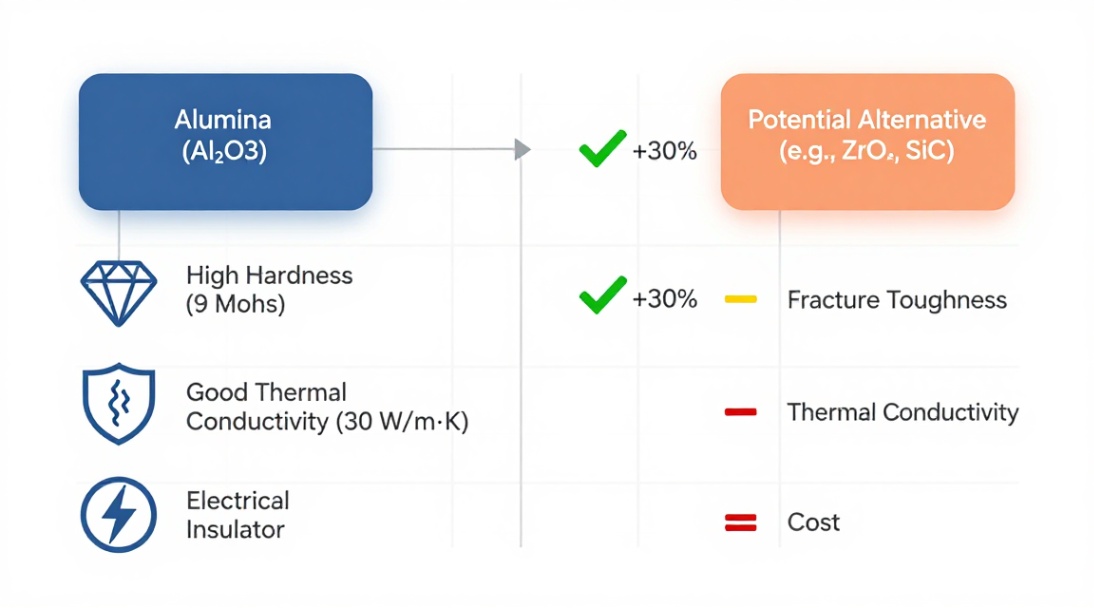
- Need Higher Thermal Conductivity? Look at aluminum nitride ceramic or silicon carbide ceramic.
- Need Superior Fracture Toughness? Evaluate silicon nitride ceramic or zirconia.
- Need Extreme Hardness for Abrasion? Consider boron carbide ceramic.
- Need Maximum Thermal Shock Resistance? Silicon carbide-bonded silicon nitride ceramics or recrystallized silicon carbide ceramics are prime candidates.
Successful engineering with aluminum oxide ceramic demands respect for its specific capabilities and limits. It is a remarkably versatile material, but its success hinges on precision in specification, design, and application context. Cross-reference your requirements against the pitfalls listed here. Consult deeply with your ceramic component supplier early in the design phase. Share this knowledge with your team to prevent costly learning experiences. The goal is not just to use a material, but to master its application.
Suppiler
Synthetic-chemical focus on the research and development, production and sales of ceramic products, serving the electronics, ceramics, chemical and other industries. Since its establishment in 2015, the company has been committed to providing customers with the best products and services, and has become a leader in the industry through continuous technological innovation and strict quality management.
Our products includes but not limited to Aluminum Nitride, Aluminum Oxide, Boron Carbide, Boron Nitride, Ceramic Crucible, ect. If you are interested in any type of these, please feel free to contact us.