Next-Generation Ceramics: Unlocking Superior Properties for Industry

You’ve Been Specifying Alumina Wrong. Here’s the Fix.
Your part failed. The wear plate cracked, the insulator arced, or the thermal shock killed a critical component. You followed the conventional wisdom and chose aluminium oxide ceramic. It’s the go-to, the safe bet. But the results fell short. Why? Because “ceramic” is not a single material. It’s a universe of compounds, each with distinct personalities and failure modes. The industry‘s over-reliance on generic alumina specs is a recipe for underperformance and cost blowouts. Let’s cut through the noise.
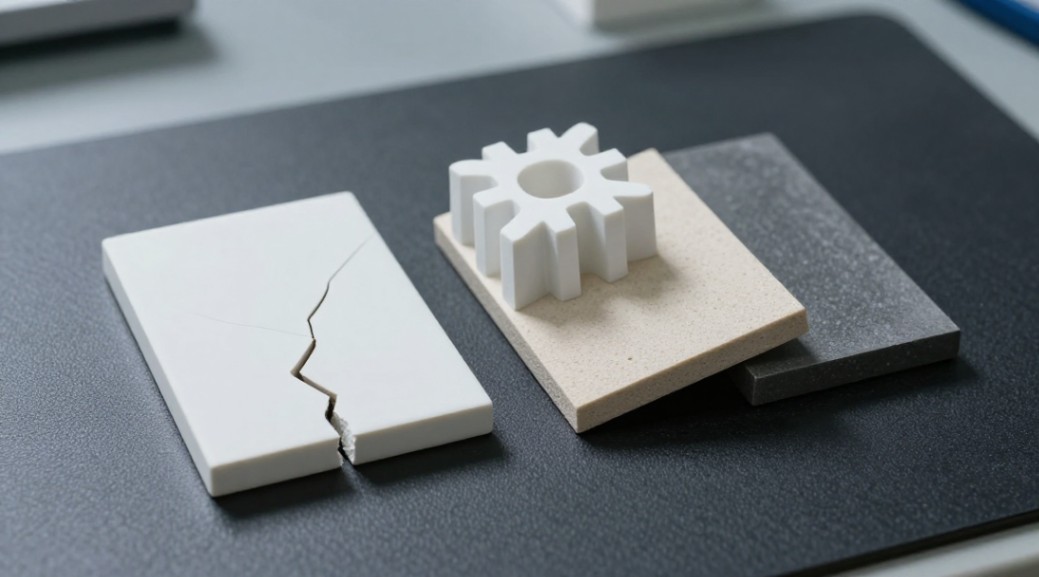
The Aluminum Oxide Ceramic Reality Check: A Balanced Scorecard
Aluminum oxide ceramic, or alumina (Al₂O₃), is the workhorse. It’s not the flashiest, but its balance makes it a contender. Forget marketing fluff. Here’s its raw performance ledger.
Where Aluminium Oxide Ceramic Wins (And Why)
- Cost-to-Performance Champion: Alumina offers the most accessible entry point into high-performance ceramics. Its raw material abundance and mature manufacturing keep it affordable.
- Hardness & Wear Armor: With a Vickers hardness often above 1500 HV, it resists abrasive particles and sliding wear better than most metals. It’s the default for seal faces, liners, and cutting tool inserts.
- Dielectric Fortress: Excellent electrical insulation and high dielectric strength make it the substrate of choice for everything from spark plugs to microelectronic packages.
- Chemical Inertia: It laughs off most acids and alkalis. This biocompatibility also makes certain grades suitable for medical implants and labware.
- High-Temperature Structure: It retains its shape and strength at temperatures that turn steel into putty, routinely operating above 1500°C.
Where Aluminum Oxide Ceramic Loses (The Fine Print)
- Thermal Conductivity Mismatch: It’s a thermal insulator. For heatsinking or managing thermal shock, alumina can be a liability. This is its Achilles’ heel in high-power electronics.
- Fracture Toughness Ceiling: It’s brittle. While fine for compressive loads, impact and tensile stress are its enemies. Don’t use it as a hammer.
- Density Penalty: It’s heavier than many advanced alternatives. In aerospace or moving assemblies, this mass matters.
- Machining Cost Trap: Once sintered, it can only be ground with diamond tools. Complex shapes get expensive, fast.
The Head-to-Head: Alumina vs. The Competition
Choosing a ceramic is a zero-sum game. Picking alumina means saying no to something else. Here’s the decisive breakdown.
Aluminum Oxide Ceramic vs. Silicon Carbide Ceramic
- Thermal Management: Silicon carbide ceramic conducts heat 3-5x better than alumina. For substrates needing to dissipate waste heat, silicon carbide is the undisputed king.
- Wear & Abrasion: Both excel, but silicon carbide is harder and more chemically resistant in certain environments. It’s the pick for extreme slurry erosion.
- Verdict: Need heat spreading or ultimate wear? Choose silicon carbide ceramic. Prioritizing cost and electrical insulation? Aluminum oxide ceramic stays.
Aluminum Oxide Ceramic vs. Zirconia (ZrO₂)
- Toughness vs. Hardness: Zirconia boasts superior fracture toughness. It resists cracking and can handle more mechanical abuse. Alumina is harder and more wear-resistant.
- Thermal Insulation: Zirconia has even lower thermal conductivity. It’s a better thermal barrier but a worse thermal manager.
- Verdict: Designing a component prone to impact or tensile stress? Zirconia is safer. For pure abrasive wear and hardness, aluminum oxide ceramic often wins.
Aluminum Oxide Ceramic vs. Boron Nitride Ceramic
- The Thermal Specialist: Boron nitride ceramic is a thermal conductor *and* an electrical insulator-a rare combo. It machines easily, unlike alumina.
- The Catch: Boron nitride is softer and far more expensive. It’s not for structural or high-wear roles.
- Verdict: Need an electrically insulating heatsink or easy-to-machine fixtures? Boron nitride ceramic is your specialist. For structural, wear-resistant components, aluminum oxide ceramic is the economical bulk material.
Your Decision Matrix: What to Do Next
Stop guessing. Use this logic tree.
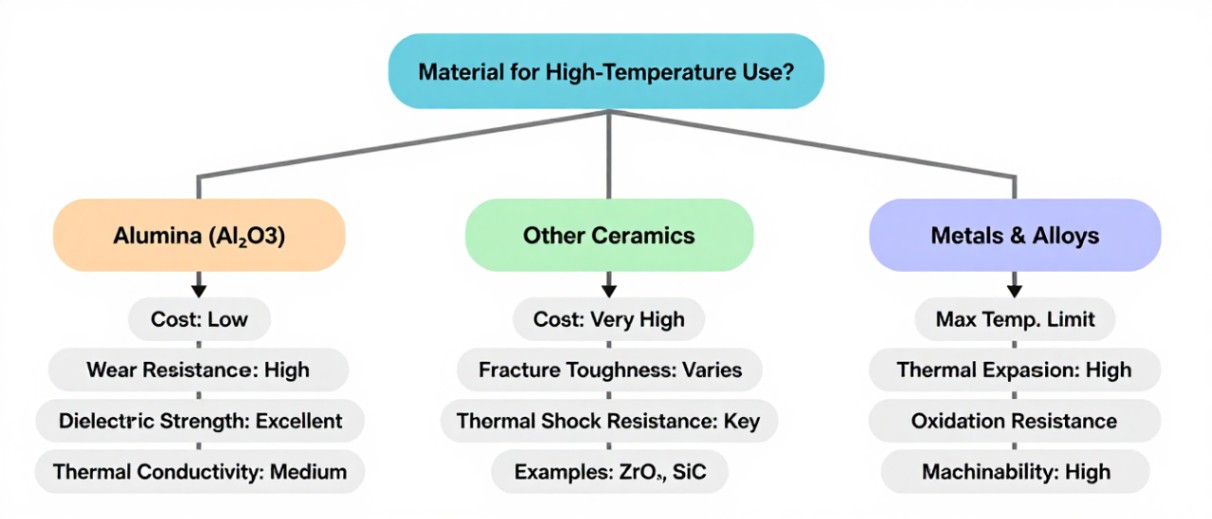
- Define the Primary Failure Mode: Is it wear? Heat? Corrosion? Electrical breakdown? Impact? Name the one thing that will kill the part first.
- Map the Failure Mode to Material Property:
- Wear/Abrasion → Hardness.
- Thermal Stress/Cracking → Thermal Conductivity & Toughness.
- Heat Dissipation → Thermal Conductivity.
- Electrical Isolation → Dielectric Strength & Volume Resistivity.
- Apply the Filter:
- Maximizing hardness on a budget? Start with aluminum oxide ceramic.
- Need heat spreading + insulation? Look at aluminum nitride ceramic or silicon carbide ceramic.
- Fighting brutal impact? Investigate zirconia or fiber-reinforced composites.
- Pressure-Test with Secondary Factors: Now consider cost, machinability, and availability. A perfect material you can’t afford or shape is useless.
The Future Isn’t Just Alumina
The frontier is moving beyond single-material thinking. Researchers are creating oxide ceramic systems with melting points exceeding 3000°C. The real breakthrough is in composites. Imagine combining the hardness of alumina with the toughness of fibers. Techniques like slurry infiltration build double continuous structures, embedding ceramics within fiber preforms. This pushes fracture toughness from the brittle 3-5 MPa·m¹/² range toward 20 MPa·m¹/². The future belongs to these engineered material systems, not monolithic ceramics alone.
Your Next Step: Don’t just order “alumina.” Write a performance specification. List the required values for hardness, thermal conductivity, dielectric strength, and fracture toughness. Then, challenge your supplier. Ask why they recommend a specific grade of aluminium oxide ceramic over silicon nitride ceramic or a mullite ceramic composite. The right material isn’t a tradition; it’s a calculated decision.
Suppiler
Synthetic-chemical focus on the research and development, production and sales of ceramic products, serving the electronics, ceramics, chemical and other industries. Since its establishment in 2015, the company has been committed to providing customers with the best products and services, and has become a leader in the industry through continuous technological innovation and strict quality management.
Our products includes but not limited to Aluminum Nitride, Aluminum Oxide, Boron Carbide, Boron Nitride, Ceramic Crucible, ect. If you are interested in any type of these, please feel free to contact us.