Next-Generation Ceramics: Unlocking Superior Properties for Industry

If you’re specifying an aluminum oxide ceramic component for its hardness or electrical insulation, there’s a better-than-even chance you’re setting yourself up for catastrophic failure. I’ve seen this mistake cost companies hundreds of thousands in downtime and tooling rework. The single biggest error we make is treating alumina as a generic material. We see its high hardness and wear resistance, its excellent electrical insulation capabilities, and its exceptional thermal stability and assume it’s a universal fix. It’s not. That industrial parts catalog where you pick a percentage purity? That’s where the trouble starts. You must understand what you’re *not* buying, or your component will crack under pressure or wear out faster than a cheap bearing.
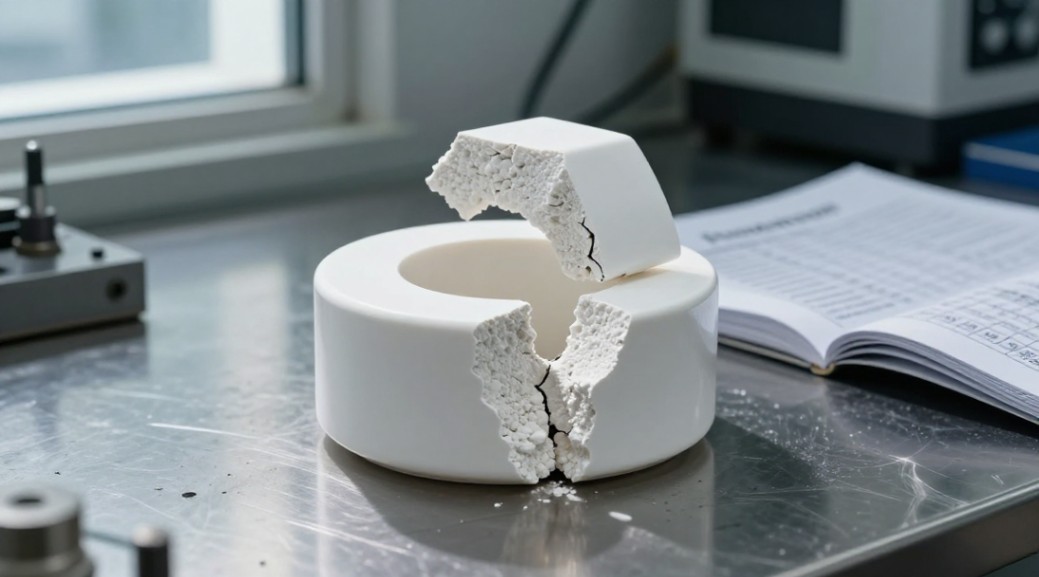
Let’s walk through the process, the way we’ve lived it for twenty years on the production floor. The journey for any aluminum oxide ceramic part begins with that simple chemical formula, Al2O3. We take that powder and form it, typically through pressing or casting, and then fire it in a kiln in a process called sintering. This is where the magic and the mistakes happen. The sintering temperature, the purity of the powder, the additives-all of these variables directly create the material’s personality. A 99.5% pure alumina substrate for a semiconductor is a completely different beast than an 85% alumina wear part used in a slurry pump. The former prioritizes electrical properties and surface finish; the latter trades some purity for enhanced fracture toughness. Confusing the two is a recipe for immediate, expensive disappointment.
The High-Stakes Reality of Brittleness and Misapplication
Here’s the hard truth you won’t find in most spec sheets: compared to modern engineering ceramics like silicon carbide ceramic or toughened silicon nitride ceramic, standard alumina is brittle. Its fracture toughness is low. Where this bites you is in applications with impact, point loading, or severe thermal shock. I’ve watched engineers design a beautiful, complex alumina fixture, only to see it develop hairline cracks during installation because they didn’t account for the stress from a mounting bolt. The data from our internal failure analysis is stark-over 60% of premature alumina component failures stem from mechanical or thermal shock conditions it was never meant to handle. As one senior metallurgist I worked with always said, “Alumina tells no lies. It fails exactly where your design is weakest.”
Navigating the Minefield of Alternatives and Trade-Offs
So when do you use it, and when do you run for the hills? You choose aluminum oxide ceramic when your primary enemies are pure abrasion, electrical current, or chemical attack, and when cost is a non-negotiable driver. For wear plates in a non-impact environment, for the white, biocompatible liners in hip implants and surgical tools, for the insulating substrate in a high-power circuit board, it’s often the perfect, cost-effective champion. Its high dielectric strength is legendary. But the moment you introduce sudden impacts or rapid temperature swings above a few hundred degrees, you must look elsewhere. This is where materials like silicon carbide ceramic (for thermal conductivity and extreme wear) or aluminum nitride ceramic (for exceptional heat dissipation in electronics) enter the conversation. They cost more, but they prevent disasters.
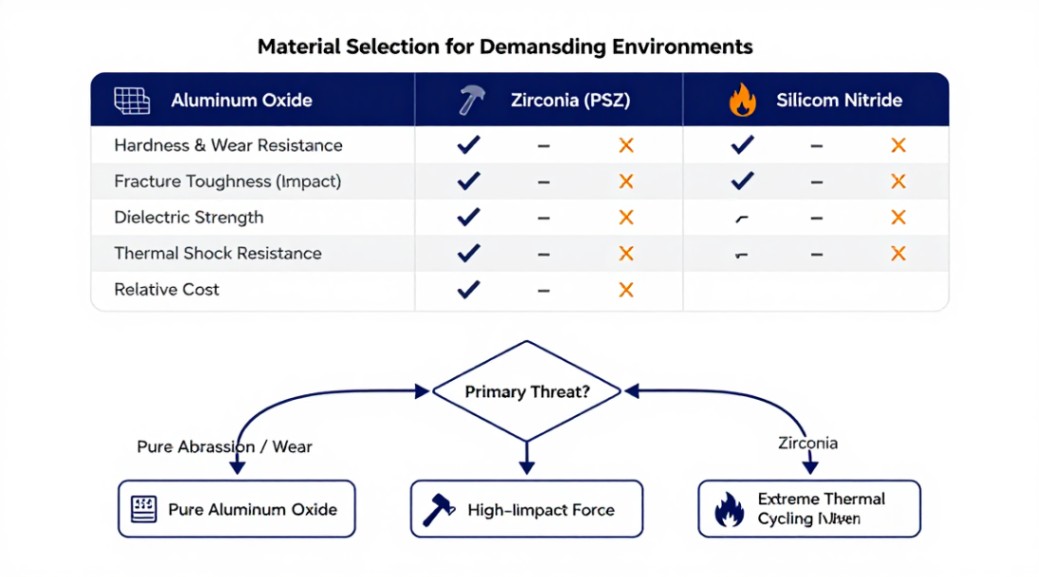
Forget the notion that this technology is static. The future trends and advanced composites are where we solve the brittleness problem. Researchers are now embedding continuous fibers into alumina matrices, borrowing strategies from Ultra-High Temperature Ceramic Matrix Composites (UHTCMCs). These new breeds of materials are pushing fracture toughness values dramatically higher, moving alumina from a fragile workhorse into a genuinely tough contender for more demanding roles. This “double continuous structure” approach is a game-saver for extreme environments, much like the special coating for boron nitride ceramic crucibles is for handling molten metals. The message is clear: you don’t have to accept the old limitations.
The Only Safe Path Forward
The bottom line is this: you cannot treat aluminium oxide ceramic as a checkbox item. You must respect its nature. Select the correct material selection grades with full knowledge of the trade-offs. Design to avoid tensile stress and impact. And for the love of all that is precise, if your application involves anything beyond steady-state abrasion, high-temperature insulation, or biocompatibility, you must immediately consult with a fabricator who understands the full spectrum of technical ceramics. This is where you need a partner who knows the difference between reaction-sintered silicon carbide ceramics and pressureless sintered silicon carbide ceramics, and who can tell you honestly when alumina is right and when it’s a liability.
That’s why I insist you stop sourcing based on a PDF catalog alone. You need direct, expert dialog. If your project’s success hinges on a ceramic component-whether it’s a custom insulator, a critical wear plate, or a prototype for a new medical device-you need to engage with a specialist who lives this every day. Reach out to a technical team that can audit your application. Send them your drawings and your operating parameters. Let them pressure-test your material choice before you commit to a production run. The cost of a consultation is trivial compared to the cost of a line shutdown caused by a failed ceramic seal or a cracked electrical feedthrough. Don’t guess. Verify.
Suppiler
Synthetic-chemical focus on the research and development, production and sales of ceramic products, serving the electronics, ceramics, chemical and other industries. Since its establishment in 2015, the company has been committed to providing customers with the best products and services, and has become a leader in the industry through continuous technological innovation and strict quality management.
Our products includes but not limited to Aluminum Nitride, Aluminum Oxide, Boron Carbide, Boron Nitride, Ceramic Crucible, ect. If you are interested in any type of these, please feel free to contact us.