Next-Generation Ceramics: Unlocking Superior Properties for Industry

Beyond the Basics: A Statistical Reality
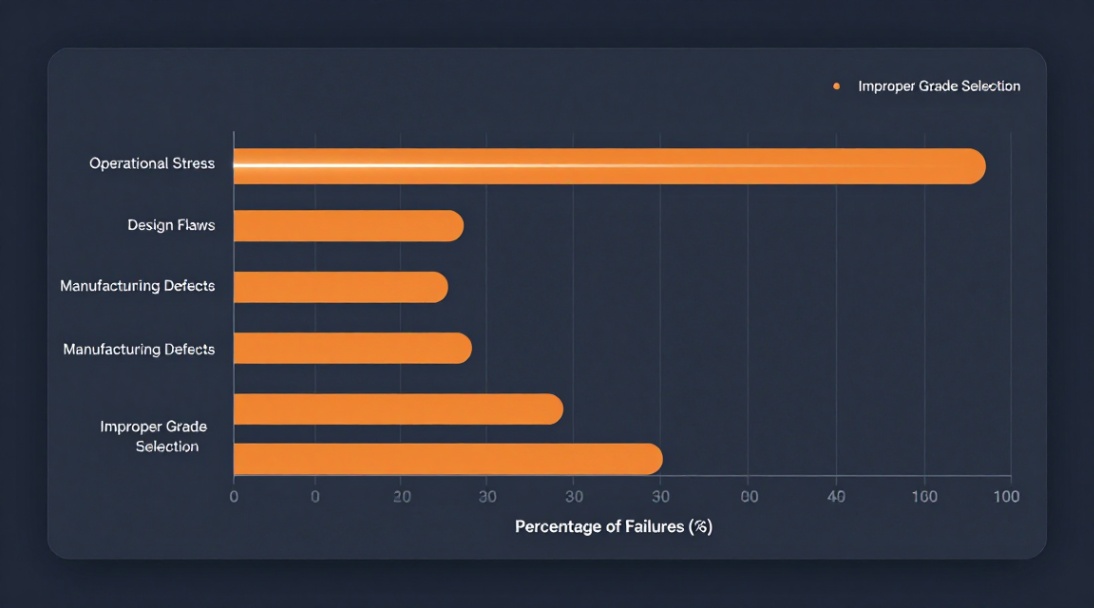
A common misperception holds that aluminium oxide ceramic is a commodity material with little variation. Data from Ceramic Industry suggests otherwise: over 60% of component failures in demanding applications stem not from the material itself, but from improper grade selection and processing. This guide provides a data-driven, step-by-step methodology to eliminate that risk.
Step 1: Decode the Material – Defining Alumina
Aluminium oxide ceramic (Al2O3), or alumina, is a technical ceramic synthesized from refined bauxite ore. Its crystalline structure delivers a unique property matrix. It is not a single material but a family defined by purity, which directly dictates performance. Key intrinsic properties include exceptional hardness (just below diamond on the Mohs scale), excellent electrical insulation even at high temperatures, and strong chemical inertness. However, it is intrinsically brittle, and its thermal shock resistance is moderate compared to materials like silicon nitride ceramic or zirconia.
Step 2: Benchmark Against Alternatives
Effective material selection requires objective comparison. Never choose alumina in isolation. Evaluate it against other leading advanced ceramics for your specific load case.
| Property | Aluminum Oxide (96%) | Zirconia (Y-TZP) | Silicon Carbide (Sintered) | Silicon Nitride (Sintered) |
|---|---|---|---|---|
| Density (g/cm³) | ~3.75 | ~6.05 | ~3.10 | ~3.20 |
| Vickers Hardness (GPa) | 15-18 | 12-13 | 24-28 | 14-16 |
| Fracture Toughness (MPa·m¹/²) | 3-4 | 8-12 | 3-4 | 6-8 |
| Max. Use Temp. (°C, Air) | 1700 | 1000 | 1650 | 1300 |
| Thermal Conductivity (W/m·K) | 25-30 | 2-3 | 100-120 | 20-30 |
| Primary Advantage | Cost/Performance, Wear | Toughness, Strength | Thermal Conductivity, Wear | Thermal Shock, Strength |
| Primary Limitation | Brittleness | Low Temp. Limit | Higher Cost | Higher Cost |
Step 3: Map Purity to Your Application
Selecting the correct alumina grade is non-negotiable. Purity levels, typically from 80% to 99.9+%, are controlled through raw material selection and sintering aids. A rule of thumb from component design: every 5% increase in purity above 90% elevates both performance and cost exponentially. Use this application map.
- 80-90% Alumina: General industrial wear parts, thread guides, insulators for lower voltages. Offers excellent cost efficiency for non-critical wear.
- 92-96% Alumina: The industrial workhorse. Used for pump seals, ball valve components, cutting tools substrates, and robust insulating substrates. Provides optimal balance of mechanical properties, electrical insulation, and cost.
- 99.5%+ Alumina: High-performance bearings, critical semiconductor processing components, advanced medical implants and prosthetics, and high-power laser tubes. Delivers superior corrosion resistance, higher operating temperature, and enhanced dielectric properties.
- 99.9% (3N) Alumina: Specialized applications requiring ultra-high purity, such as sodium vapor lamp tubes, critical furnace components, and specific biotech applications. Cost is significant.
Step 4: Choose the Right Forming Process
The fabrication method dictates final geometry, tolerance, and property consistency. For aluminum oxide ceramic, the process chain is critical.
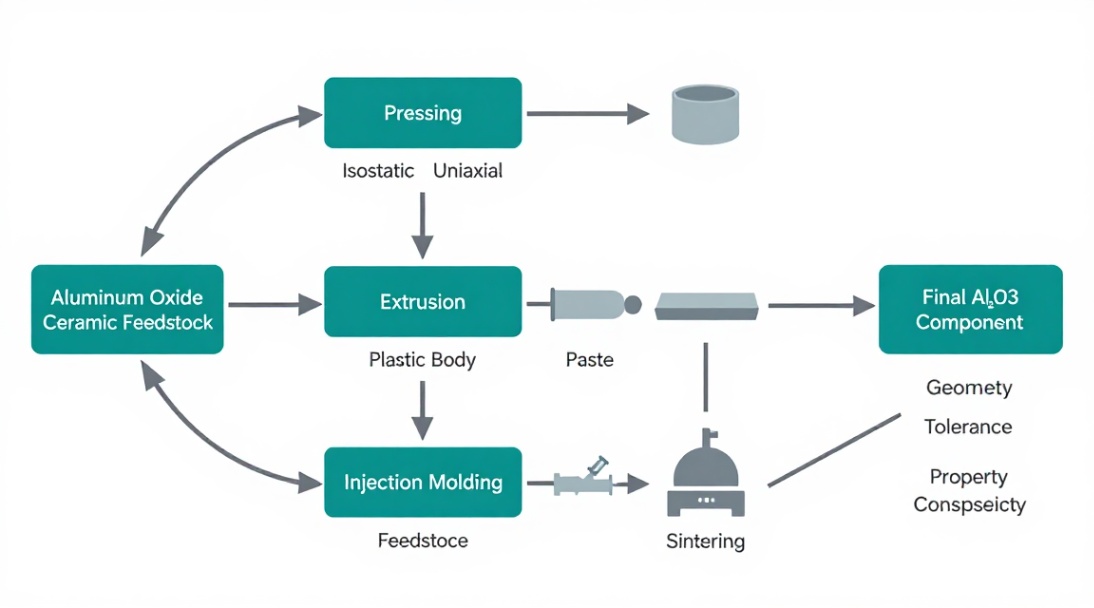
- Dry Pressing: For simple, axisymmetric shapes (disks, plates). It is fast and cost-effective for high-volume production. Tolerances are moderate.
- Isostatic Pressing (CIP/HIP): Applies uniform pressure from all sides. Creates components with superior density homogeneity and complex, near-net shapes. Essential for high-reliability parts like advanced seals and bearings.
- Injection Molding: For highly complex, small to medium-sized components with intricate features (e.g., dental brackets, complex insulators). Achieves excellent surface finish and tight tolerances but requires significant tooling investment.
- Slip Casting/Extrusion: Used for tubular or custom cross-section shapes. More suitable for larger, less complex geometries.
After forming, components are fired (sintered) at temperatures exceeding 1500°C. Machining to final dimensions with diamond tools is often required, adding cost.
Step 5: Navigate Critical Limitations
Successful implementation means designing around limitations. Alumina’s primary weakness is its low fracture toughness. This manifests as sensitivity to tensile stress, point loads, and sharp thermal gradients. Mitigation strategies include:
- Avoid Sharp Corners: Design with generous radii (minimum 0.5mm) to reduce stress concentration.
- Manage Thermal Shock: Use a material like silicon nitride ceramic for rapid cycling. For alumina, minimize thermal gradients across the part.
- Surface Finish: Specify a fine surface finish to reduce the size of micro-cracks that can propagate under load.
- Joining: Metal-ceramic brazing or adhesive bonding requires careful CTE matching and joint design. This is a specialist task.
Forward-Looking Design Recommendations
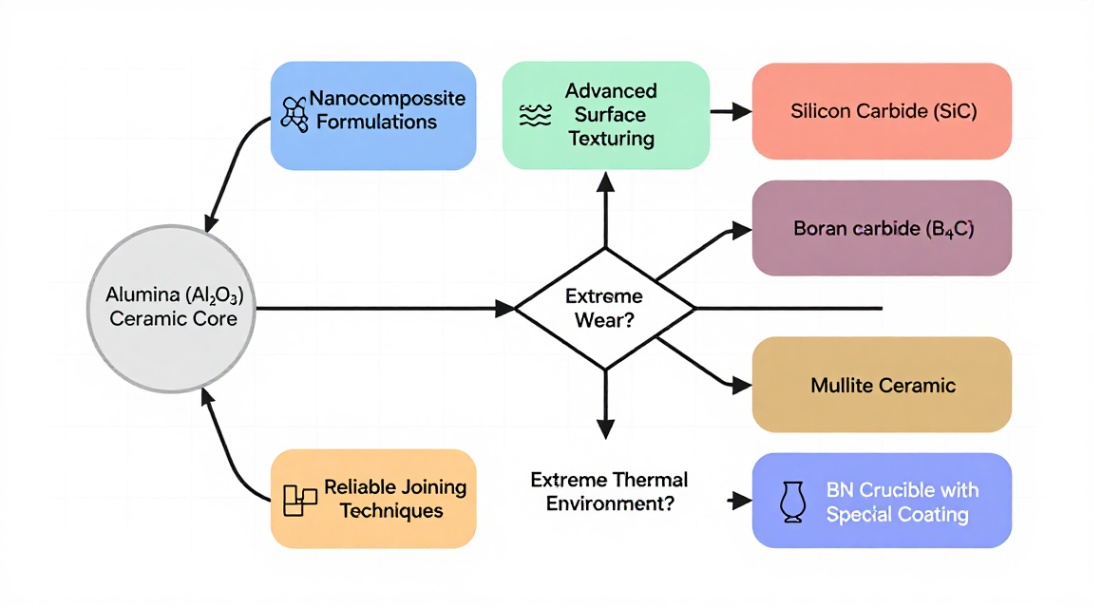
Innovation in aluminium oxide ceramic technology focuses on property enhancement. Trends include nanocomposite formulations for increased strength and toughness, advanced surface texturing for tribological performance, and the development of more reliable joining techniques. For extreme wear applications, consider silicon carbide ceramic or boron carbide ceramic. For extreme thermal environments, evaluate mullite ceramic. In specialized melting applications, a special coating for boron nitride ceramic crucibles might offer a superior solution.
The final step is validation. Before committing to a full production run, prototype with your selected alumina grade and process. Work with a reputable manufacturer who provides full material certification (e.g., ISO 6474). Their expertise in tailoring the grade and process to your specific design is the single most effective way to ensure project success and component longevity.
Suppiler
Synthetic-chemical focus on the research and development, production and sales of ceramic products, serving the electronics, ceramics, chemical and other industries. Since its establishment in 2015, the company has been committed to providing customers with the best products and services, and has become a leader in the industry through continuous technological innovation and strict quality management.
Our products includes but not limited to Aluminum Nitride, Aluminum Oxide, Boron Carbide, Boron Nitride, Ceramic Crucible, ect. If you are interested in any type of these, please feel free to contact us.