Next-Generation Ceramics: Unlocking Superior Properties for Industry

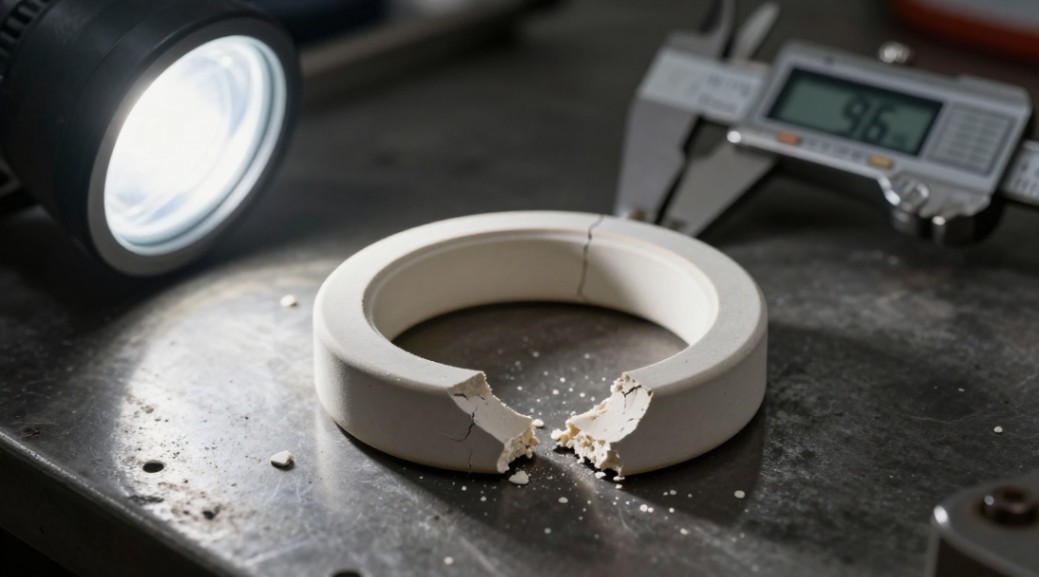
The phone rang at 3:14 AM. It was Dave, the night shift supervisor. The main slurry pump on Line 3 had just died. That meant a 48-hour production halt at $9,000 an hour. The root cause? A mechanical seal face made of aluminium oxide ceramic that shattered like a wine glass. The procurement manager had saved sixty cents per unit by switching from a 99.5% grade to a generic 96% alumina part. Sixty cents. The total cost of that decision: four hundred and fifty thousand dollars in lost production, emergency freight, and ruined customer contracts. This is not a hypothetical. I was the technical consultant called in to analyze the fracture.
The Delta Phase Lie: Why Your Alumina Is Already Cracked
Most engineers believe they are specifying alpha phase (α-Al₂O₃) when they write “Aluminum oxide ceramic” on a drawing. You likely are not. Or rather, you might be getting a mix of transitional phases that only partially convert during sintering. The alpha phase is the only thermodynamically stable form. It has the rhombohedral crystal structure that gives aluminium oxide ceramic its extreme hardness-9 on the Mohs scale-and its compressive strength exceeding 3,000 MPa. But if your supplier rushes the firing cycle, residual gamma or delta phases remain. Those phases have lower density and contain micro-cracks that propagate under thermal cycling.
Here is the rule: Demand a phase analysis certificate for every production lot. If they cannot provide X-ray diffraction data confirming >99% alpha phase, you are buying rejects. I have seen ISO-certified factories ship components with 12% delta phase content. The parts passed visual inspection but failed catastrophically at 85% of the rated pressure. The industry norm is silence on this. They call it “acceptable variation.” I call it negligence.
The Thermal Shock Trap: Why Alumina Fails When You Need It Most
Another product manager told me last month: “Alumina has good thermal shock resistance because of its high melting point.” That statement is dangerously wrong. Aluminum oxide ceramic has a melting point of 2,072°C, yes. But its thermal conductivity is pathetically low-around 30 W/m·K for 96% purity, dropping below 20 W/m·K for porous grades. Compare that to aluminum nitride ceramic at 170 W/m·K or silicon carbide ceramic at 120 W/m·K. Alumina does not conduct heat away fast enough to relieve thermal gradients. When you shock it-hot water into a cold seal, or a laser pulse on a substrate-the surface expands faster than the bulk. The crack initiates at the grain boundaries. You get a brittle fracture that looks like a jigsaw puzzle.
Do not use aluminum oxide ceramic in applications where the temperature swing exceeds 150°C per minute. If you must, specify a fine-grain, high-purity grade (99.8% minimum) with a grain size under 2 microns. Better yet, switch to silicon nitride ceramic for your thermal shock environments. That material handles a 700°C quench into water without blinking. Your designers will complain about the cost. Ask them how much a line shutdown costs.
The Hardness Myth: Alumina Is Hard, But It Is Not Tough
There is a widespread cult of hardness in manufacturing. Engineers see a Mohs rating of 9 and assume the part is indestructible. Then they get a hammer impact, a pipe whip, or a pressure spike, and the component shatters. Aluminum oxide ceramic has a fracture toughness (K_IC) of approximately 3 to 4 MPa·m^½. Zirconia ceramic (Y-TZP) has a toughness of 7 to 10 MPa·m^½. Silicon carbide ceramic can reach 4 to 5 MPa·m^½, but with far higher hardness. Alumina is not tough. It is a glass-ceramic hybrid that behaves like a rock: you can scratch it with almost nothing, but drop it on concrete and it is dust.
I once watched a field technician tighten a mechanical seal bolt to the spec torque. The alumina face cracked during tightening because the stress concentration at the bolt hole exceeded the material’s tensile strength-which is only about 300 MPa, about one-tenth of its compressive strength. The datasheet did not warn him. It listed compressive strength in bold print. Tensile strength was in a footnote. You must design alumina components in compression only. No point-loading. No sharp internal corners. If your design requires tensile stress, choose a tougher ceramic like boron carbide ceramic or reaction-sintered silicon carbide ceramics.
The Purity Price Trap: 96% vs. 99.5% vs. 99.9% Al₂O₃
Procurement loves cheap. They see a 96% alumina part that costs one-third of a 99.5% part, and they buy ten thousand pieces. Then they bleed money on failures. Here is what the purity numbers actually mean:
- 96% Al₂O₃: Contains silica, calcia, and magnesia as sintering aids. These form a glassy grain boundary phase that softens above 800°C. Hardness drops to 12 GPa. Wear resistance is acceptable only for low-load, low-temperature applications like stationery guides or hobbyist insulators. Never use this for seals, bearings, or armor.
- 99.5% Al₂O₃: This is the baseline for industrial engineering. Hardness is about 17 GPa. Grain size can be controlled to 3-5 microns. Thermal conductivity improves to 30-35 W/m·K. This grade handles 90% of mechanical seal applications, provided you stay within thermal limits.
- 99.9% Al₂O₃: Nearly pure alpha phase. Grain size below 1 micron. Hardness approaches 20 GPa. Used for high-wear nozzles, semiconductor plasma chambers, and medical implants. The downside: far more difficult to sinter, requires hot isostatic pressing for full density, and must be machined exclusively with diamond grinding. Do not use this grade unless you truly need the wear resistance and chemical inertness against strong acids or alkalis.
The 60-cent mistake I mentioned earlier? The plant bought 96% grade parts thinking they were “just as good.” The glassy grain boundary phase corroded in the alkaline slurry and washed away. The grains fell out. The seal leaked, the bearing overheated, and the pump seized. Do not repeat that error. Specify the grade on every purchase order. Audit the incoming material with density verification (>3.9 g/cm³ for 99.5%) and grain size measurement.
Manufacturing Methods: The Hidden Defects You Cannot See
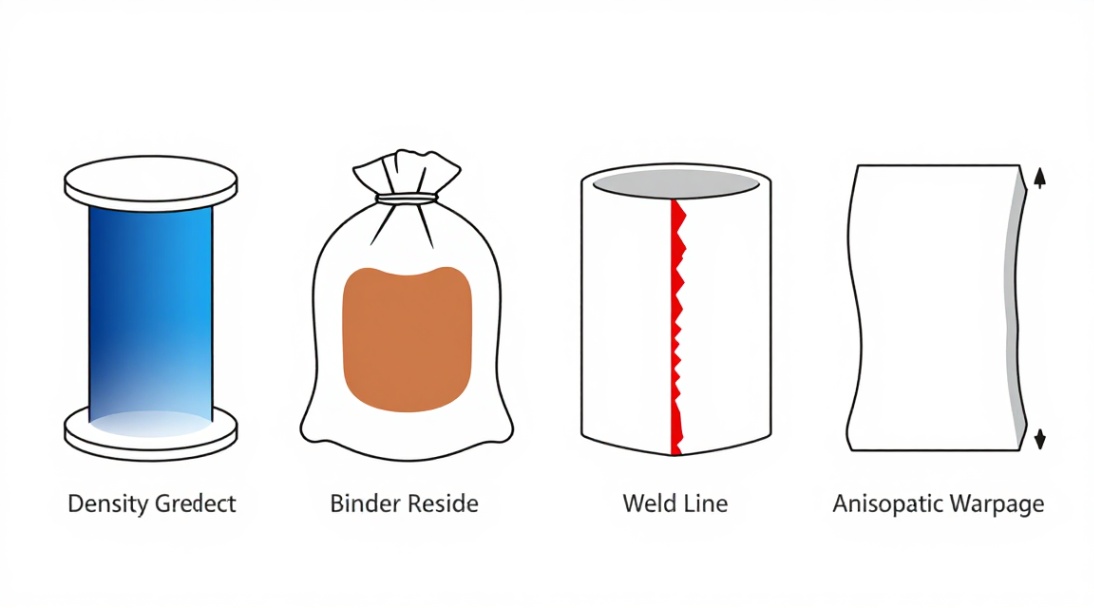
Aluminium oxide ceramic components are typically formed by dry pressing, isostatic pressing, or injection molding, then sintered at 1,600-1,800°C. The problem is that each method introduces specific defects: Dry pressing creates density gradients near the punch faces. Isostatic pressing can trap binder residues in the center. Injection molding leaves weld lines where the polymer flow fronts meet. Sintering shrinkage is anisotropic-the part shrinks differently in the pressing direction versus the lateral direction, leading to warpage and residual stress.
I have inspected hundreds of ostensibly identical bushings from the same supplier. Ten percent had internal voids visible only under a scanning electron microscope. Those voids were nucleation sites for cracks. The ASTM standard C1161 covers flexural strength testing, but most buyers do not request it. They rely on the supplier’s “typical values.” You know what “typical” means? It means the batch they tested on the best day. Demand a process capability study (Cpk > 1.67) for density and grain size. If the supplier frowns, walk away. There are dozens of ceramic fabricators that can meet that spec.
Why Diamond Grinding Is Non-Negotiable
Post-sinter machining of aluminium oxide ceramic is a nightmare. You cannot use carbide tools. You cannot use EDM unless the material contains conductive additives. You can only use diamond grinding, and the grinding parameters are unforgiving. Feed too fast, and you create micro-cracks that propagate later. Coolant too hot, and thermal shock fractures the part. Grinding wheel too coarse, and the surface roughness leaves crack initiation sites.
I once consulted for a manufacturer that tried to drill a 1 mm hole in a 99.5% alumina part using a carbide drill. The drill didn’t cut; it shattered the part into three pieces. That scrap cost $2,000. The correct method: diamond core drill at 0.5 mm per minute, with a water-based coolant at a precise temperature. No shortcuts. If your design requires complex features, consider using special coating for boron nitride ceramic crucibles or hybrid designs where the ceramic is a pre-sintered blank that is diamond-ground to final geometry.
Cost Comparison: When to Say No to Alumina
Many engineers default to aluminum oxide ceramic because it is the cheapest advanced ceramic. That is a mistake. Alumina is the cheapest only in raw material cost. In total cost of ownership, it often loses to silicon carbide ceramic for high-wear applications, to zirconia ceramic for impact-heavy uses, and to silicon nitride ceramic for thermal shock resistance. Here is a rule of thumb I use:
- If your application involves pure abrasion (sand, slurry, hard particles), use pressureless sintered silicon carbide ceramics or recrystallized silicon carbide ceramics. They cost 2-3x more but last 10x longer. The math favors SiC.
- If your application involves impact or point loading, use zirconia ceramic (Y-TZP). Alumina will fail.
- If your application involves rapid temperature changes, use silicon nitride ceramic or aluminum nitride ceramic. Alumina will crack.
- If your application involves moderate wear at low temperature with steady-state thermal conditions, aluminum oxide ceramic is the correct choice. Use 99.5% grade, specify alpha phase, demand Cpk > 1.67, and diamond-grind the critical surfaces.
Do not fall for the marketing claims that alumina is a “universal ceramic.” It is a specialized material with sharp limitations. Respect those limits, or you will pay for them in catastrophic failure.
Final Warning: The Datasheet Is a Sales Document
Ceramic datasheets list maximum values. They do not list the failure modes. They do not tell you that the silicon carbide-bonded silicon nitride ceramics you ordered for a crucible lining will oxidize at 1,200°C in a steam environment. They do not tell you that the boron nitride ceramic crucible coating delaminates if the thermal expansion mismatch exceeds a certain threshold. These are lessons learned from field failures, not from polished technical papers.
I have been in this industry for over 20 years. I have seen alumina seals fail after three months that were supposed to last five years. I have seen mullite ceramic furnace tubes melt because someone specified the wrong alumina content. I have seen quartz ceramic windows fracture due to impurity absorption. The common factor in all these failures? Decisions made based on datasheet numbers rather than on a thorough understanding of the material’s behavior in the actual service environment.
If you are specifying aluminium oxide ceramic for a critical application right now, stop. Do the following: (1) Confirm the alpha phase content and grain size. (2) Verify the purity grade against the supplier’s certificate. (3) Run a finite element analysis focusing on tensile stress locations. (4) Test a prototype under the worst-case expected conditions, not the average conditions. If you cannot perform these steps, hire someone who can. The cost of an expert is far lower than the cost of a $450,000 line shutdown.
I work with a select group of fabricators who understand these realities. We use aluminium oxide ceramic when it is the right tool for the job, and we refuse to sell it when it is not. If you want to review your current ceramic specifications and identify potential risks before they become failures, reach out. That is the conversation you need to have. Not a sales pitch-a risk assessment. Your plant’s uptime depends on it.
Suppiler
Synthetic-chemical focus on the research and development, production and sales of ceramic products, serving the electronics, ceramics, chemical and other industries. Since its establishment in 2015, the company has been committed to providing customers with the best products and services, and has become a leader in the industry through continuous technological innovation and strict quality management.
Our products includes but not limited to Aluminum Nitride, Aluminum Oxide, Boron Carbide, Boron Nitride, Ceramic Crucible, ect. If you are interested in any type of these, please feel free to contact us.