Next-Generation Ceramics: Unlocking Superior Properties for Industry

Stop Treating Alumina Like a Generic Ceramic
Aluminium oxide ceramic (Al2O3, or alumina) looks straightforward. It is white, hard, and tough. Engineers reach for it because it offers extreme hardness, a high melting point around 2072°C, and excellent electrical insulation. They also pick it because it costs less than alternatives like silicon carbide ceramic or silicon nitride ceramic. But this familiarity breeds a dangerous level of complacency.
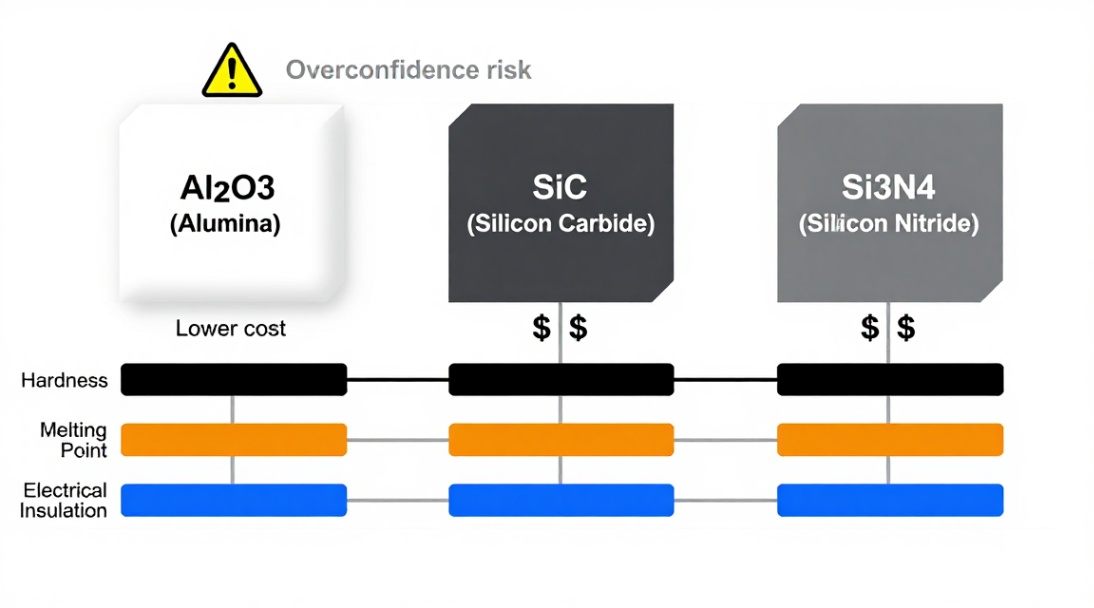
Alumina is not a single material. It is a family. A 96% grade behaves drastically different from a 99.5% grade. Using the wrong type in the wrong process will crack your part, ruin your budget, or poison your system. This article lists the seven worst things you can do with aluminum oxide ceramic. Read this before you order a single powder or green body.
1. Ignoring the Purity Grade for Cost Savings
This is the most common mistake. A designer looks at a spec sheet, sees aluminum oxide ceramic, and orders the cheapest 85% grade. They assume all alumina is the same. They are wrong, and the failure is often spectacular.
What Happens with Low-Purity Alumina:
- 85% Alumina: This grade contains glassy phases (silica, calcia) to aid sintering. It has lower hardness and lower corrosion resistance. Use it for cheap electrical insulators where mechanical load is zero. Never use it in a chemical environment.
- 96% Alumina: The workhorse. It offers a good balance of mechanical strength, wear resistance, and cost. Suitable for most mechanical seals, pump parts, and wear liners.
- 99.5%+ Alumina: High-density, maximum hardness, superior corrosion resistance. Essential for semiconductor applications, medical implants, and high-temperature vacuum environments. The glassy phase is virtually absent.
The logic is simple: if you need chemical inertness, you must pay for 99.5% purity. If you try to save money with 96% in a corrosive acid bath, the glassy grain boundaries will leach out. The part will lose strength and contaminate your process. Do not trade purity for price in critical applications.
2. Assuming High Hardness Means High Fracture Toughness
Aluminum oxide ceramic is extremely hard. It ranks 9 on the Mohs scale. Diamond is a 10. This hardness makes it excellent for abrasives and cutting tools. However, hardness and toughness are inversely related in this case.
Alumina has moderate fracture toughness. It is brittle. Hit it wrong with a steel wrench, and it shatters. Compare this to boron carbide ceramic or silicon nitride ceramic, which often have better toughness for impact scenarios.
Critical Engineering Rules:
- Do not use alumina for parts that experience sudden impact or point loading. Think armor plate choices: alumina works, but boron carbide ceramic or silicon carbide-bonded silicon nitride ceramics handle shock better.
- Always design with chamfers and fillets. Sharp corners create stress risers that initiate cracks. A square edge on an alumina part is a crack waiting to happen.
- Know your thermal shock limit. While alumina has decent thermal shock resistance due to low thermal expansion, rapid heating (e.g., >100°C/min) can cause catastrophic failure. Mullite ceramic or quartz ceramic often handle thermal shock better than high-purity alumina.
3. Machining Alumina after Firing Like It Is a Metal
Alumina is finished (sintered) in a furnace. The final part is extremely hard. Trying to machine it with conventional tools is a fool’s errand. Standard carbide drills will wear out in seconds. HSS tools will not even scratch the surface.
What Smart Engineers Do:
- Green Machining: Machine the part while it is in the ‘green’ (unfired) state. The powder compact is soft. You can cut, drill, and mill it easily. Then sinter it. This is the standard method for complex shapes.
- Diamond Grinding: If you must machine a fired part, use diamond-impregnated tools. It is expensive. Grinding adds significant cost to any alumina component. Factor this into your budget.
- Near-Net Shape Forming: Use injection molding or isostatic pressing to get as close to the final shape as possible. This reduces or eliminates post-sintering machining costs.
Do not expect to order a solid block of alumina and drill a hole in it on a lathe. It will destroy your tooling and your part. Plan your manufacturing process around the material’s hardness, not against it.
4. Overlooking the Importance of Surface Finish in Seals
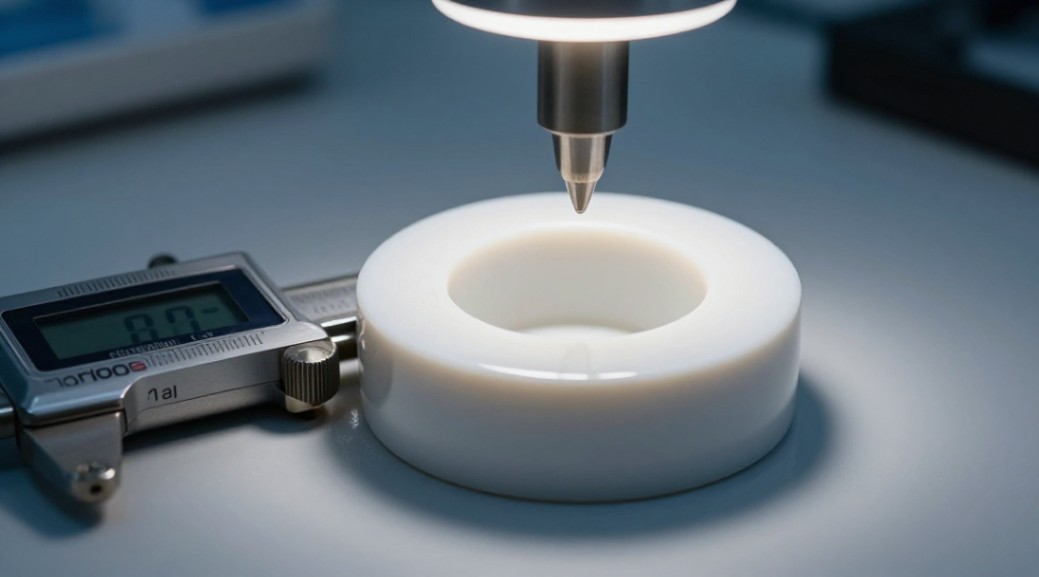
Aluminum oxide ceramic is a favorite for mechanical seals and pump components because of its wear resistance. But surface finish is everything. A rough surface on an alumina seal face will cause leakage and premature failure.
The material works well because it can be polished to a mirror finish using diamond lapping. This creates a virtually leak-proof interface. Many failures occur when the spec sheet calls for a ‘ceramic seal’ but does not specify the surface roughness (Ra).
Key Requirements:
- Specify a surface finish of Ra 0.1 µm or better for high-speed rotating seals.
- Ensure the counter-face material (often carbon or silicon carbide ceramic) is compatible and has the correct finish.
- Never assume standard ‘as-fired’ surfaces are suitable for sealing applications. They are not. As-fired surfaces are typically too rough and porous.
5. Using Alumina in High-Vacuum or Reducing Atmospheres Without Checking
Alumina is chemically stable in air and oxidizing environments. This is a well-known fact. But it is vulnerable in specific environments. Do not assume universal chemical resistance.
In a high-vacuum environment (e.g., < 10^-5 Torr) at high temperatures, the glassy phase in 96% alumina can volatilize. This outgassing contaminates the chamber. You need 99.5% or 99.7% alumina to minimize this.
Environmental Warnings:
- Reducing Atmospheres: Hydrogen or dissociated ammonia at high temperature can attack the alumina surface, especially at grain boundaries. This leads to embrittlement.
- Water Vapor at High Temperature: Steam at > 300°C can react with alumina to form aluminum hydroxide, causing surface degradation.
- Fluorine and HF Acid: Alumina reacts chemically with hydrofluoric acid and fluorine gas. Do not use it in these environments. Use boron nitride ceramic or quartz ceramic instead.
For extreme thermal or reactive environments, look at alternatives like reaction-sintered silicon carbide ceramics or pressureless sintered silicon carbide ceramics. These materials offer superior corrosion resistance in specific harsh environments.
6. Forgetting the Metallization and Bonding Constraints
Alumina is an excellent electrical insulator. It is used extensively for substrates and insulators in electronics. However, bonding it to metals is a specialized process. You cannot just glue it with standard epoxy and expect it to survive thermal cycles.
Correct Bonding Techniques:
- Active Metal Brazing: Uses a braze alloy (often silver-copper-titanium) that wets the ceramic. The titanium reacts with the alumina to form a chemical bond. This is the standard method for high-reliability hermetic seals.
- Thick Film Metallization: Screen printing a paste of metals like tungsten or molybdenum onto the alumina, then firing it at high temperature. The metal sinters onto the ceramic. This is common for electronic substrates.
- Direct Bond Copper (DBC): A copper sheet is heated in a controlled oxidizing atmosphere to form a copper oxide eutectic that bonds to the alumina. This is used in power modules.
Do not attempt to solder directly to alumina. Solder does not wet the oxide surface. You will get a weak joint that fails under the slightest stress. Always use a specialized metallization layer. If you need a crucible holder, consider a special coating for boron nitride ceramic crucibles as it handles thermal mismatch better than bare alumina.
7. Selecting Alumina When You Need Transparency or Thermal Conductivity
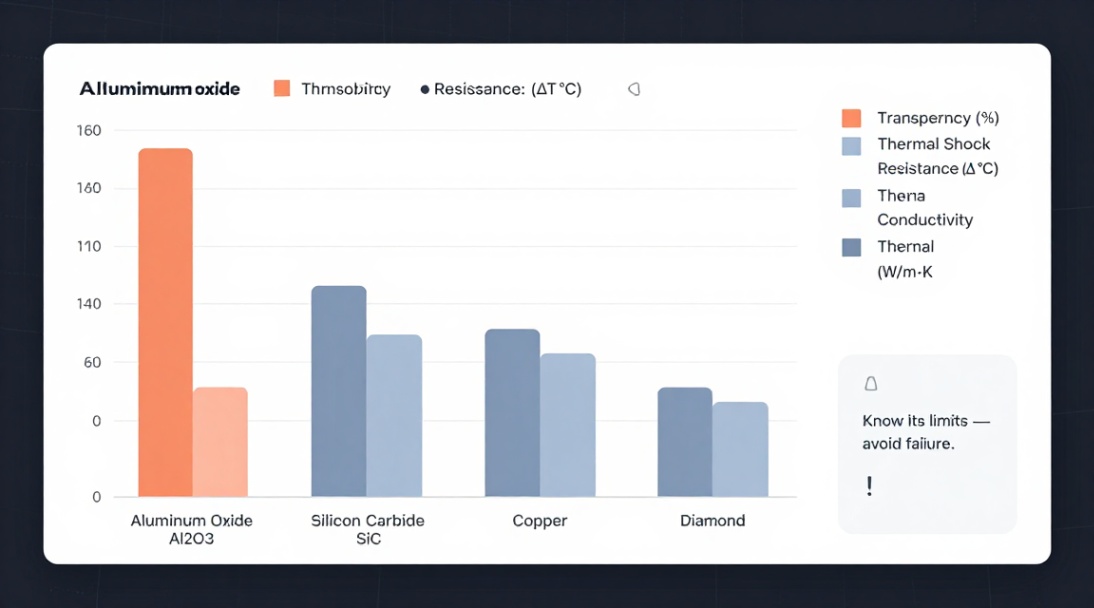
Alumina is opaque unless processed via a special route (single crystal sapphire or transparent polycrystalline alumina). Standard alumina is white and opaque. If you need optical transparency, you have chosen the wrong material.
Furthermore, while alumina has good thermal conductivity (~25-30 W/mK), it is mediocre compared to other ceramics. Aluminum nitride ceramic conducts heat roughly 6 times better than alumina. Boron nitride ceramic also offers higher thermal conductivity with excellent dielectric properties.
Material Selection Logic:
- Need to dissipate heat from a power LED? Choose aluminium nitride ceramic, not alumina.
- Need a transparent window for a high-temperature furnace? Choose quartz ceramic or sapphire (single crystal Al2O3), not standard polycrystalline alumina.
- Need a crucible for reactive metals? Consider recrystallized silicon carbide ceramics or silicon nitride ceramic for their specific inertness.
Alumina is a jack-of-all-trades, master of few. It is strong, hard, cheap, and insulates well. But trying to force it into applications that demand transparency, extreme thermal shock resistance, or ultra-high thermal conductivity will result in a failed project. Know its limits.
Your next step is to review your material specification. Ask yourself: Which grade? What environment? What finish? If you cannot answer these three questions precisely, stop the process and redesign. Your project depends on it.
Suppiler
Synthetic-chemical focus on the research and development, production and sales of ceramic products, serving the electronics, ceramics, chemical and other industries. Since its establishment in 2015, the company has been committed to providing customers with the best products and services, and has become a leader in the industry through continuous technological innovation and strict quality management.
Our products includes but not limited to Aluminum Nitride, Aluminum Oxide, Boron Carbide, Boron Nitride, Ceramic Crucible, ect. If you are interested in any type of these, please feel free to contact us.