Next-Generation Ceramics: Unlocking Superior Properties for Industry

Your Ceramic Part Just Fractured. Now What?
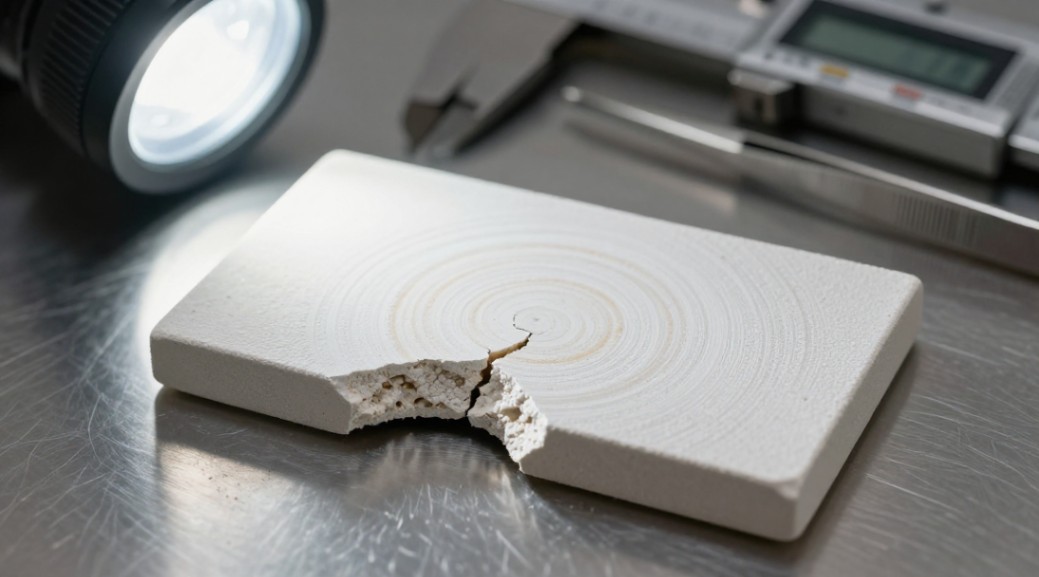
Have you ever watched a carefully engineered component shatter during its first thermal cycle? Or perhaps an electronic substrate failed, costing production an entire day. These failures share a common root: a misunderstanding of aluminum oxide ceramic and its limits. This material is not a magic bullet. Used correctly, it is a workhorse. Used carelessly, it is a brittle liability. This article identifies seven costly mistakes and provides clear, actionable corrections.
1. The Purity Trap: Chasing 99.9% When 96% Wins
Engineers often default to the highest purity grade. This is wasteful. Aluminum oxide ceramic is available in common grades: 96%, 99.5%, and 99.9%. The logic seems simple: higher purity equals better performance. This is false. The relationship between purity, strength, and cost is not linear.
Comparing Purity Grades of Alumina (Al2O3)
| Property | 96% Alumina | 99.5% Alumina | 99.9% Alumina |
|---|---|---|---|
| Relative Cost | Baseline (1x) | ~1.8x | ~4x |
| Flexural Strength | 330 MPa | 380 MPa | 400 MPa (marginal gain) |
| Volume Resistivity at RT | Excellent (>10^14 ohm-cm) | Excellent (>10^14 ohm-cm) | Excellent (>10^14 ohm-cm) |
| Thermal Conductivity | 24 W/mK | 30 W/mK | 35 W/mK |
| Grain Size Control | Easy (glass phase helps) | Crucial | Critical |
| Best Application | Wear parts, electrical insulators | Medical implants, electronic substrates | Specialized optical or laser components |
Notice the small strength jump between 99.5% and 99.9%. The cost, however, triples. For most applications, 96% alumina provides sufficient mechanical strength and electrical insulation. The glassy phase in 96% material actually improves sintering. It reduces porosity. It makes the part easier to metalize. Do not chase purity. Match the grade to the application. Using 99.9% for a standard insulator is engineering negligence.
2. Ignoring Thermal Dissipation: Why Alumina Fails Where Silicon Carbide Succeeds
Thermal conductivity is a critical parameter many designers overlook. Aluminum oxide ceramic conducts heat at roughly 24-30 W/mK. Compare this to Silicon carbide ceramic which conducts at 120-200 W/mK. For high-power electronics, using alumina as a substrate is a recipe for thermal runaway.
Thermal Conductivity Comparison of Technical Ceramics
| Material | Thermal Conductivity (W/mK) | Electrical Insulation |
|---|---|---|
| Aluminum oxide ceramic | 24 – 35 | Excellent |
| Aluminum nitride ceramic | 170 – 200 | Excellent |
| Silicon carbide ceramic | 120 – 200 | Low to moderate |
| Boron nitride ceramic | 30 – 60 (anisotropic) | Excellent |
If your design requires heat spreading, and you need electrical insulation, choose Aluminum nitride ceramic or Boron nitride ceramic. Do not force alumina into this role. It will work, but the system will be hot. Reliability will drop. The part will crack.
3. The Misguided Search for Absolute Hardness
Aluminum oxide ceramic is hard. Its Mohs hardness is 9. This hardness gives it excellent wear resistance. But hardness alone does not guarantee performance against impact. A common mistake is substituting alumina for Boron carbide ceramic or Silicon nitride ceramic in ballistic applications.
Boron carbide ceramic is the third hardest material known (Mohs 9.5). More importantly, it has a very high Hugoniot elastic limit (HEL). It handles shock loading better. Alumina has lower fracture toughness. It fails catastrophically under high-velocity impact. For armor, use Silicon carbide ceramic or Boron carbide ceramic. Reserve aluminum oxide ceramic for low-velocity wear applications like slurry pumps.
4. Forgetting the Sintering Shrinkage
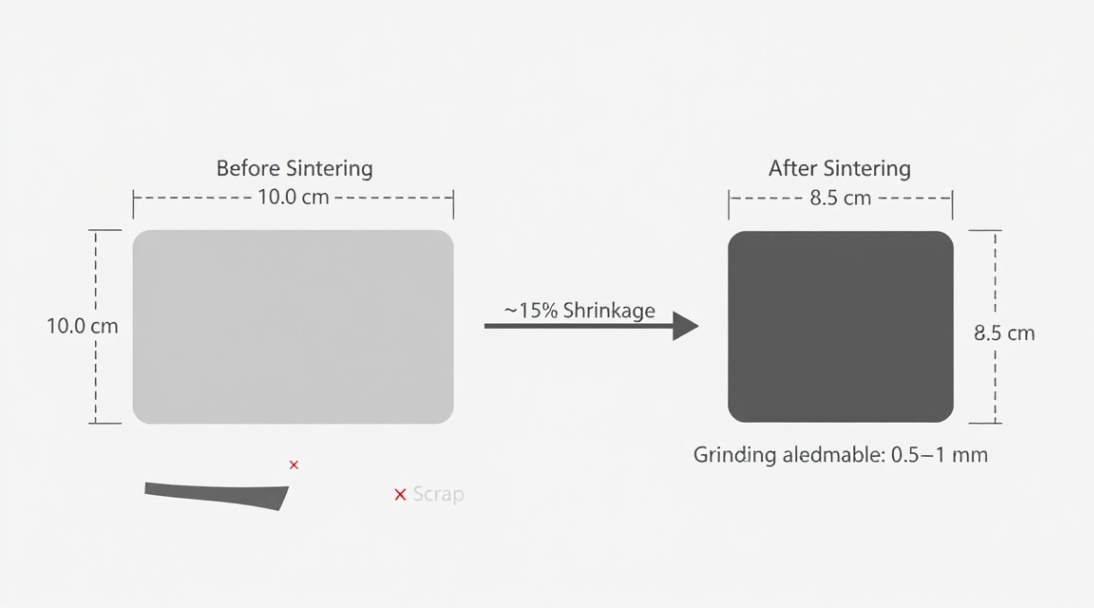
Ceramic manufacturing is not net-shape. It is near-net-shape. Manufacturing processes like pressing, sintering, injection molding, and isostatic pressing all have one thing in common: significant and anisotropic shrinkage. A green body shrinks 15% to 20% during firing.
Do not design a part assuming the final dimensions match the mold. You will be wrong. Calculate the shrink factor carefully. Use pressureless sintered silicon carbide ceramics or reaction-sintered silicon carbide ceramics as a reference for their tighter tolerances, but remember they are different materials. For alumina, always add 0.5mm to 1mm for post-sintering grinding. Ignoring this leads to scrap piles.
5. Misjudging Chemical Resistance in Complex Environments
Chemical inertness of aluminum oxide ceramic is excellent against most acids and alkalis. However, there are exceptions. Hot concentrated alkalis attack alumina. So does hydrofluoric acid (HF). Do not assume universal resistance.
If your application involves molten metals or glass, consider Mullite ceramic or Quartz ceramic for their superior thermal shock resistance. If you need a crucible for reactive metals, examine the special coating for boron nitride ceramic crucibles as an alternative. Alumina can contaminate the melt if it is chemically attacked. Test your specific chemical environment. Assumptions kill parts.
6. The Joining Failure: Metalization and Brazing Basics
Attaching aluminum oxide ceramic to metal is challenging. Direct soldering is impossible. The common solution is metallization (applying a refractory metal paste like molybdenum-manganese) followed by electroplating and brazing. A frequent mistake is skipping the thermal expansion mismatch calculation.
Alumina has a coefficient of thermal expansion (CTE) of ~8 x 10^-6 /K. Steel is ~12 x 10^-6 /K. Copper is ~17 x 10^-6 /K. When you braze alumina to a thick copper base, the joint will shear during cooling or thermal cycling. Use a compliant layer (like a thin copper shim) or a metal with a matched CTE (Kovar). Do not force the joint. It will fail.
7. Ignoring Surface Finish and Grain Size
The surface finishing of alumina parts determines their practical strength. A standard as-sintered surface has micro-cracks. These act as stress concentrators. For high-stress applications, specify a polished or ground surface.
Furthermore, the crystallographic structure and grain size matter. A part with large grains ( >10 microns) is weaker than one with fine grains ( 1-5 microns). The Hall-Petch effect applies to ceramics. If your vendor does not control grain size, do not order. Demand the data. Your wear-resistant components depend on it.
Summary: Your Decision Framework for Aluminum Oxide Ceramic
| Situation | Correct Material Strategy | Common Mistake to Avoid |
|---|---|---|
| Need a general wear-resistant electrical insulator | 96% aluminum oxide ceramic | Specifying 99.9% unnecessarily |
| Need to dissipate heat in a power module | Aluminum nitride ceramic | Using alumina for its low thermal conductivity |
| Need armor against high-velocity impact | Boron carbide ceramic or Silicon carbide ceramic | Using alumina for its inferior toughness |
| Need a chemically inert crucible for molten glass | Mullite ceramic or Quartz ceramic | Assuming alumina is universally inert |
| Need to join a ceramic part to a metal housing | Matched CTE metals + metallization | Direct brazing without compliance layers |
Stop repeating these mistakes. The performance of aluminum oxide ceramic is well understood. The data is clear. The failures are predictable. Audit your current designs. Check your material selection against this table. If you find a mismatch, change it. Your prototype cycle will thank you.
Suppiler
Synthetic-chemical focus on the research and development, production and sales of ceramic products, serving the electronics, ceramics, chemical and other industries. Since its establishment in 2015, the company has been committed to providing customers with the best products and services, and has become a leader in the industry through continuous technological innovation and strict quality management.
Our products includes but not limited to Aluminum Nitride, Aluminum Oxide, Boron Carbide, Boron Nitride, Ceramic Crucible, ect. If you are interested in any type of these, please feel free to contact us.