Next-Generation Ceramics: Unlocking Superior Properties for Industry

Aluminum oxide ceramic is a high-performance technical ceramic material primarily composed of alumina (Al2O3), renowned for its exceptional hardness, wear resistance, and thermal stability. Its combination of mechanical, thermal, and electrical properties makes it a foundational material across industrial, electronic, and medical sectors. This material outperforms many metals and polymers in demanding environments, offering a reliable solution for extreme operating conditions.
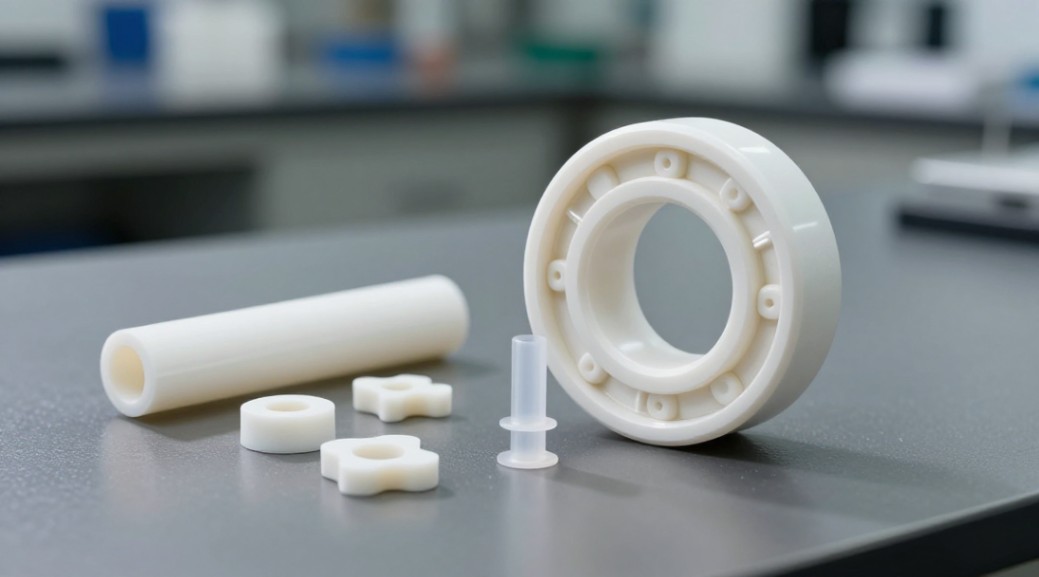
1. Core Definition and Composition
Aluminum oxide ceramic, often called alumina ceramic, is a manufactured material synthesized from refined aluminum oxide powder. The raw powder is formed and then sintered at high temperatures, typically between 1600°C and 1800°C, to create a dense, polycrystalline structure. Its fundamental composition is α-Al2O3, also known as corundum, which is its most stable crystalline phase. This structure dictates its primary characteristics. Engineers select it based on logical analysis of its inherent property profile versus application needs.
2. Key Material Properties and Characteristics
Understanding these properties is essential for logical material selection. They derive directly from the strong ionic/covalent bonding in its crystal lattice.
- Extreme Hardness and Wear Resistance: Alumina ranks 9 on the Mohs scale, surpassed only by diamond and a few specialized ceramics like boron carbide and silicon carbide. This grants superior resistance to abrasion, erosion, and particle impingement.
- High Thermal Stability: It maintains structural integrity at temperatures up to 1700°C. It is an excellent thermal insulator with low thermal conductivity compared to metals or aluminium nitride ceramic.
- Superior Electrical Insulation: Aluminum oxide ceramic possesses high dielectric strength and volume resistivity, even at elevated temperatures. This makes it indispensable for electrical and electronic applications.
- Chemical Inertness: It resists attack from most acids, alkalis, and molten metals. This property is not absolute but covers a broad spectrum of corrosive environments.
- Primary Limitation: Brittleness. Like most ceramics, alumina lacks metallic ductility. It is prone to catastrophic brittle fracture under tensile or impact loading, a critical design constraint.
3. Common Grades and Purity Levels
Performance scales directly with purity. Logical material selection balances cost and capability.
- 96% Alumina: The workhorse grade. Contains silicate-based glass phases that aid sintering but slightly reduce properties. Offers the best cost-to-performance ratio for general industrial wear parts and insulators.
- 99.5% Alumina (and higher): High-purity grades. They offer superior hardness, wear resistance, thermal stability up to 1800°C, and dielectric properties. Used in advanced electronics, high-temperature furnace components, and precision medical components.
- 99.9% (3N) and 99.99% (4N) Alumina: Ultra-high purity. Used for specialized applications like sodium vapor lamp tubes or critical semiconductor processing components where any impurity migration is unacceptable.
4. Manufacturing Processes
The forming method directly influences part geometry, cost, and final density.
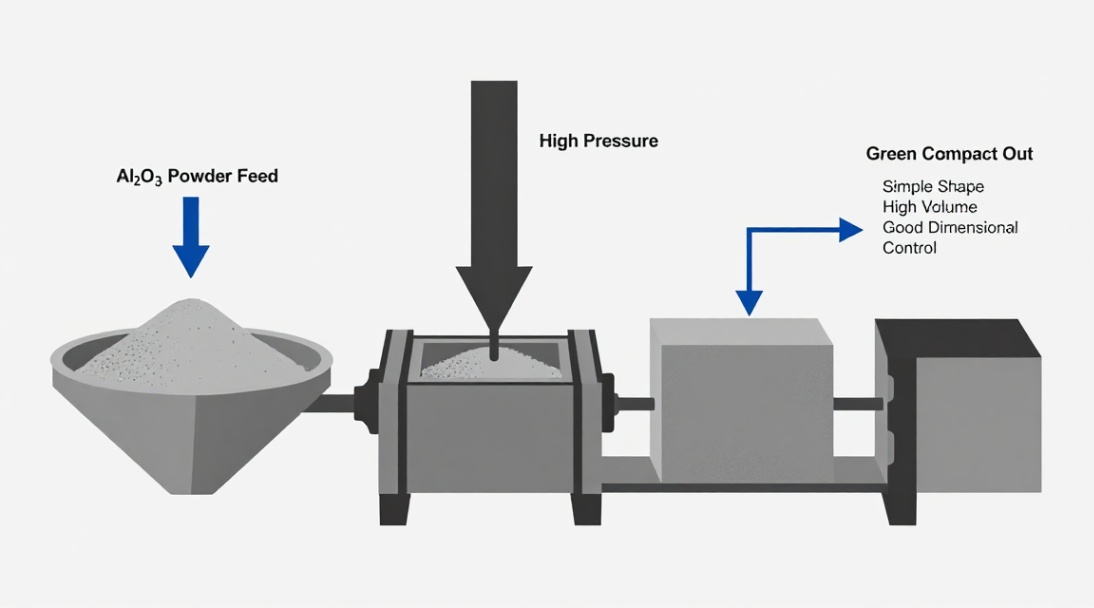
Dry Pressing
Powder is compacted in a rigid steel die using high pressure. Best suited for simple, high-volume shapes like tiles, substrates, and simple wear plates. Offers good dimensional control and low cost per part.
Isostatic Pressing
Powder is compacted in a flexible mold using uniform hydrostatic pressure. Produces more uniform density and complex shapes than dry pressing. Ideal for larger, near-net-shape components like pump seals or intricate liners.
Extrusion
Plasticized ceramic paste is forced through a shaped die. This process creates long, continuous profiles with a constant cross-section, such as tubes, rods, and thermocouple sheaths.
5. Major Industrial and Technical Applications
- Wear Components and Liners: Pump seals, valve seats, abrasive blasting nozzles, wear plates in mining and mineral processing. Its hardness outlasts tool steel and many other ceramics.
- Electronics Substrates and Insulators: Circuit boards for high-power electronics, RF windows, spark plug insulators, and insulating housings. Its electrical properties are non-negotiable here.
- Medical Implants and Tools: Used in orthopedic implants like hip joint balls, dental abutments, and surgical cutting tools. Its biocompatibility and wear resistance are paramount.
- High-Temperature Components: Kiln furniture, thermocouple protection tubes, and insulating tubes in industrial furnaces.
6. Comparison to Other Technical Ceramics
Selection is a logical trade-off. Do not default to alumina; choose based on dominant property requirements.
- vs. Zirconia (ZrO2): Zirconia offers higher fracture toughness (less brittle) and lower thermal conductivity. Choose zirconia for impact resistance. Choose alumina for maximum hardness and lower cost.
- vs. Silicon Carbide (SiC) & Silicon Nitride (Si3N4): These silicon carbide ceramic and silicon nitride ceramic materials have higher thermal conductivity and strength at extreme temperatures. Use them for severe thermal shock applications. Aluminium oxide ceramic is superior for electrical insulation and is often more cost-effective for wear.
- vs. Aluminium Nitride (AlN): Aluminum nitride ceramic is a specialist. It combines high thermal conductivity with electrical insulation. For managing heat in electronics, choose AlN. For general insulation and wear, choose Al2O3.
7. Material Selection Criteria
Apply this decision framework. Start by defining the single most critical failure mode.
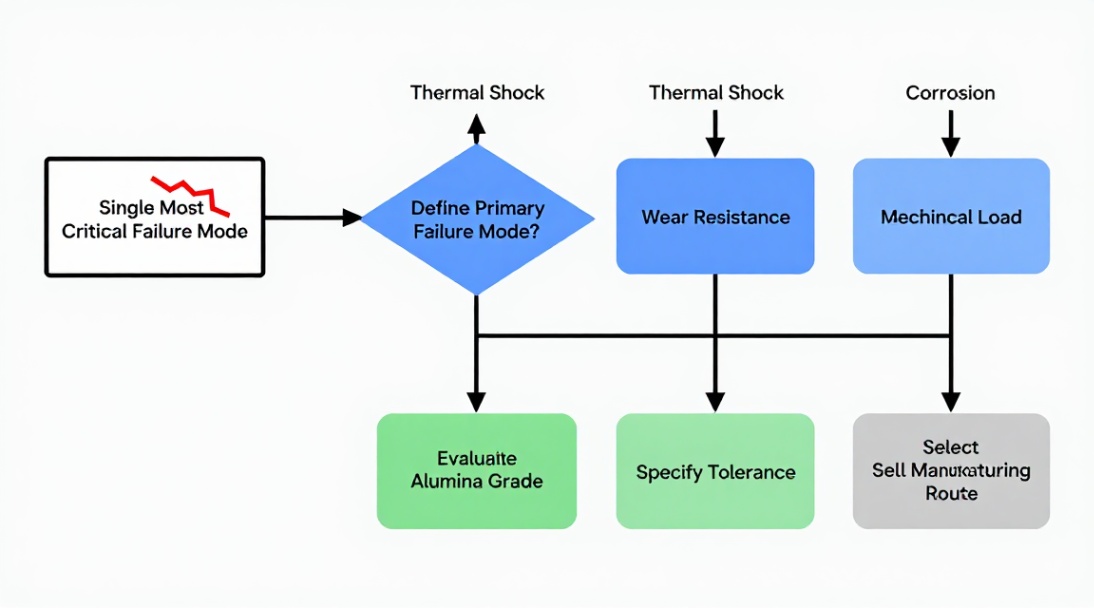
- Identify the Dominant Stressor: Is it abrasive wear, high temperature, electrical voltage, or corrosive chemicals? The primary stressor dictates the primary required property.
- Quantify the Environment: Define temperature range, pressure, chemical exposure, and mechanical load types (compressive, tensile, impact).
- Consider Fabrication Needs: Assess required tolerances, part geometry complexity, and necessary surface finish. Machining hardened aluminum oxide ceramic is difficult and expensive; aim for net-shape forming.
- Analyze Total Cost: Evaluate material cost, fabrication cost, and lifetime/replacement cost. A more expensive ceramic like reaction-sintered silicon carbide ceramics may offer lower lifetime cost if it lasts five times longer.
8. Your Next Logical Step
The theory is clear. Now, validate it against your specific application. Generic advice leads to suboptimal performance and cost overruns. You require a precise, data-backed recommendation. Do not waste engineering time on guesswork. Contact our materials engineering team for a formal application analysis. We will provide a comparative property datasheet, including alumina versus relevant alternatives like zirconia, silicon nitride, or boron carbide. Submit your application parameters and request a free material selection consultation today. Specify your requirements, and we will specify the correct material.
Suppiler
Synthetic-chemical focus on the research and development, production and sales of ceramic products, serving the electronics, ceramics, chemical and other industries. Since its establishment in 2015, the company has been committed to providing customers with the best products and services, and has become a leader in the industry through continuous technological innovation and strict quality management.
Our products includes but not limited to Aluminum Nitride, Aluminum Oxide, Boron Carbide, Boron Nitride, Ceramic Crucible, ect. If you are interested in any type of these, please feel free to contact us.