Next-Generation Ceramics: Unlocking Superior Properties for Industry

Have You Ever Watched a Critical Component Fail Too Soon?
It’s a frustrating moment. You invested in a part that promised durability. It looked robust. Yet, within months—or even weeks—the surface is pitted. The seal is leaking. The insulator is shorting. You are now facing downtime, replacement costs, and a nagging question: What works better?
I have spent decades helping engineers navigate this exact problem. The world of advanced ceramics is not a monolith. Aluminum oxide ceramic (often called alumina) is a workhorse. But it has limits. So does silicon carbide. So does zirconia. The goal here is not to sell you a single material. It is to arm you with logic, so you pick the right one for your specific pain point.
1. What Exactly Is Aluminum Oxide Ceramic, and Why Does It Dominate?
Let’s start with the basics. Aluminum oxide ceramic is a crystalline compound of aluminum and oxygen. In its most stable form, we call it alpha-alumina. Think of it as densely packed ruby or sapphire, minus the color impurities. This structure gives it a unique set of traits.
Its Core Strengths (Where It Shines)
- High hardness and wear resistance: It is exceptionally hard. This makes it the default choice for grinding media, sandblasting nozzles, and cutting tool inserts. It resists abrasion far better than most metals or polymers.
- Excellent thermal stability: Its melting point exceeds 2000°C. It does not soften or creep under extreme heat. This is why it is used in furnace tubes and thermocouple sheaths.
- Electrical insulation: It has high dielectric strength. It is a reliable insulator for spark plugs and electronic substrates. It stops current where you need it to stop.
- Chemical inertness: It resists attack from most acids, bases, and corrosive gases. This makes it a standard material for chemical processing components.
Its Real Limitations (Where It Struggles)
- Brittle nature: It is hard, but it is not tough. A sharp impact or sudden thermal shock can cause catastrophic cracking. You cannot bend it. You cannot deform it. It fractures.
- Lower thermal conductivity: Compared to silicon carbide ceramic or aluminum nitride ceramic, alumina does not conduct heat as well. This can be a problem if you need to rapidly dissipate heat from a high-power device.
- Difficult machining: After sintering, it is incredibly hard. Shaping it requires diamond grinding. This adds cost if you need complex geometries.
2. When Should You Choose Aluminum Oxide Ceramic Over Zirconia?
This is a common fork in the road. Zirconia is tougher. Alumina is harder and cheaper. Here is the logical split:
Choose aluminum oxide when:
- Your primary enemy is abrasive wear, not impact. Think slurry pumps or wire guides.
- You need excellent electrical insulation. Zirconia is a conductor at high temperatures; alumina stays insulating.
- Cost is a primary driver. Alumina is significantly less expensive than high-purity zirconia.
Choose zirconia when:
- Your application involves thermal shock or mechanical impact. Zirconia’s transformation toughening gives it crack resistance that alumina lacks.
- You need a smooth, polished surface for a sealing face. Zirconia can achieve a finer surface finish.
There is no universal winner. It is a trade-off between toughness and cost.
3. How Does Aluminum Oxide Compare to Silicon Carbide Ceramic?
Silicon carbide is the harder, tougher sibling in many ways. But it comes with different costs and processing challenges.
Key Differences at a Glance
- Hardness and wear: Silicon carbide ceramic is harder than aluminum oxide. For extreme abrasion, like mechanical seal faces in abrasive slurries, silicon carbide lasts longer.
- Thermal conductivity: Silicon carbide conducts heat much better. If you need to move heat away from a hot zone—like in a kiln furniture or a heat exchanger—silicon carbide is a clear winner.
- Cost and processing: Aluminum oxide is easier and cheaper to sinter. Pressureless sintered silicon carbide ceramics and reaction-sintered silicon carbide ceramics require more controlled atmospheres and higher temperatures. This drives up cost. Recrystallized silicon carbide ceramics are even more expensive but offer extreme purity and thermal shock resistance.
My advice: For a cost-sensitive, general wear part, stick with alumina. For high-heat or high-wear applications where performance justifies the price, move to silicon carbide.
4. What About Boron Carbide Ceramic and Boron Nitride Ceramic? Where Do They Fit?
These are specialty materials, not direct competitors to alumina for most bulk applications.
The Role of Boron Carbide
Boron carbide ceramic is one of the hardest known materials. It is lighter than aluminum oxide and silicon carbide. Its primary use is in armor and nuclear shielding (it absorbs neutrons well). Do not choose it for general wear parts. It is expensive, difficult to sinter to full density, and its hardness makes it nearly impossible to machine without diamond tooling.
The Role of Boron Nitride
Boron nitride ceramic is soft—the opposite of alumina. It is a lubricating ceramic. It has excellent thermal shock resistance and is used as a release agent or crucible liner. If you need a special coating for boron nitride ceramic crucibles, you are dealing with a very specific application. For structural, load-bearing wear parts, aluminum oxide is far superior.
5. Can Aluminum Oxide Ceramic Handle High Temperatures Better Than Mullite Ceramic or Quartz Ceramic?
Yes, generally. Let’s be logical:
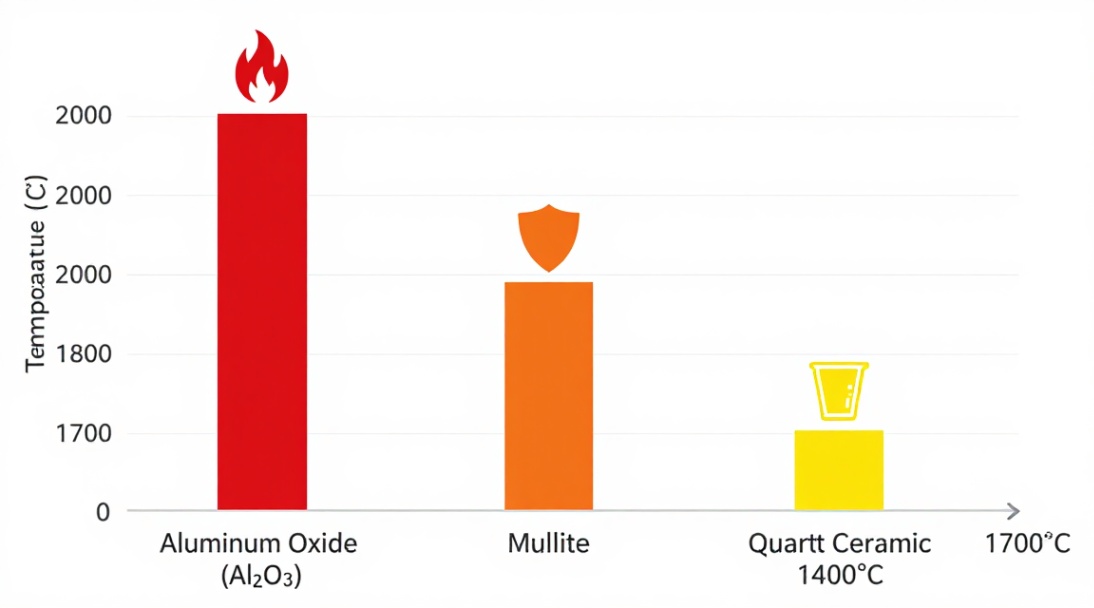 Maximum continuous service temperature comparison: Al₂O₃ (1800°C) > Mullite (1750°C) > Quartz (1400°C).
- Mullite ceramic is a silicate material. It has excellent thermal shock resistance and low thermal expansion. However, its maximum use temperature (around 1800°C) is lower than alumina’s (over 2000°C). Mullite is cheaper and easier to form into complex shapes. Use it for kiln shelves where thermal cycling is severe. Use alumina for higher temperature stability and better creep resistance.
- Quartz ceramic (fused silica) has extremely low thermal expansion. It can survive dramatic thermal shocks. But it softens at very high temperatures (around 1200-1400°C). Alumina wins hands-down for applications above 1400°C. Quartz is better for precision thermal shock components at lower temperatures.
6. How Do Manufacturing Processes Affect Your Choice?
This is where theory meets reality. The way a ceramic is made directly impacts its final properties and cost.
Pressing and Sintering
Most aluminum oxide parts are made by pressing a powder into a shape and then sintering at high temperature. This is a mature, cost-effective process. For larger or more complex shapes, slip casting or injection molding are options. The key point: alumina can be sintered at lower temperatures than silicon carbide or boron carbide, making it cheaper to produce.
Machining Considerations
After sintering, aluminum oxide is very hard. You can only machine it with diamond tools. This is expensive and slow. If your design requires many precise holes, threads, or undercuts, you might reconsider. Green machining (machining the powder compact before sintering) is possible for alumina, but it requires careful handling to avoid cracking. Silicon nitride ceramic is often easier to machine in the green state, but it is a different material with different thermal and mechanical properties.
7. What About Silicon Carbide-Bonded Silicon Nitride Ceramics? Is That a Better Option?
This material is a niche solution for specific high-temperature, high-corrosion environments. It combines the strength of silicon carbide with the thermal shock resistance of silicon nitride. It is extremely tough and resistant to chemical attack. However, it is not a direct replacement for aluminum oxide in most wear applications. It is typically more expensive and harder to source. Reserve it for extreme environments where both thermal shock and chemical attack occur simultaneously.
8. How Do Surface Finishing and Coatings Change the Performance?
Do not ignore this step. The surface of your aluminum oxide part dramatically affects its real-world performance.
Why You Should Care About Surface Finish
A rough surface has micro-cracks. These act as stress concentrators. A polished surface can be 2-3 times stronger in bending. For mechanical seals or bearing surfaces, a fine polish is essential to reduce friction and prevent leaks. For grinding media, a smooth surface reduces contamination from wear debris.
Coatings: When to Add a Layer
- Glazing: A glassy coating can seal surface porosity and improve chemical resistance. This is common in chemical processing components.
- Metallization: For brazing alumina to metals, a metallized layer (like molybdenum-manganese) is applied. This allows you to create hermetic seals in electronic packages.
- Special coatings: If you are using a boron nitride crucible for molten metal handling, a special coating for boron nitride ceramic crucibles can prevent wetting and contamination. This is not a general-purpose solution for alumina parts.
9. What Are the Key Performance Metrics You Should Demand?
When comparing datasheets, do not get lost. Focus on these three numbers:
- Density: A higher density (near theoretical) means fewer pores. Fewer pores mean higher strength and better wear resistance. Look for 3.9 g/cm³ or higher for 99%+ alumina.
- Fracture toughness: This measures resistance to crack propagation. Typical alumina is around 3-4 MPa·m^1/2. Zirconia can be 6-8. Silicon carbide is around 3-4, but its flaw tolerance is different. Lower toughness means the part is more brittle.
- Thermal conductivity: For alumina, expect 25-35 W/m·K at room temperature. This is modest. If you need higher conductivity, consider aluminum nitride ceramic (150-200 W/m·K) or silicon carbide (100-150 W/m·K).
Do not compare a 96% alumina part with a 99.8% alumina part and expect the same performance. The purity directly impacts all these metrics.
Your Next Step: Test Before You Commit
I have seen too many engineers select a material based on a single property—like maximum hardness—and then watch the part fail due to thermal shock or impact. The smart move is to test a representative sample in your actual operating conditions.
Look for suppliers who offer small test coupons or prototype runs of aluminum oxide ceramic. Run them in your wear test rig, your thermal cycle chamber, your chemical bath. Measure the weight loss. Inspect for cracks. Only then scale up. This is the path to a successful implementation, not a costly mistake.
If you are ready to move forward, or if you simply want to discuss your specific application, reach out to a technical ceramics specialist. Describe your operating conditions—temperature, pressure, chemical environment, impact force—and let them guide you to the optimal material. The right choice will save you money, time, and frustration in the long run.
Suppiler
Synthetic-chemical focus on the research and development, production and sales of ceramic products, serving the electronics, ceramics, chemical and other industries. Since its establishment in 2015, the company has been committed to providing customers with the best products and services, and has become a leader in the industry through continuous technological innovation and strict quality management.
Our products includes but not limited to Aluminum Nitride, Aluminum Oxide, Boron Carbide, Boron Nitride, Ceramic Crucible, ect. If you are interested in any type of these, please feel free to contact us.