Next-Generation Ceramics: Unlocking Superior Properties for Industry

You’re Probably Using the Wrong Ceramic
Do you see cracks after thermal cycling? Is your wear plate failing after six months? Have you ever specified a ‘premium’ ceramic only to discover a standard-grade material would have performed identically? You’re not alone. This isn’t just about picking a material. It’s about avoiding costly failures and navigating a market flooded with hype. I’ve seen projects derailed by one poor ceramic choice. Let’s fix that.
Aluminum Oxide Ceramic: The Workhorse Unpacked
Aluminium oxide ceramic, or alumina (Al₂O₃), is not exotic. That’s its superpower. It’s the ultimate industrial pragmatist. Forget ‘game-changers.’ This is about reliable, predictable performance at a cost that won’t make your finance department wince. It’s a high-purity oxide ceramic derived from bauxite, processed through sintering to achieve its key properties.
Why Engineers Keep Coming Back to It
- Exceptional Hardness & Wear Resistance: It outlasts most metals in abrasive environments, making it ideal for liners, nozzles, and cutting tool inserts.
- Superior Electrical Insulation: Its dielectric strength and volume resistivity make it the default choice for substrates, insulators, and spark plug bodies.
- Thermal Stability: It maintains strength and shape up to ~1700°C, perfect for furnace components and thermocouple tubes.
- Chemical Inertness: It laughs at most acids and molten metals. This is why it dominates labware like crucibles and tubes.
- Biocompatibility: High-purity grades are bio-inert, enabling use in dental implants, joint replacements, and surgical tools.
The Real-World Showdown: Alumina vs. The Competition
Choosing alumina is a decision of elimination. You don’t pick it for one amazing trait. You pick it because the alternatives have a fatal flaw for your application. Here’s the unfiltered comparison.
Alumina vs. Silicon Nitride (Si3N4)
This is the classic toughness battle. Silicon nitride ceramic has far better fracture toughness and thermal shock resistance. Use it for bearings, turbocharger rotors, or any high-impact application. But it’s expensive and a worse electrical insulator. Many users on engineering forums like Reddit confirm: if you need pure electrical performance and moderate wear, alumina wins on cost every time.
Alumina vs. Zirconia (ZrO2)
Zirconia is tougher and has a higher flexural strength. It’s the choice for sharp blades, scissors, or hip implants where mechanical load is extreme. However, its long-term stability at high temperatures is questionable due to phase transformations. Alumina’s thermal and chemical stability above 1000°C is more reliable.
Alumina vs. Silicon Carbide (SiC)
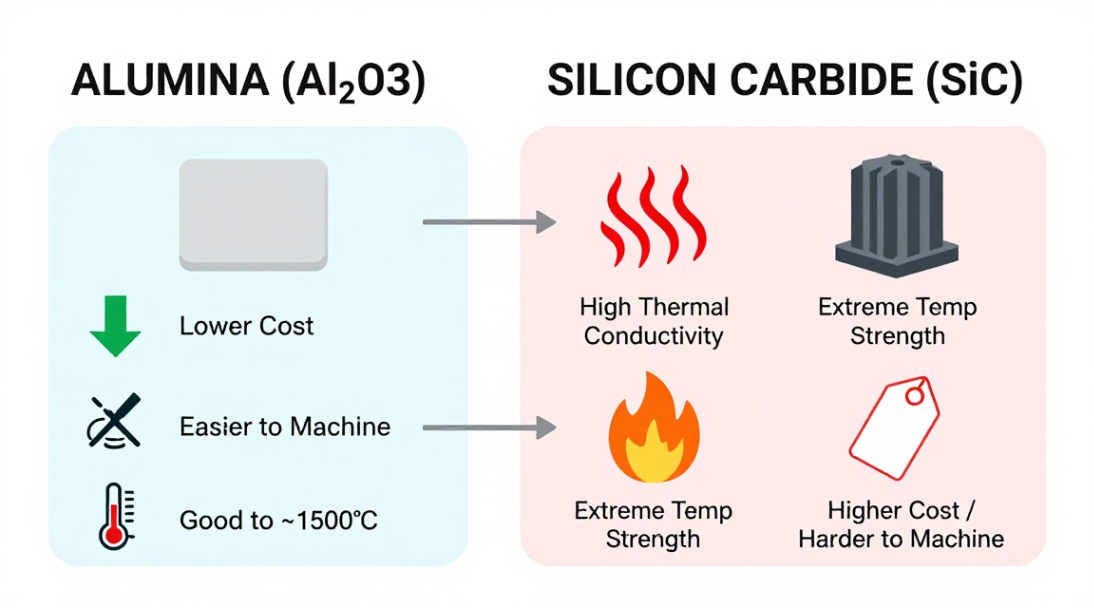
Silicon carbide ceramic crushes alumina in thermal conductivity (it’s a semi-conductor) and has better extreme temperature strength. For heat exchangers or kiln furniture, SiC is superior. But it’s harder to machine and more expensive. For an electrically insulating, wear-resistant part under 1500°C, alumina is often the simpler, cheaper solution. Advanced forms like reaction-sintered silicon carbide ceramics or recrystallized silicon carbide ceramics have niche benefits but at a significant cost premium.
The Specialized Niche Fighters
- Aluminium Nitride Ceramic: Stunning thermal conductivity and electrical insulation. Use it only if you’re cooling high-power electronics and budget is secondary.
- Boron Nitride Ceramic: Excellent lubricity and thermal shock resistance, often used with a special coating for boron nitride ceramic crucibles for metal melting. It’s soft and mechanically weak compared to alumina.
- Boron Carbide Ceramic: Extremely hard for armor, but brittle and very expensive. Overkill for most industrial wear.
- Mullite & Quartz Ceramics: Offer lower thermal expansion. Consider them for specific thermal cycling situations, but expect lower mechanical strength than alumina.
The Ugly Truth: Alumina’s Limitations & Machining Hell
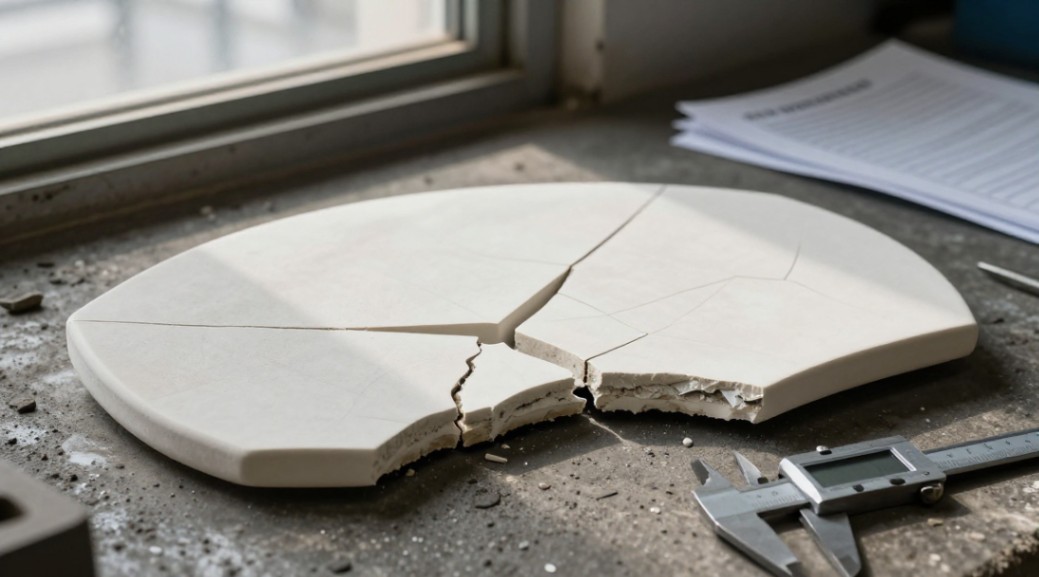
We must address the elephant in the room. Alumina is brittle. Its low fracture toughness is its Achilles’ heel. Designers must avoid sharp corners and tensile stress concentrations. Machining finished alumina parts requires diamond grinding tools. It’s slow, costly, and generates fine dust. This is why net-shape sintering is critical. New innovations, like the ‘double continuous structure’ used for ultra-high temperature composites, which blend fibers with ceramic powder to boost toughness from 3-5 to 10-20 MPa·m¹/², are the future. But for now, you design around the brittleness.
The Final Verdict: When to Specify Aluminium Oxide Ceramic
Stop overthinking. Follow this decision map.
Specify aluminum oxide ceramic when: Your priority is electrical insulation. You need good wear resistance on a tight budget. Chemical corrosion is a primary concern. Operating temperatures are below 1700°C. Biocompatibility is required. The part shape allows for simple, stress-free geometry.
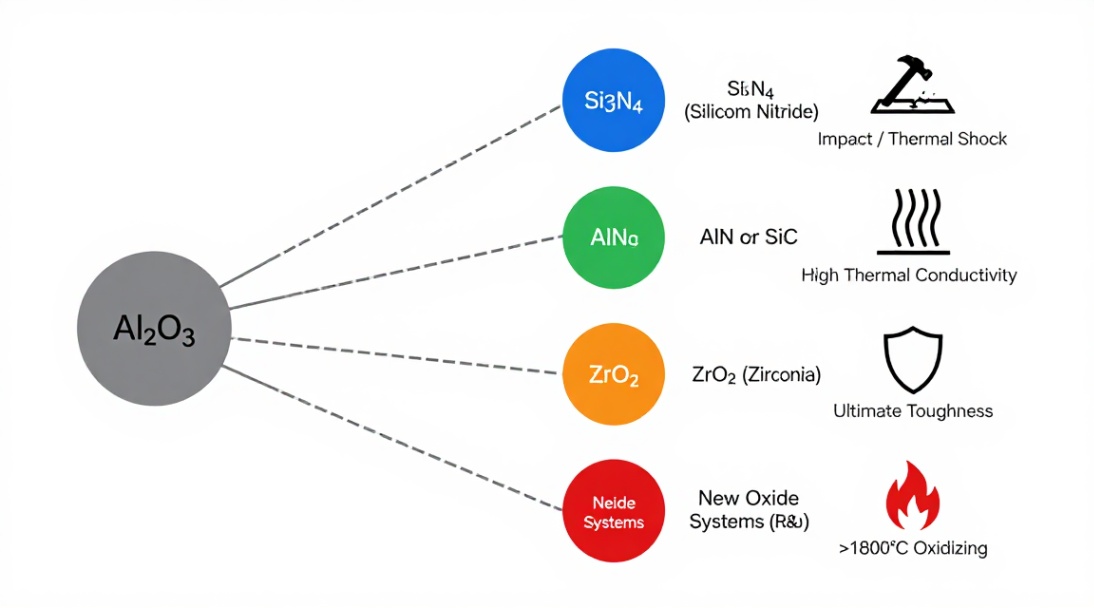
Look immediately at alternatives when: The part suffers impact or severe thermal shock (use silicon nitride). Extreme thermal conductivity is needed (use aluminium nitride or silicon carbide). The application demands the ultimate toughness (use zirconia). You’re working above 1800°C in an oxidizing environment (new oxide systems above 3000°C are in development).
Stop Researching. Start Testing.
Theoretical data is useless. Real-world performance is everything. You’ve seen the analysis. You understand the trade-offs. Now, you need to validate with actual material. Don’t risk your project on a datasheet. I recommend sourcing standardized test coupons-alumina, silicon nitride, zirconia-and putting them through your specific environment. Bench-test wear. Cycle the temperature. Expose them to your chemical soup. The material that survives is your answer. For a reliable, no-hassle source of high-quality alumina test samples and components, partner with a specialist who understands engineering, not just sales. Get samples. Test them. Prove it.
Suppiler
Synthetic-chemical focus on the research and development, production and sales of ceramic products, serving the electronics, ceramics, chemical and other industries. Since its establishment in 2015, the company has been committed to providing customers with the best products and services, and has become a leader in the industry through continuous technological innovation and strict quality management.
Our products includes but not limited to Aluminum Nitride, Aluminum Oxide, Boron Carbide, Boron Nitride, Ceramic Crucible, ect. If you are interested in any type of these, please feel free to contact us.