Next-Generation Ceramics: Unlocking Superior Properties for Industry

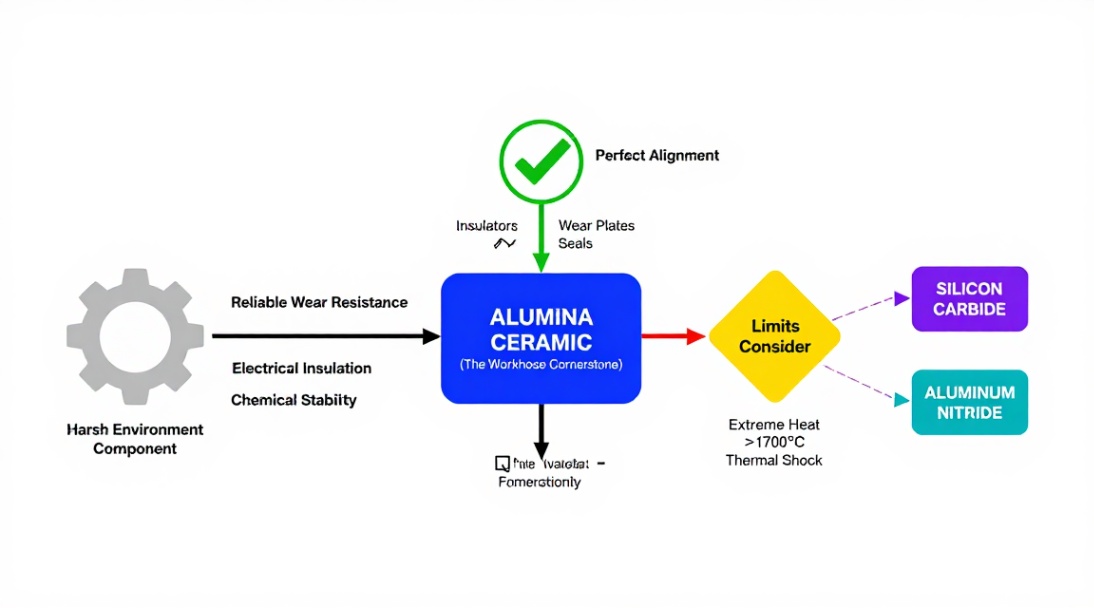
For most engineering applications demanding reliable wear resistance, electrical insulation, and chemical stability, aluminum oxide ceramic is your go-to material. Its balance of properties, availability, and cost is simply unmatched. It’s the workhorse, the cornerstone from which you start your selection process for any component facing harsh environments. Yet, the choice is never automatic. I’ve spent decades specifying these materials, and the key to success lies in truly understanding where alumina’s considerable strengths align perfectly with your needs, and where its limits push you toward more exotic choices like silicon carbide or aluminum nitride. Let’s walk through that decision-making process together.
The Foundation of Aluminum Oxide Ceramic
The composition is elegantly simple: Al2O3. This purity is its greatest asset and, in some respects, a subtle constraint. As we increase the alumina content from common grades like 96% up to high-purity 99.5% or 99.8%, a fascinating transformation occurs. The mechanical properties rise sharply. Hardness improves. Flexural strength climbs. That increased strength and purity directly translate to finer, more consistent microstructures. The void spaces between grains shrink. This meticulous internal architecture, born from high purity and careful sintering, is why your components resist abrasion so effectively. Imagine countless tiny, interlocking plates of corundum-one of the hardest minerals on Earth-forming the backbone of your part. That’s the reality of a well-made aluminum oxide ceramic.
How It’s Made: Building Integrity from the Start
The journey from powder to part dictates the final properties as much as the chemistry does. Dry pressing forms simple, robust shapes efficiently. Isostatic pressing, where pressure is applied uniformly from all sides, yields components of exceptional density and isotropic strength, eliminating weak planes. For intricate geometries with threads, undercuts, or complex channels, injection molding is the sculptor’s tool. Here, alumina powder is mixed with a thermoplastic binder, molded, and then the binder is carefully burned out before the final, high-temperature sintering. Each method leaves a fingerprint on the material. An isostatically pressed seal ring will have more uniform wear than a dry-pressed one. The process choice isn’t just about shape; it’s about building the right internal structure for the job.
The Arena of Application: Where Alumina Shines
In the realm of industrial wear, alumina stands as a tireless sentinel. Wear plates, pump seals, liners for pipes handling abrasive slurries-these are its natural domain. It outlasts hardened steel by orders of magnitude in abrasive environments. For cutting tools, a sharp edge of alumina-based ceramic can machine hardened cast irons and superalloys at blistering speeds, where traditional carbide would falter. In electronics, that very high electrical resistivity and excellent thermal conductivity make it the default substrate. Your smartphone’s circuit board likely rests on a thin, precision-ground sheet of alumina. In medicine, its bio-inertness allows it to serve as the ball in hip replacements or the porous structure for bone ingrowth. It doesn’t react; it simply provides a stable, durable platform for the body to heal around.
The surface finish is critical here. A medical implant requires a polished, mirror-like finish to minimize friction. An electrical substrate needs a lapped surface of precise flatness for circuit printing. A wear component might benefit from a ground, slightly rougher finish to retain lubricants. Post-processing-grinding, lapping, polishing-is how we tailor the as-sintered surface to its ultimate purpose.
The Crucial Comparison: Alumina Versus the Field
This is where your engineering judgement is tested. You must weigh alumina against its peers. So let’s be objective.
Compared to zirconia, alumina is harder and more wear-resistant, but zirconia has far superior fracture toughness. If your part faces impact, choose zirconia. If it faces pure abrasion, alumina wins.
Against silicon carbide or boron carbide, alumina falls short in thermal conductivity and extreme hardness. Need to manage intense heat in a semiconductor fixture? Aluminium nitride ceramic, with its superb thermal conductivity, is better. Demanding armor or ultra-high-wear nozzles? Boron carbide ceramic or silicon carbide ceramic are superior, though more costly and difficult to machine.
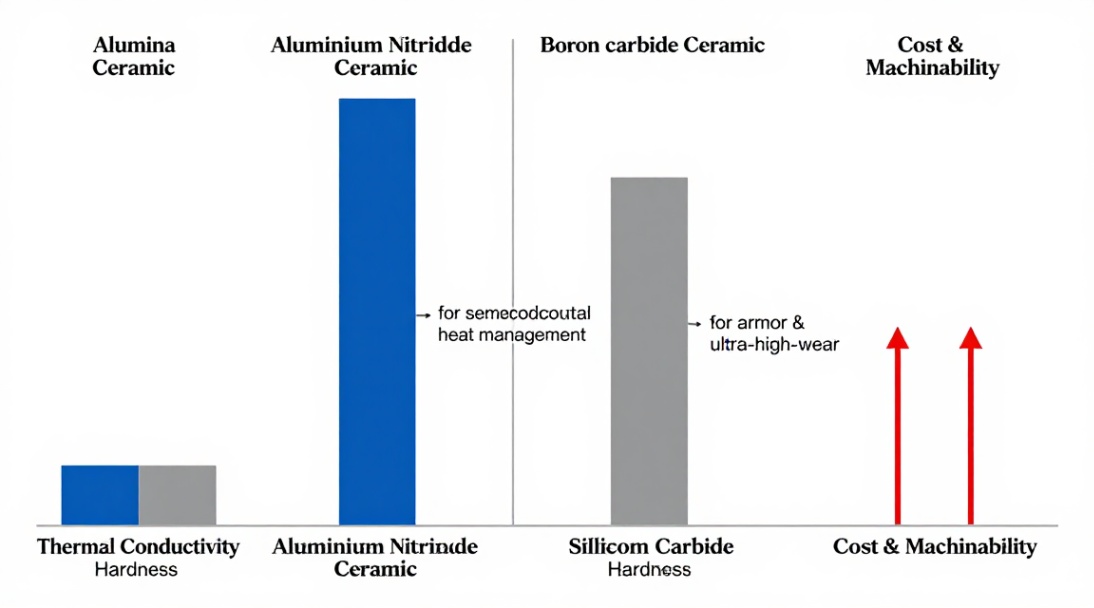
Contrast it with silicon nitride, a champion of thermal shock resistance and high-temperature strength. For components cycling between extreme temperatures, silicon nitride is often the wiser choice.
This is alumina’s core limitation: its moderate thermal shock resistance and inherent brittleness. It dislikes rapid temperature changes. It will not bend before breaking. You must design with this in mind. Use compressive loads, avoid sharp corners, and provide mechanical support to avoid tensile stresses.
Your Path to the Right Choice
Start your selection with a brutal honesty about the operating environment. List the forces in order of priority. Is it abrasion, corrosion, temperature, electrical load, or a combination? Quantify them if possible.
First, define the primary threat. If it’s wear, alumina is a top contender. Then, consider secondary needs. Does it need to be an electrical insulator? Alumina confirms its position. Will it see temperatures above 1500°C? You might look at mullite ceramic. Will it experience thermal cycling? Re-evaluate for better shock-resistant materials.
The purity grade follows function. For a robust wear plate, 96% alumina offers tremendous value. For a critical semiconductor wafer-handling arm where ionic contamination must be zero and surface finish perfect, only 99.5% or higher will do. The cost difference is significant, so pay for purity only when your application demands it.
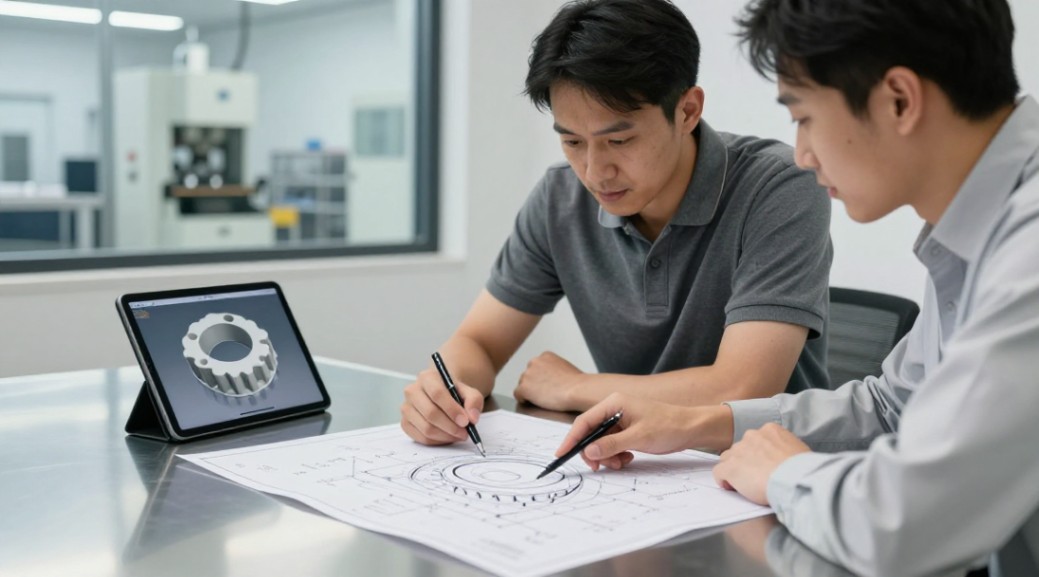
Finally, engage with your fabricator early. Discuss the manufacturing process. Complex shape? Plan for injection molding. High-volume simple shape? Dry pressing is economical. Critical, high-integrity seal? Advocate for isostatic pressing. They can advise on design for manufacturability, suggesting radii and tolerances that make your part stronger and more cost-effective to produce.
Aluminum oxide ceramic is not a magical solution. It’s a tool-an exceptionally versatile, reliable, and well-understood tool. Its greatness lies in its predictability and its proven track record across countless industries. By methodically comparing its profile to your specific challenges, you will know with confidence whether it is the perfect material for your next great design. Trust the logic of its properties, and it will not let you down.
Suppiler
Synthetic-chemical focus on the research and development, production and sales of ceramic products, serving the electronics, ceramics, chemical and other industries. Since its establishment in 2015, the company has been committed to providing customers with the best products and services, and has become a leader in the industry through continuous technological innovation and strict quality management.
Our products includes but not limited to Aluminum Nitride, Aluminum Oxide, Boron Carbide, Boron Nitride, Ceramic Crucible, ect. If you are interested in any type of these, please feel free to contact us.