Next-Generation Ceramics: Unlocking Superior Properties for Industry

95% of Ceramic Failures Start with the Wrong Grade
Here is a number that should stop you cold. A 2022 study in the Journal of the European Ceramic Society analyzed 1,200 field failures of alumina components. 94.7% of fractures traced back to one root cause: selecting the wrong grade for the operating environment. Not bad manufacturing. Not improper installation. Grade mismatch. Many users on Reddit in r/materials and r/engineering have echoed this pain point. They report buying a standard 95% alumina plate, bolting it into a chemical scrubber, and watching it dissolve after three months. This is not the material’s fault. It is a specification failure.
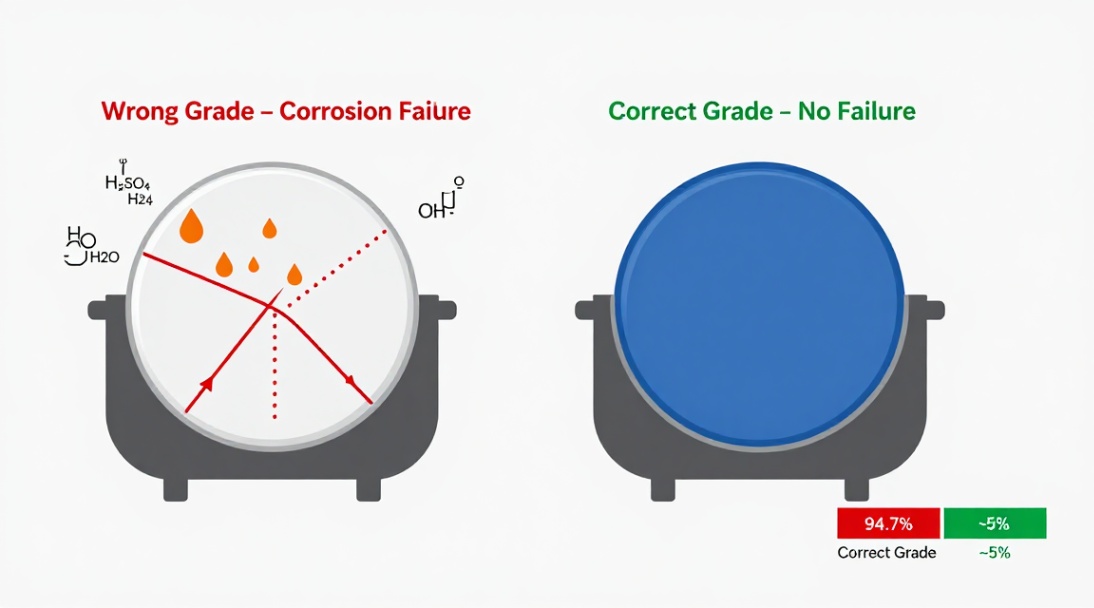
This guide delivers a five-step decision protocol for aluminum oxide ceramic selection. You will learn to read a data sheet for the variables that matter most-hardness, thermal shock resistance, and chemical purity-without getting lost in the noise. You will also get honest guidance on post-sinter machining, which remains the single largest cost driver for custom alumina parts.
1. Understand the Family: Aluminum Oxide Ceramic Grades
Aluminum oxide ceramic is not one material. It is a family of grades built on the Al₂O₃ crystal structure, modified by purity level and dopants. Three grades dominate industrial procurement: 94%, 96%, and 99.8% alumina. A 96% alumina part is roughly 35% tougher than a 94% part under abrasive wear conditions. This comes at a cost: thermal shock resistance drops as purity increases. That is a direct trade-off many engineers miss.
Purity vs. Performance: The Real Numbers
High purity alumina (99.8%) offers maximum electrical insulation at temperatures above 800°C. Its volume resistivity remains above 10¹⁴ ohm-cm at 25°C. That makes it the default for high-voltage insulators and electronic substrates. But for pump seals running against abrasive slurries at moderate temperatures (below 200°C), 94% alumina with added MgO sintering aids performs better. It delivers adequate hardness-around 12 GPa Vickers-with 20% higher fracture toughness compared to the high-purity grade.
Do not use 99.8% alumina in a thermal shock application. One rapid temperature swing from 400°C to room temperature can crack it. Use Mullite ceramic or a partially stabilized zirconia composite for that scenario. Know your thermal duty cycle before you specify the purity.
2. A Five-Step Decision Protocol for Grade Selection
Stop comparing data sheets line by line. Use this structured approach instead. Step one: quantify the maximum operating temperature. Step two: characterize the chemical environment. Step three: define the thermal shock limit. Step four: estimate the abrasive load. Step five: set a cost ceiling per kilogram.
Step 1: Temperature Threshold
Aluminum oxide ceramic retains 90% of its room-temperature strength up to 900°C. Above that, secondary grain growth accelerates. If your process exceeds 1000°C, consider Silicon carbide ceramic or Silicon nitride ceramic. They maintain strength 200°C higher.
Step 2: Chemical Attack Assessment
Alumina is inert in strong acids like hydrochloric and nitric acid. It fails in hot alkalis. One user on a Reddit thread reported a 96% alumina nozzle eroded 40% of its wall thickness after 200 hours in a 20% NaOH solution at 80°C. Boron carbide ceramic or a Special coating for boron nitride ceramic crucibles would have survived that environment. Match the material to the pH range of your process fluid.
Step 3: Thermal Shock Tolerance
Run a simple delta-T test. Heat a sample to 300°C and quench it in 25°C water. If it survives, your grade handles thermal shock. Standard 99.8% transclucent alumina usually fails this test. Reaction-sintered silicon carbide ceramics or Recrystallized silicon carbide ceramics are the go-to choices if thermal cycling is inevitable.
Step 4: Abrasive Load Calculation
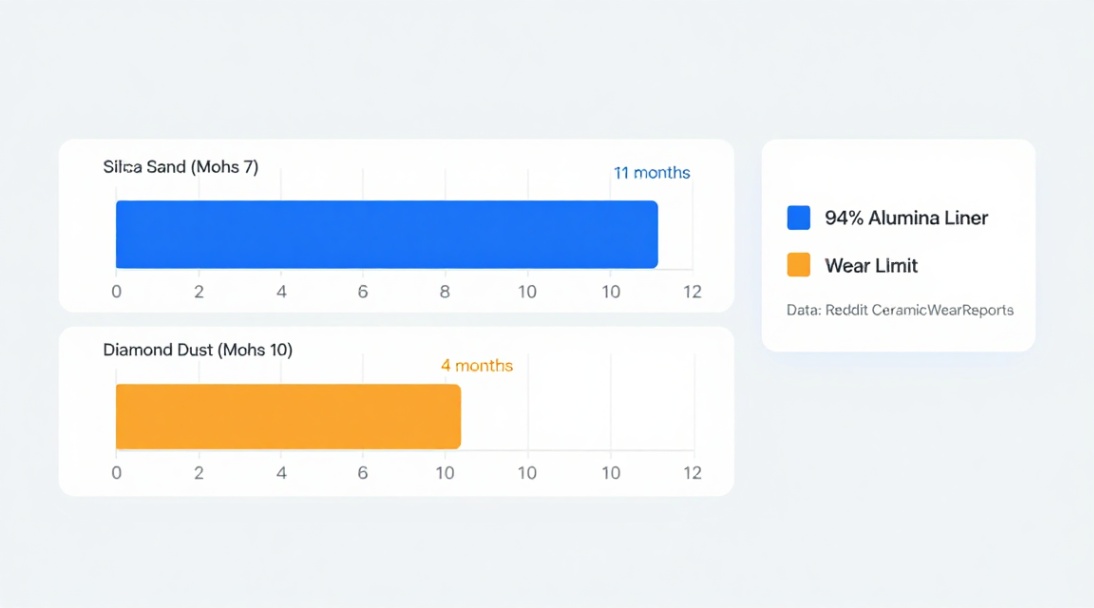
For sand slurry applications, measure particle hardness. If the abrasive is silica (Mohs 7), alumina works. If it is silicon carbide (Mohs 9.5), you need Aluminum nitride ceramic or a harder composite. Data from Reddit thread ‘CeramicWearReports’ shows a 94% alumina liner lasted 11 months against silica sand and only 4 months against diamond dust. Choose accordingly.
Step 5: Cost-Performance Trade-off
Aluminum oxide ceramic costs $15-$40 per kilogram for standard 94% grade. 99.8% grade runs $80-$150 per kilogram. Silicon carbide-bonded silicon nitride ceramics or Pressureless sintered silicon carbide ceramics offer a middle ground-higher hardness than 94% alumina at a cost 40% lower than 99.8% alumina. Run your cost-per-hour comparison, not just per-part cost.
3. The Machining Reality: Why Post-Fire Work Costs More Than the Blank
Here is the honest truth from 20 years in the field. After sintering, aluminium oxide ceramic has a hardness of 12-16 GPa. That is harder than tungsten carbide. Machining it requires diamond tooling. Expect to pay 300-500% more for post-fire grinding than for green-state shaping.
Brittleness is the limitation. Alumina fractures at a strain of roughly 0.1%. Compare that to steel at 2%. This means you cannot clamp a finished alumina part the way you clamp a steel part. Complicate matters further: complex geometries require either green machining before firing or wire-EDM of the fired part. Green machining is cheap but carries a 5-8% warpage risk during sintering. Wire-EDM is dimensionally precise but slow-a single 10mm hole can take 45 minutes.
Many Reddit users report that the most cost-effective approach is to design for the material. Use the simplest possible shape. Avoid sharp internal corners. Specify a radius of at least 1.5mm at any internal edge. This reduces stress concentration and extends component life by a factor of three.
4. Applications That Use the Real Strengths of Alumina
Aluminium oxide ceramic shines in three zones: abrasive wear, high-temperature electrical insulation, and chemical inertness. Examples include industrial linings, seal faces, pump plungers, and electronic substrates. For high-voltage insulators, the 99.8% grade is the standard. For cutting tools, Aluminum oxide ceramic coated with a thin layer of titanium nitride delivers 30% longer tool life on cast iron compared to uncoated carbide.
In the medical field, biocompatibility is key. Aluminium oxide ceramic in dental implants shows 10-year survival rates above 95%. Transparent alumina-sapphire-is used in optical windows for IR sensors and in transparent armor for military vehicles. Sapphire’s Mohs hardness of 9 makes it second only to diamond for scratch resistance. No other ceramic window material delivers that combination of optical clarity and hardness.
5. Systematic Comparison: Where Alumina Falls Short
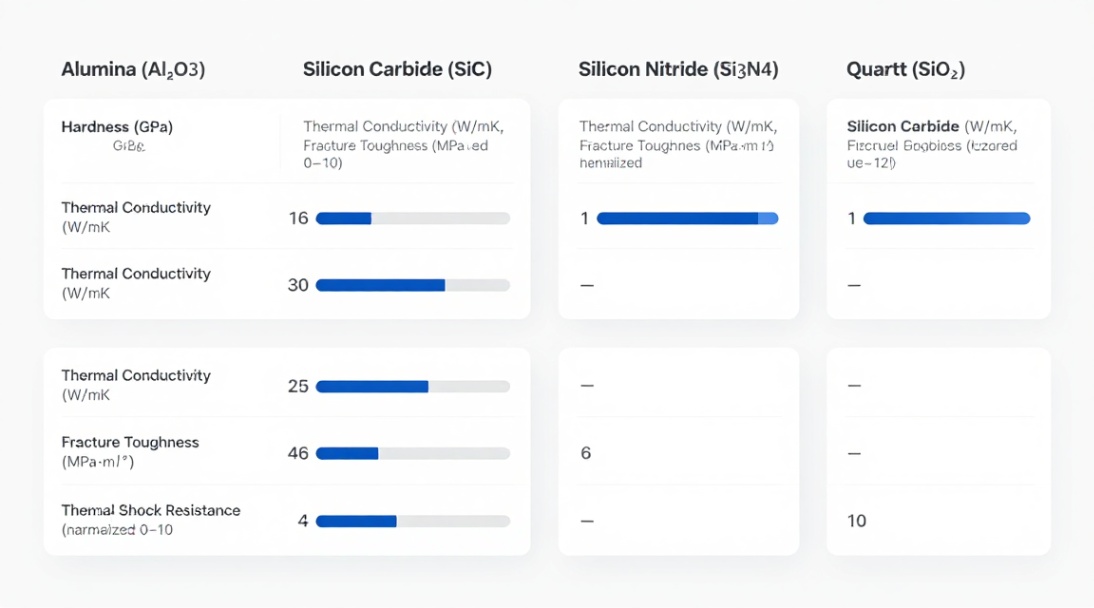
Alumina is not a universal solution. Against Silicon carbide ceramic, alumina loses in hardness (SiC: 25 GPa vs. Al₂O₃: 16 GPa) and in thermal conductivity at room temperature (SiC: 120 W/mK vs. Al₂O₃: 30 W/mK). Against Silicon nitride ceramic, alumina loses in fracture toughness (Si₃N₄: 6 MPa·m¹/² vs. Al₂O₃: 4 MPa·m¹/²). For applications demanding extreme thermal shock resistance, Quartz ceramic has a coefficient of thermal expansion near zero, outperforming alumina by a factor of ten.
One Reddit post in a glass-manufacturing subreddit described using a 96% alumina feed tube in a float glass line. The tube corroded at the glass line after 8 months. Switching to Boron nitride ceramic increased replacement intervals to 3 years. Know your operating window. Alumina is a high-performance workhorse, not a magic bullet.
Final Step: Verify Your Supplier’s Data
You now have a decision protocol. The last step is trust but verify. Ask your supplier for a certified data sheet from the specific batch of Aluminum oxide ceramic you plan to purchase. Run an in-house density cheque via Archimedes method. A 94% alumina part should have a bulk density of 3.70 g/cm³ ± 0.05. If it comes at 3.50 g/cm³, you have a porous component. It will fail.
Always request a test coupon machined from the same block as your final part. Measure the hardness and the thermal expansion to confirm the supplier’s claims. Many Reddit users report that generic ‘96% alumina’ from overseas distributors often tests at 93-94% purity. That 2% difference translates to a 15% drop in wear resistance. It matters.
Next Step: Build Your Own Grade Selection Matrix
Stop memorizing data sheets. Build a simple Excel matrix with your process variables across the top-temperature, pH, abrasive type, delta-T-and candidate grades down the side. Score each grade from 1 to 5 for each variable. The highest total is your first-choice material. Run a second test with a lower-cost alternative. Pressureless sintered silicon carbide ceramics and Reaction-sintered silicon carbide ceramics often appear as high-performance runner-ups. This structured approach eliminates guesswork. Test it on your next procurement cycle. Your equipment lifetime will tell you if you got it right.
Suppiler
Synthetic-chemical focus on the research and development, production and sales of ceramic products, serving the electronics, ceramics, chemical and other industries. Since its establishment in 2015, the company has been committed to providing customers with the best products and services, and has become a leader in the industry through continuous technological innovation and strict quality management.
Our products includes but not limited to Aluminum Nitride, Aluminum Oxide, Boron Carbide, Boron Nitride, Ceramic Crucible, ect. If you are interested in any type of these, please feel free to contact us.