Next-Generation Ceramics: Unlocking Superior Properties for Industry

Have you ever spec’d a ceramic part, only to watch it fail catastrophically on the first thermal cycle? You followed the datasheet. You paid premium prices. And yet, the component cracked, chipped, or just wore out too fast. The problem isn’t you. It is the industry’s lazy habit of lumping all “engineering ceramics” together. They are not the same. Stop treating them like they are.
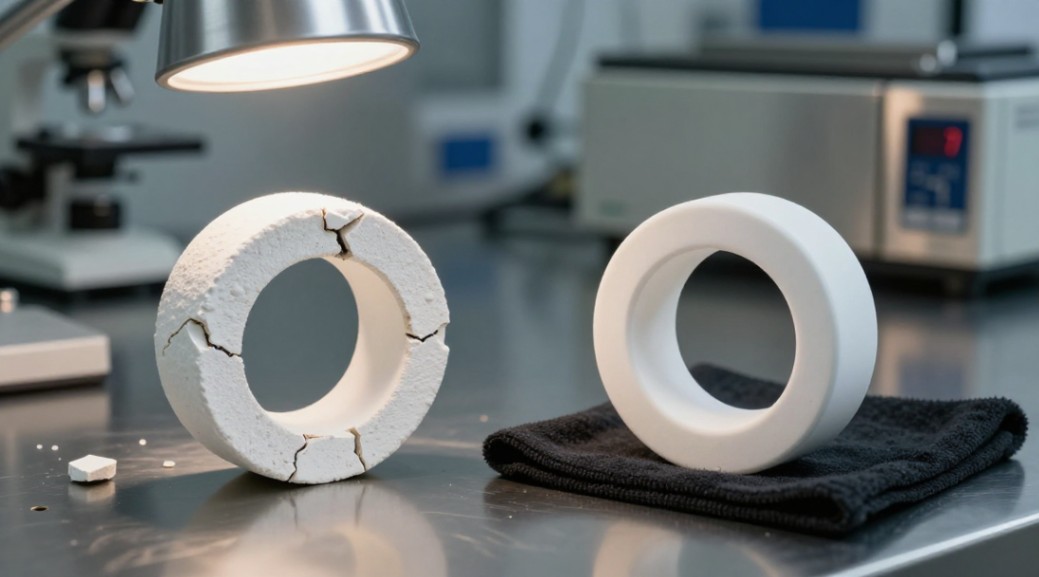
Aluminum oxide ceramic is the workhorse. It is the baseline. If you do not understand this material deeply, you will make expensive mistakes with exotic alternatives like Silicon nitride or Boron carbide. This article cuts through the noise. You will learn exactly what this oxide is, where it dominates, and—more importantly—where it fails. No fairy tales. Just engineering truth.
1. The Atomic Truth: What Is Aluminum Oxide Ceramic?
Aluminum oxide ceramic is a dense, polycrystalline material based on the chemical compound Al₂O₃. The stable crystalline phase at high temperature is alpha-alumina (corundum). This specific hexagonal crystal structure is not a marketing gimmick. It is the reason this material achieves a hardness of 9 on the Mohs scale—second only to diamond and Boron carbide.
Purists refer to it as “alumina.” Industrial guys call it “oxide ceramic.” Whatever name you use, the fundamental structure is the same: tightly packed oxygen ions with aluminum ions filling the octahedral gaps. This arrangement resists dislocation movement. That is why it is hard. That is why it wears like a beast. If the purity drops below 99.5%, grain boundary phases soften the structure. You lose performance. Fast.
“Many users on Reddit ask why their 96% alumina parts fail in thermal cycling. The answer is simple: too much silica glass at the grain boundaries. It flows at high temp. Alpha alumina does not.”
2. The Property Stack: Why Engineers Rely on It
Aluminum oxide ceramic is not the toughest ceramic. It is not the lightest. But it is the most predictable. Here is why it dominates industrial applications.
2.1. Extreme Hardness & Wear Resistance
This material destroys softer materials in abrasive environments. Think sand slurry pipes, wire guides, and grinding media. Its hardness (15–19 GPa Vickers) resists scratching and erosion. However, do not confuse hardness with toughness. It is brittle. A sharp impact will fracture it. That is where Boron carbide ceramic or Silicon carbide ceramic excels—they offer a slightly higher toughness-to-hardness ratio.
2.2. Thermal Behavior: The Double-Edged Sword
Aluminum oxide ceramic has high thermal conductivity for an oxide (around 30 W/m·K). It dissipates heat better than Zirconia, making it safe for electronic substrates. Its low thermal expansion (~8 × 10⁻⁶ /K) matches some metals, reducing joint stress. But thermal shock resistance is mediocre. If you quench a thick alumina block from 300°C into water, it will crack. For extreme thermal shock, use Quartz ceramic or Mullite ceramic. For high-temperature strength, use Silicon nitride ceramic.
2.3. Electrical Insulation & Chemical Inertness
Alumina is an outstanding electrical insulator. High dielectric strength (>10 kV/mm) and low loss factor make it the default for spark plugs, high-voltage bushings, and vacuum interrupters. It laughs at most acids and alkalis, except for hydrofluoric acid and extremely hot caustics. This chemical resistance is why biomedical implants (like hip balls) use high-purity alumina. The body does not react to it.
3. Manufacturing: The Brutal Reality of Shaping Alumina
Aluminum oxide ceramic is not easy to machine. It is hard. You cannot just CNC it like steel. You must shape it before sintering, or you grind it with diamond abrasives afterward. That drives up costs.
- Dry Pressing + Sintering: Cheap for simple geometries. High-volume spark plug insulators use this. Shrinkage is ~15-20%.
- Hot Pressing: Produces near-theoretical density. Fewer defects. Used for ballistic armor tiles.
- HIP (Hot Isostatic Pressing): Removes internal pores. Necessary for biomedical components. Expensive.
- Advanced techniques: Reaction-sintered Silicon carbide ceramics and Silicon carbide-bonded Silicon nitride ceramics are different beasts. Alumina cannot be reaction-sintered easily. It requires solid-state sintering or liquid-phase sintering with additives.
Machining alumina after firing requires diamond grinding. It is slow. It wears tools. The Special coating for Boron nitride ceramic crucibles is irrelevant here—alumina does not need a release layer unless you are casting reactive metals. For complex shapes, consider net-shape forming with Pressureless sintered Silicon carbide ceramics or Recrystallized Silicon carbide ceramics. They offer better dimensional control.
4. Aluminum Oxide vs. The Competition: The Honest Comparison
Industry marketing loves to claim every ceramic is the best. They are lying. Here is a direct, no-BS comparison based on property trade-offs.
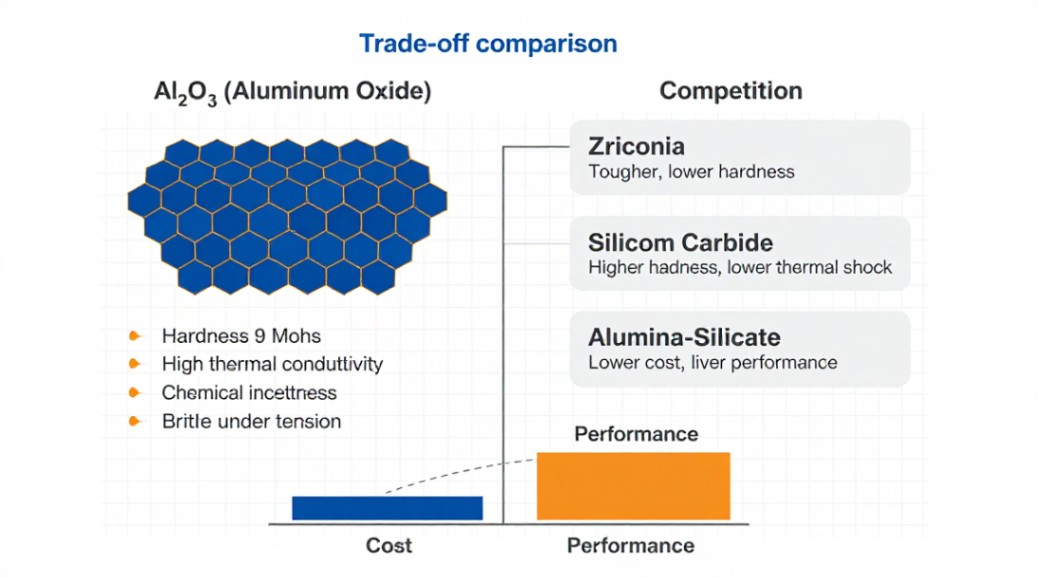
| Ceramic | Hardness | Toughness | Thermal Shock | Machinability |
|---|---|---|---|---|
| Aluminum oxide | Very High | Moderate | Low | Poor (diamond grind) |
| Silicon nitride ceramic | High | High | High | Difficult |
| Silicon carbide ceramic | Very High | Moderate | Very High | Very Poor |
| Boron carbide ceramic | Highest | Low | Low | Extremely Poor |
| Aluminum nitride ceramic | Low | Low | Moderate | Fair |
| Zirconia | Moderate | Highest | High | Fair |
Key takeaway: Aluminum oxide ceramic is not a “super ceramic.” It is a solid, reliable, affordable oxide. Use it where wear resistance and electrical insulation matter, and where thermal shock is controlled. For high-stress, rapid-cycling environments, look at Silicon carbide-bonded Silicon nitride ceramics or Pressureless sintered Silicon carbide ceramics. They cost more. They survive longer in those conditions.
5. Where You See Alumina Every Day (And Where You Don’t)
Common applications for Aluminum oxide ceramic include:
- Abrasives & Cutting Tools: Grinding wheels, sandblasting nozzles.
- Electronic Substrates: Thick-film hybrid circuits, LED heat sinks.
- Armor: Body armor plates (often combined with Boron carbide or Polyethylene backing).
- Biomedical Implants: Hip joints, dental crowns. High-purity (99.9%) alumina is bio-inert.
- Chemical Processing: Valve seats, pump impellers, thermocouple sheaths.
What you don’t see: Large structural parts. Alumina cannot be cast into huge beams. It sinters with too much shrinkage and risk of warpage. For large, complex monolithic structures, reaction-sintering or recrystallized ceramics (like Recrystallized Silicon carbide ceramics) are more practical. Alumina is a small-part material.
6. The Cost Reality Check
Aluminum oxide ceramic is inexpensive compared to almost every non-oxide ceramic. Raw alumina powder costs dollars per kilogram. Fabricated parts range from $10 to $100 per unit, depending on complexity and purity. Boron nitride ceramic can cost ten times more. Silicon nitride ceramic can cost five times more. Boron carbide ceramic is also significantly more expensive.
This cost advantage is why alumina dominates. It is “good enough” for thousands of applications. But do not let the low price fool you. Machining costs often exceed material costs. A simple alumina cylinder might cost $5 in powder and $40 in diamond grinding labor. If your design can be net-shape molded (injection molding or dry pressing), you save big. If you need post-machining, the cost skyrockets.
7. The Verdict: When to Use It, When to Run Away
Use Aluminum oxide ceramic when:
- You need hardness and wear resistance at a reasonable price.
- You need electrical insulation at high temperatures (up to 1500°C in oxidizing atmospheres).
- Your thermal cycle is slow and uniform.
- You can design for simple shapes.
Run away from it when:
- You need high impact toughness (use Zirconia or Silicon nitride).
- You face extreme thermal shock (use Silicon carbide or Mullite).
- You need complex, hollow geometries (consider Aluminum nitride or special coatings).
One final note: Many engineers ignore the surface finish issue. Alumina’s hardness means grinding marks act as stress raisers. A ground surface on a Recrystallized Silicon carbide ceramic part behaves differently than on alumina. If you need a polished, defect-free surface for a sealing application, budget for a grinding process with <50 µm diamond grit. The alternative is early failure. And that costs more than the grinding.
Stop guessing. Start specifying. Aluminum oxide ceramic is a tool, not a magic material. Use the right tool for the job. If you are ready to select the exact grade for your next project, consult a technical ceramic engineer. Your wallet (and your equipment) will thank you.
Suppiler
Synthetic-chemical focus on the research and development, production and sales of ceramic products, serving the electronics, ceramics, chemical and other industries. Since its establishment in 2015, the company has been committed to providing customers with the best products and services, and has become a leader in the industry through continuous technological innovation and strict quality management.
Our products includes but not limited to Aluminum Nitride, Aluminum Oxide, Boron Carbide, Boron Nitride, Ceramic Crucible, ect. If you are interested in any type of these, please feel free to contact us.