Next-Generation Ceramics: Unlocking Superior Properties for Industry

Aluminium Oxide Ceramic: The Uncompromising Workhorse of Industry
Aluminum oxide ceramic (Al₂O₃), or alumina, is the most widely used technical ceramic due to its optimal balance of high hardness, excellent electrical insulation, chemical inertness, and cost-effectiveness. Its dominance is not accidental; it results from a superior performance-to-price ratio across more applications than any other ceramic material. For engineers and procurement specialists, understanding where alumina excels and where alternatives like silicon carbide ceramic or zirconia are superior is critical for design success and cost management.
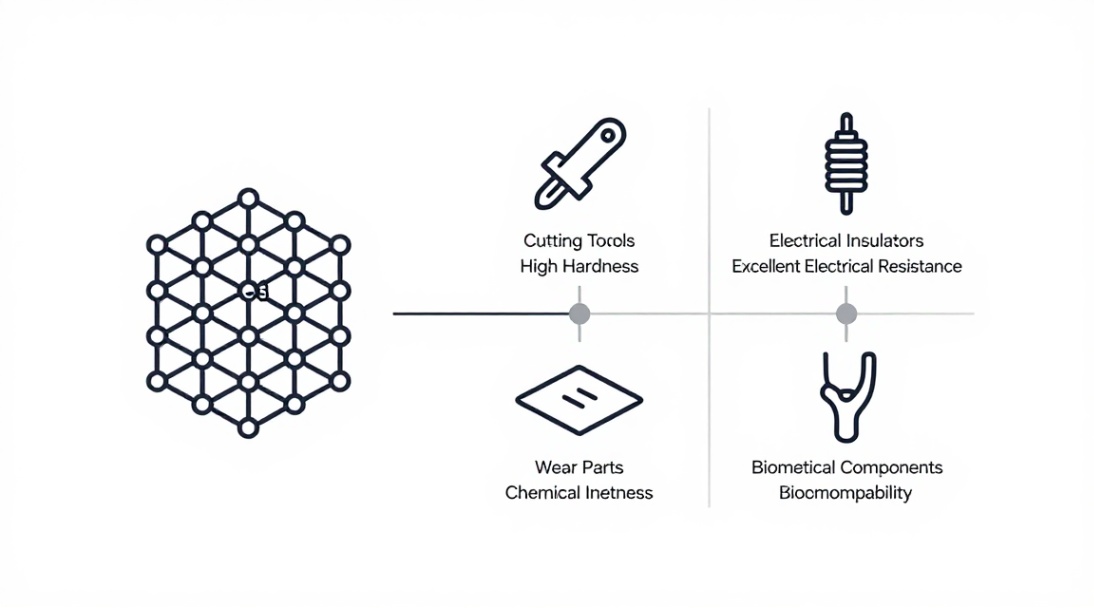
Core Properties: Why Alumina is the Default Choice
Alumina‘s position stems from a reliable property portfolio. It offers a Vickers hardness of 1500-2000 HV, making it exceptionally wear-resistant. Its dielectric strength exceeds 10 kV/mm, and it maintains structural integrity up to 1650°C. Chemical stability is near total; it resists attack from all acids and alkalis except hydrofluoric acid and concentrated phosphoric acid at high temperatures. These properties are consistently delivered across standard purity grades like 96% and 99.5% Al₂O₃, with higher purity enhancing hardness, wear, and corrosion resistance at a higher sintering cost.
Direct Comparison: Alumina vs. Other Engineering Ceramics
Selecting a ceramic is a trade-off. Here is a decisive breakdown of where alumina stands against its primary competitors.
1. Aluminium Oxide Ceramic vs. Zirconia (ZrO₂)
- Alumina Advantages: Superior hardness and wear resistance. Better long-term chemical stability. Significantly lower material cost. Excellent electrical insulation properties.
- Zirconia Advantages: Much higher fracture toughness (resistance to crack propagation). Higher flexural strength. Lower thermal conductivity, useful as a thermal barrier. Can be transformation-toughened.
- Decision Point: Choose alumina for wear parts, electrical insulators, and chemically hostile environments where pure abrasion is the failure mode. Choose zirconia for mechanical components subject to impact, tensile stress, or requiring metal-like toughness.
2. Aluminium Oxide Ceramic vs. Silicon Carbide Ceramic (SiC)
- Alumina Advantages: Far superior electrical insulator. Easier and less expensive to sinter to high density. More readily available in complex shapes via injection molding. Better high-frequency dielectric properties.
- Silicon Carbide Advantages: Exceptional thermal conductivity (3-5x higher than alumina). Higher maximum use temperature (~1600°C in air, up to 1800°C in inert atm). Superior thermal shock resistance. Excellent resistance to molten metals.
- Decision Point: Use alumina for substrates, insulators, and wear parts in moderate thermal environments. Switch to reaction-sintered silicon carbide ceramics or pressureless sintered silicon carbide ceramics for heat exchangers, burner nozzles, kiln furniture, and applications demanding rapid heat dissipation.
3. Aluminum Oxide Ceramic vs. Boron Nitride Ceramic (BN)
- Alumina Advantages: High mechanical strength and rigidity. Excellent abrasion resistance. Much lower cost. Standard ceramic machining processes apply.
- Boron Nitride Advantages: Outstanding thermal shock resistance. Acts as a solid lubricant. Is machinable with standard carbide tools. Chemically inert to molten metals and slags. Often requires a special coating for boron nitride ceramic crucibles to prevent oxidation.
- Decision Point: Alumina is for structural wear components. Boron nitride is for break-rings in continuous steel casting, crucibles for special metals, and applications requiring easy machinability and lubricity in high-temperature settings.
Key Applications and Manufacturing Considerations
Where Aluminum Oxide Ceramic Dominates
Alumina’s applications map directly to its properties. In industrial wear, it lines pumps, forms nozzle orifices, and serves as ball valve components. As an electrical material, it is the substrate for 99% of thick-film and thin-film circuits and the insulator in high-voltage stations. Its biocompatibility makes it the material of choice for femoral heads in hip replacements and dental implants. Manufacturing typically involves dry pressing or isostatic pressing of powder, followed by sintering at 1600-1800°C. Near-net-shape forming is possible with injection molding, though post-sinter machining with diamond grinding is almost always required due to its extreme hardness.
Navigating Alumina’s Limitations
- Brittleness: Like all ceramics, alumina has low fracture toughness. Design must avoid tensile stress concentrations. Use compressive loads.
- Thermal Shock: Its moderate thermal conductivity and high elastic modulus make it vulnerable to rapid temperature changes. Mitigate with gradual heating/cooling or design modifications.
- Machining Cost: Final shaping with diamond tools is expensive. Minimize machining needs through smart near-net-shape design.
- Weight: It is denser than silicon carbide ceramic or aluminium nitride ceramic. Consider this in dynamic applications.
The Future and Your Next Step
Advanced forms like alumina-matrix composites and nanostructured grades are pushing performance boundaries. However, for over 80% of industrial ceramic needs, standard alumina remains the most logical and economical choice. The decision matrix is clear: prioritize wear, insulation, and chemical resistance on a budget? Alumina wins. Require extreme thermal conductivity or toughness? Look to silicon carbide or zirconia.
For component designers, the path forward involves precise specification. Define the mechanical, thermal, and electrical envelopes first. Then, the ceramic selection often becomes self-evident. When prototyping or selecting a supplier for aluminum oxide ceramic components, prioritize manufacturers with expertise in the specific forming method your part requires, whether it’s isostatic pressing for large tubes or injection molding for complex shapes. Request material test reports for the relevant grade to verify properties before committing to production.
Suppiler
Synthetic-chemical focus on the research and development, production and sales of ceramic products, serving the electronics, ceramics, chemical and other industries. Since its establishment in 2015, the company has been committed to providing customers with the best products and services, and has become a leader in the industry through continuous technological innovation and strict quality management.
Our products includes but not limited to Aluminum Nitride, Aluminum Oxide, Boron Carbide, Boron Nitride, Ceramic Crucible, ect. If you are interested in any type of these, please feel free to contact us.