Next-Generation Ceramics: Unlocking Superior Properties for Industry

Defining the Standard: What Is Aluminium Oxide Ceramic?
Aluminum oxide ceramic, commonly called alumina, is a workhorse material defined by its chemical composition (Al₂O₃) and polycrystalline microstructure. Its widespread adoption stems from a balanced portfolio of mechanical, electrical, and thermal properties achieved through precise sintering processes. With grades ranging from 85% to 99.9% purity, alumina offers a scalable solution where cost and performance must be carefully balanced.
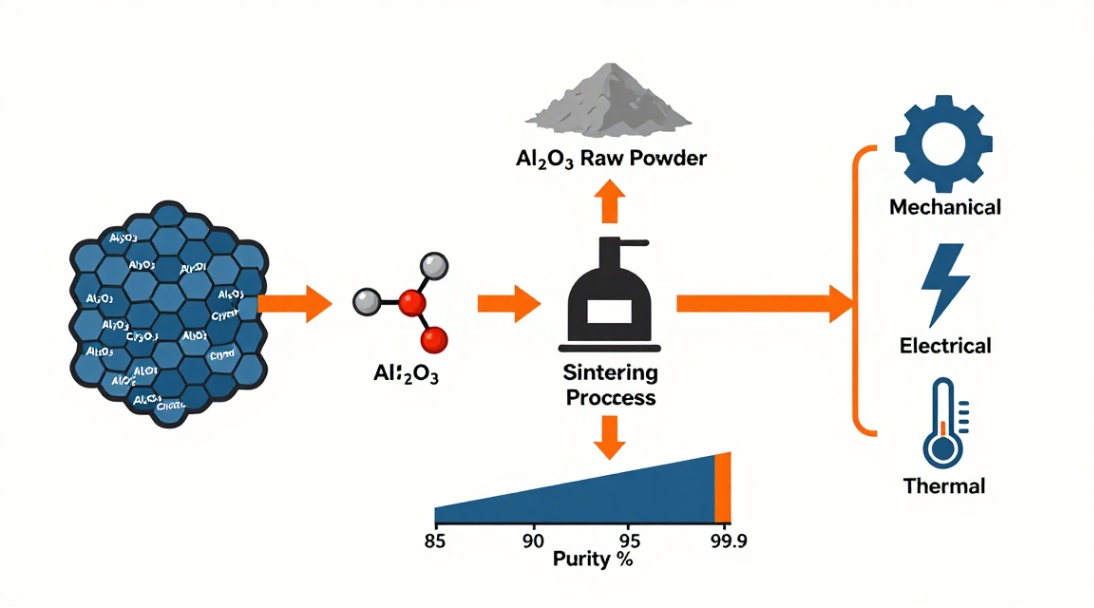
Core Properties of Alumina
The utility of aluminum oxide ceramic is built on a foundation of well-understood characteristics:
- High Hardness & Wear Resistance: Mohs hardness of 9, surpassed only by diamonds and a few carbides. This makes it ideal for abrasive environments.
- Electrical Insulation: Excellent dielectric strength and volume resistivity, even at elevated temperatures, securing its role in electronic substrates and insulating housings.
- Thermal Stability: Maintains structural integrity up to 1700°C, with low thermal expansion and good thermal conductivity for a ceramic. This ensures dimensional stability under thermal shock.
- Chemical Inertness & Biocompatibility: Resistant to strong acids and alkalis. High-purity grades are biologically inert, permitting use in medical implants and semiconductor processing.
- Cost-Effectiveness: Among technical ceramics, alumina typically offers the most favorable raw material and manufacturing cost profile for a given set of requirements.
Comparative Analysis: Alumina vs. Competing Ceramics
Material selection is about trade-offs. Aluminum oxide ceramic rarely excels in every category but provides a robust compromise. Here’s an objective comparison against key alternatives.
Aluminium Oxide vs. Silicon Carbide & Silicon Nitride
These non-oxide ceramics compete directly in high-temperature and wear applications.
- High-Temperature Performance: Silicon carbide ceramic (all forms: reaction-sintered, pressureless sintered, recrystallized) and silicon nitride ceramic offer superior thermal conductivity and creep resistance above 1400°C. They are the choice for extreme environments like turbine components.
- Toughness & Strength: Silicon nitride exhibits significantly higher fracture toughness and flexural strength than standard alumina grades. For demanding mechanical loads, it is often superior.
- Electrical Conductivity: Silicon carbide is a semiconductor; alumina remains an excellent insulator. This is a decisive factor in electronic applications.
- Oxidation Resistance: In long-term oxidative environments, alumina’s stable oxide layer is superior to the passive layers on non-oxides.
Aluminum Oxide vs. Zirconia (Zirconium Dioxide)
Zirconia challenges alumina where mechanical performance is paramount.
- Toughness & Strength: Zirconia’s transformation toughening mechanism grants it fracture toughness 2-4 times higher than alumina. It is the preferred choice for applications like cutting blades and biomedical implants subject to high stress.
- Wear Resistance: While zirconia is tough, alumina often demonstrates better wear resistance against certain abrasives due to its higher intrinsic hardness.
- Thermal Conductivity: Alumina has approximately 5-10 times higher thermal conductivity. For substrates requiring heat dissipation, alumina is the default choice.
- Cost & Stability: High-purity zirconia powders and processing are more expensive. Zirconia can also suffer from low-temperature degradation in moist environments, a non-issue for alumina.
Aluminium Oxide vs. Boron Nitride & Boron Carbide
These are specialized materials with niche advantages.
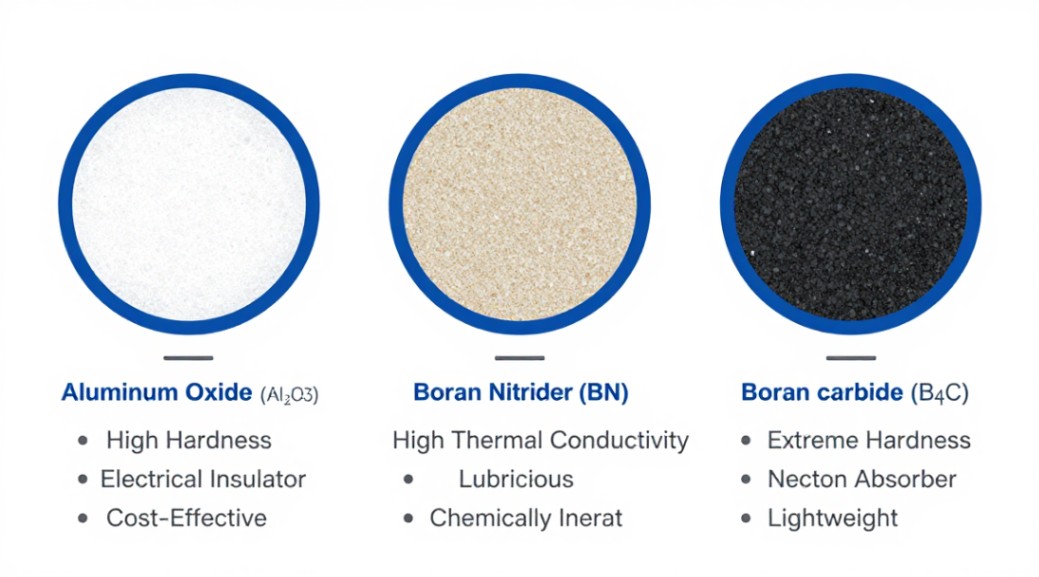
- Thermal Management: Boron nitride ceramic, particularly with a special coating for boron nitride ceramic crucibles, offers exceptional thermal shock resistance and is non-wetting to molten metals, a unique property alumina lacks.
- Extreme Hardness: Boron carbide ceramic is one of the hardest known materials, surpassing alumina. It is used in armor and ultra-abrasive applications where cost is secondary to performance.
- Machinability: Hexagonal boron nitride is soft and machinable with standard tools, unlike dense, hard alumina which requires diamond grinding.
- Electrical Properties: Boron nitride is an excellent insulator, similar to alumina, but with higher thermal conductivity.
Selection Guide: Choosing the Correct Alumina Grade
The ‘right’ alumina is not a single material. Purity and microstructure dictate performance.
- Identify the Primary Failure Mode: Is it wear, thermal shock, electrical breakdown, or chemical corrosion? This narrows the property focus.
- Map the Operating Environment: Document temperature extremes, chemical exposure, stress types (static, cyclic, impact), and required dimensional tolerances.
- Select by Purity Tier:
- 85%-95% Alumina: For general industrial wear parts, insulators, and lower-cost components where extreme properties are not critical.
- 99%-99.5% Alumina: The standard for high-performance applications. Used in semiconductor wafer handling, precision laser tubes, high-temperature furnace fixtures, and advanced pump seals. Offers the best balance of properties.
- 99.7%-99.9% Alumina: For the most demanding biomedical implants, critical electronic substrates, and applications requiring maximum corrosion resistance and surface finish.
- Consider Post-Sintering Finishing: High-tolerance parts require diamond grinding. The cost of finishing can exceed the cost of the blank. Design for manufacturability from the start.
The Future of Aluminum Oxide Ceramic Technology
Innovation continues to expand alumina’s capabilities. Current research focuses on overcoming traditional limitations.
- Enhanced Toughness: Borrowing from advanced composites like Ultra-High Temperature Ceramic Matrix Composites (UHTCMCs), researchers are exploring alumina matrix composites reinforced with fibers or platelets. The goal is to improve fracture toughness from the typical 3-5 MPa·m¹/² range, addressing the primary weakness of brittleness.
- Nanostructured Grades: Using sub-micron and nano-sized powders to create finer, more uniform microstructures. This can significantly increase strength, hardness, and optical properties for transparent armor or windows.
- Advanced Manufacturing: Additive manufacturing (3D printing) of complex alumina geometries is moving from prototyping to production, enabled by advanced binder systems and debinding/sintering protocols.
- Hybrid and Coated Systems: Applying functional coatings (e.g., for wear or thermal management) to alumina substrates to create components with surface properties of another material and the bulk economics of alumina.
Making the Informed Decision
Aluminium oxide ceramic remains the default engineering ceramic for a reason. Its combination of performance, availability, and cost is unmatched for a vast array of applications. For thermal management and insulation, it outperforms zirconia. Against silicon carbide, it wins on cost and oxidation resistance in many scenarios.
Start your specification process with alumina as the baseline. Only move to a more exotic (and expensive) ceramic like silicon nitride, boron carbide, or high-purity zirconia when a quantitative analysis proves alumina cannot meet a critical performance threshold, such as extreme toughness or ultra-high temperature strength. Consult with a specialized manufacturer early. They can advise on optimal grades, design for manufacturability, and whether a custom-sintered aluminum oxide ceramic component or a standard substrate, tube, or plate is the most efficient path to a reliable solution.
Suppiler
Synthetic-chemical focus on the research and development, production and sales of ceramic products, serving the electronics, ceramics, chemical and other industries. Since its establishment in 2015, the company has been committed to providing customers with the best products and services, and has become a leader in the industry through continuous technological innovation and strict quality management.
Our products includes but not limited to Aluminum Nitride, Aluminum Oxide, Boron Carbide, Boron Nitride, Ceramic Crucible, ect. If you are interested in any type of these, please feel free to contact us.