Next-Generation Ceramics: Unlocking Superior Properties for Industry

Aluminium Oxide Ceramic: The Hard Choice
Aluminium oxide ceramic (alumina) is not the newest or the toughest ceramic. It is the most reliable. For over 80 years, it has been the workhorse of industrial ceramics, chosen not for hype but for predictable performance at a justifiable cost. This guide cuts through the marketing to compare alumina directly against its competitors. We provide objective analysis to help engineers and buyers make a clear, cost-effective material decision.
The Core Advantages: Why Aluminum Oxide Ceramic Still Dominates
Its dominance stems from an unmatched balance of properties. Alumina offers very high hardness (up to 9 on the Mohs scale), excellent wear resistance, and superb electrical insulation. It maintains strength at high temperatures and resists corrosion from most chemicals. Crucially, it achieves this at a lower production cost than zirconia or silicon nitride, thanks to abundant raw materials and mature processing. This makes it the default choice for applications where extreme toughness isn’t the primary requirement, but reliability and cost are.
Frequently Asked Questions (FAQ)
Q: Is aluminum oxide ceramic brittle like glass?
A: Yes, all technical ceramics are brittle compared to metals. However, modern grades of alumina (like 99.5%) have improved fracture toughness through refined microstructure control. Think of it as highly reliable chalk, not fragile glass. For context, typical alumina has a fracture toughness (KIC) of 3-4 MPa·m1/2, while advanced composites using strategies like continuous fiber reinforcement can push this to 10-20 MPa·m1/2.
Q: What’s the difference between 96% and 99.5% alumina?
A> This is the most critical specification. 96% alumina is the industrial standard, offering the best balance of properties and cost for wear plates, insulator bodies, and nozzles. 99.5% alumina (high-purity) provides superior corrosion resistance, higher operating temperature, better electrical insulation, and can be polished to a smoother surface. It’s used for semiconductor wafer handling, advanced medical implants, and high-vacuum components.
Q: When should I choose alumina over silicon carbide or zirconia?
A> Choose alumina when your priorities are electrical insulation, wear resistance, and cost-effectiveness. Choose silicon carbide for superior thermal conductivity and extreme abrasion resistance. Choose zirconia (especially Y-TZP) when you need the highest fracture toughness and strength in a ceramic. As one industry expert put it: “Alumina is your daily driver; silicon carbide is your race car; zirconia is your tank.”
Direct Material Comparison: Aluminum Oxide Ceramic vs. The Field
Let’s break down the competition. Here’s how alumina stacks up against other key technical ceramics.
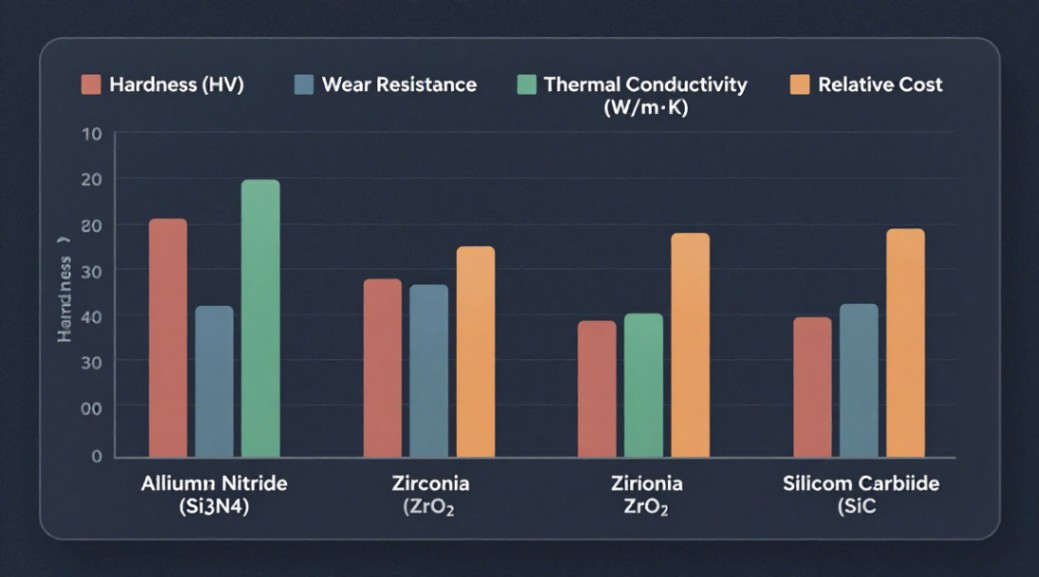
Aluminum Oxide vs. Zirconia (ZrO2)
- Alumina Wins On: Cost (often 3-5x cheaper), hardness, wear resistance, and thermal stability. It’s less prone to low-temperature aging degradation.
- Zirconia Wins On: Fracture toughness (2-3x higher), flexural strength, and can be made more translucent for aesthetic applications like dental crowns.
- Verdict: Use alumina for wear and electrical parts. Use zirconia where impact resistance is critical (e.g., scissors, knife blades, joint replacements).
Aluminum Oxide vs. Silicon Nitride (Si3N4)
- Alumina Wins On: Cost and dielectric strength. It’s a better electrical insulator.
- Silicon Nitride Wins On: Thermal shock resistance, fracture toughness, and specific strength. It excels in high-temperature dynamic applications like bearing balls and turbocharger rotors.
- Verdict: Use alumina for static insulators and liners. Use silicon nitride for moving parts under thermal stress.
Aluminum Oxide vs. Advanced Composites
The frontier is in composites. Research into ‘double continuous structure’ composites, where ceramic matrices like alumina are reinforced with continuous fibers, is addressing the brittleness flaw. These materials aim to combine ceramic hardness with metal-like damage tolerance. While not yet standard commodities, they represent the future for extreme applications.
Critical Applications: Where Aluminium Oxide Ceramic is Unbeatable
Alumina isn’t just a generic material; it solves specific, high-value problems.
- Electronics & Semiconductors: 99.5% alumina substrates are the bedrock of microelectronics. Its dimensional stability, electrical insulation, and thermal conductivity are perfect for circuit carriers and wafer handling robots.
- Industrial Wear Components: Pump seals, nozzles, liners, and cutting tools. 96% alumina provides a cost-effective shield against abrasive slurries and dry powders.
- Medical Technology: High-purity, biocompatible alumina is used in hip joint prostheses, dental implants, and surgical instrument tips. Its bio-inertness prevents adverse reactions.
- High-Temperature & Insulation: From furnace tubes to spark plug insulators, alumina withstands thermal and electrical challenges where metals fail and plastics melt.
The Final Decision: Should You Use Aluminum Oxide Ceramic?
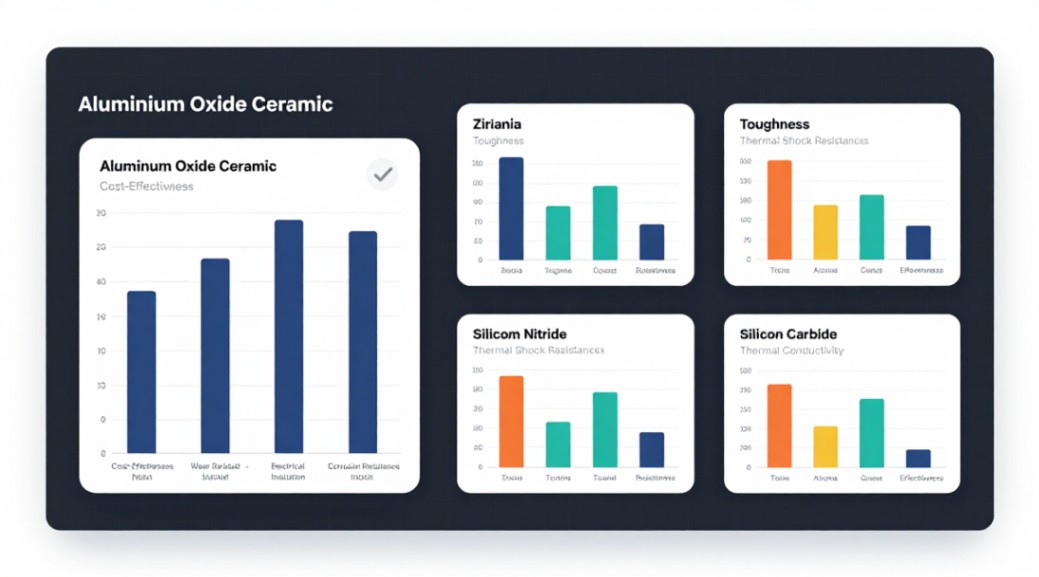
Stop overthinking. Use aluminium oxide ceramic if your project requires excellent wear resistance, high electrical insulation, and reliable performance in corrosive or high-temperature environments-and you need to control costs. It is the proven, no-nonsense solution. For applications demanding ultimate toughness, extreme thermal shock resistance, or highest thermal conductivity, look to zirconia, silicon nitride, or silicon carbide.
Ready to Specify Alumina? Do not buy generic “ceramic” parts. The performance gap between 96% and 99.5% alumina is massive. Consult with an expert manufacturer who can guide you on grade selection, design for manufacturability to avoid costly machining, and ensure proper finishing. The right alumina specification will save you money and prevent field failures. Contact a specialist today for a formal quote and design review.
Suppiler
Synthetic-chemical focus on the research and development, production and sales of ceramic products, serving the electronics, ceramics, chemical and other industries. Since its establishment in 2015, the company has been committed to providing customers with the best products and services, and has become a leader in the industry through continuous technological innovation and strict quality management.
Our products includes but not limited to Aluminum Nitride, Aluminum Oxide, Boron Carbide, Boron Nitride, Ceramic Crucible, ect. If you are interested in any type of these, please feel free to contact us.