Next-Generation Ceramics: Unlocking Superior Properties for Industry

Here’s a number that surprises a lot of engineers the first time they hear it: over 90% of the world’s advanced ceramic components use aluminium oxide ceramic in some form. Yet, for all its dominance, it’s rarely the absolute top performer in any single category. Its true power lies in being the relentless, reliable workhorse that gets the job done more affordably than the exotic alternatives. This puts us in a constant dialog of comparison. Should we spec the 99.5% pure Al2O3, or is the 96% grade good enough? When does it make sense to pay a premium for silicon carbide or accept the complexities of zirconia? That’s the conversation we’ve been having on shop floors for decades, and it’s one I want to have with you today.
The Unassuming Powerhouse
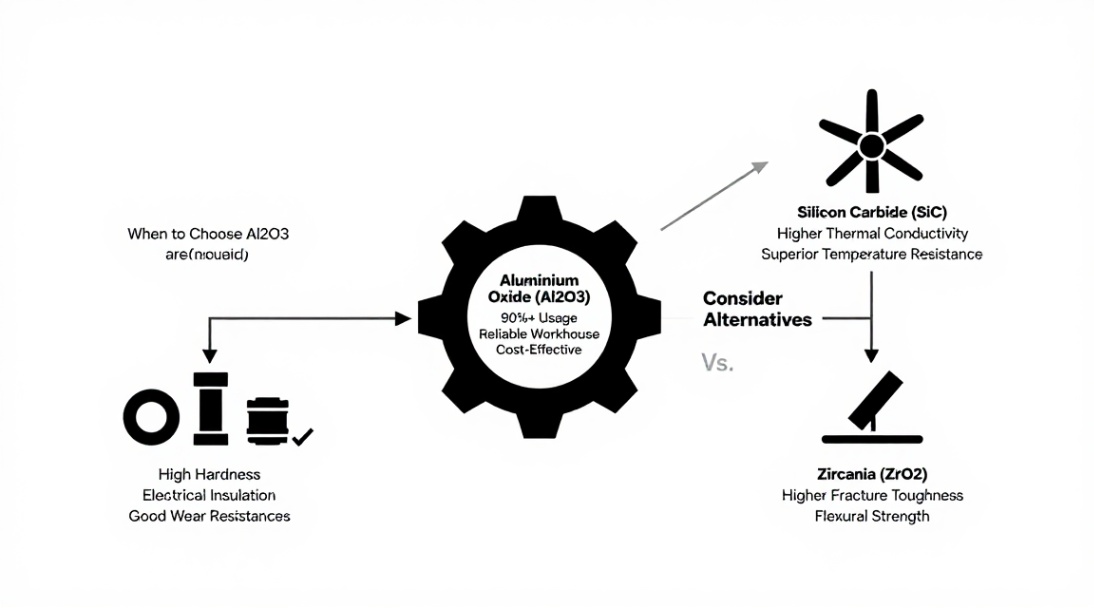
Let’s start by understanding what we’re dealing with. Aluminum oxide ceramic (Al2O3), often called alumina, is simply the ceramic form of aluminum and oxygen. Don’t let that simplicity fool you. Through processes like dry pressing, isostatic pressing, and high-temperature sintering, we transform that powder into a material with exceptional hardness – think industrial sandpaper, where the abrasive grit is often alumina. It’s that hardness that underpins its legendary wear resistance. We use it for pump seals, grinding media, and textile guides because it shrugs off abrasion year after year. Its thermal stability is another cornerstone. While it won’t handle the scorching temperatures of silicon carbide ceramic, it comfortably operates in environments up to 1700°C, making it a go-to for furnace linings and thermocouple tubes.
The Purity Gamble: 85%, 96%, or 99.5%?
Choosing the right grade isn’t about picking the ‘best.’ It’s about cost versus performance. The 85% and 96% purity grades are our industrial soldiers. They’re strong, hard, and relatively inexpensive to make via standard dry pressing. We reach for these when we need a wear plate, an insulating bushing, or a simple mechanical component where extreme purity isn’t critical. The trade-off? Slightly lower density and mechanical strength. Now, step up to 99.5% purity. This is where things change. Made via isostatic pressing, this grade offers superior density, higher strength, better surface finish, and much improved electrical insulation. This is the material we specify for high-performance medical implants, precision laser tubes, and critical electronic substrates where a tiny impurity could cause a failure. But you pay for that purity, both in material cost and more complex manufacturing.
The Real Competition: A Head-to-Head with the Alternatives
This is where the rubber meets the road. We never choose a material in a vacuum. We’re always weighing it against the field. Compared to zirconia, alumina is harder and more wear-resistant, but it’s also far more brittle. Zirconia’s incredible fracture toughness makes it the choice for applications with impact or thermal shock, like blade guides or dental crowns, where alumina would simply crack. Against silicon carbide ceramic, alumina loses in thermal conductivity and extreme temperature capability. For a rocket nozzle throat or a high-heat-exchanger tube, silicon carbide is king. But silicon carbide is also more expensive and harder to machine to a fine finish. Then there’s aluminum nitride ceramic. If your primary need is getting heat out of a high-power semiconductor, aluminium nitride’s thermal conductivity dwarfs alumina’s. But for pure electrical insulation at a lower cost, alumina often wins.
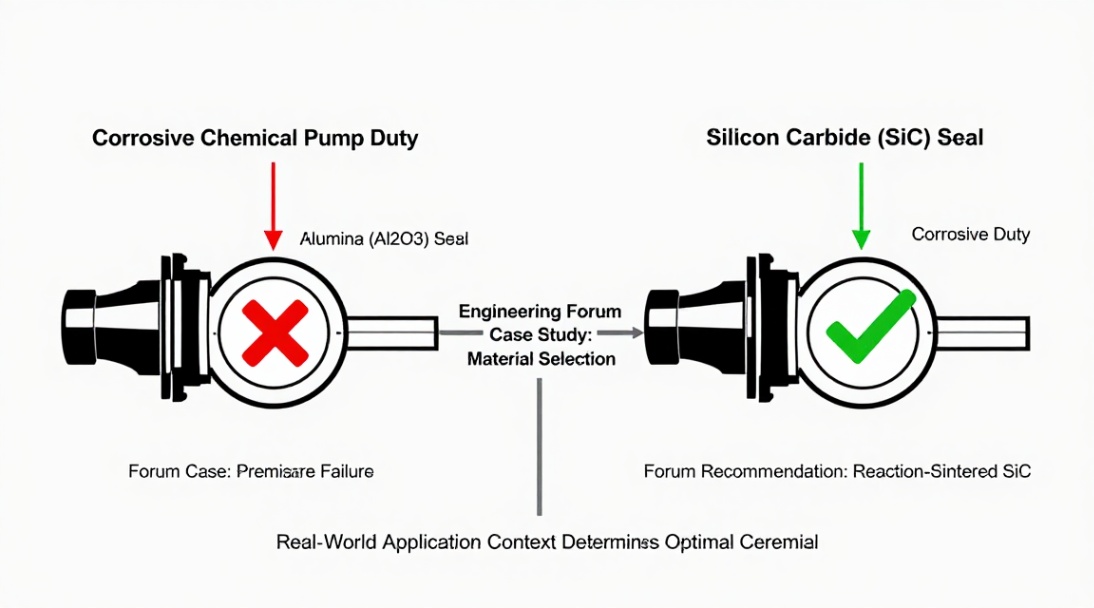
We see these trade-offs play out in user communities all the time. On engineering forums, you’ll find threads where someone tried to use a 96% alumina seal in a highly corrosive chemical pump, only to have it fail prematurely. The feedback there often points them toward a reaction-sintered silicon carbide ceramic for that specific duty. Conversely, you’ll see others champion alumina for generic wear pads in mining equipment, arguing that the tenfold cost difference compared to boron carbide simply isn’t justified for that application. These real-world stories are the best guide.
Designing With and Around Alumina
Working with aluminium oxide ceramic means respecting its nature. Its brittleness is its Achilles’ heel. You can’t design it like steel. We avoid sharp corners, design in generous fillets, and support it properly to avoid point loading. Joining it to metals is an art form in itself, often requiring specialized brazing alloys or diffusion bonding techniques. Post-processing is critical. As-sintered, it has a relatively rough surface. For a sealing face or a bearing surface, we’ll diamond grind it to a mirror finish, a process that requires skill to avoid micro-cracks. Its role as a substrate in electronics is a perfect example of its balanced portfolio. It provides excellent electrical insulation, good thermal path (enough for many applications), and can be metallized with precision to create robust circuits. It’s the default for a reason.
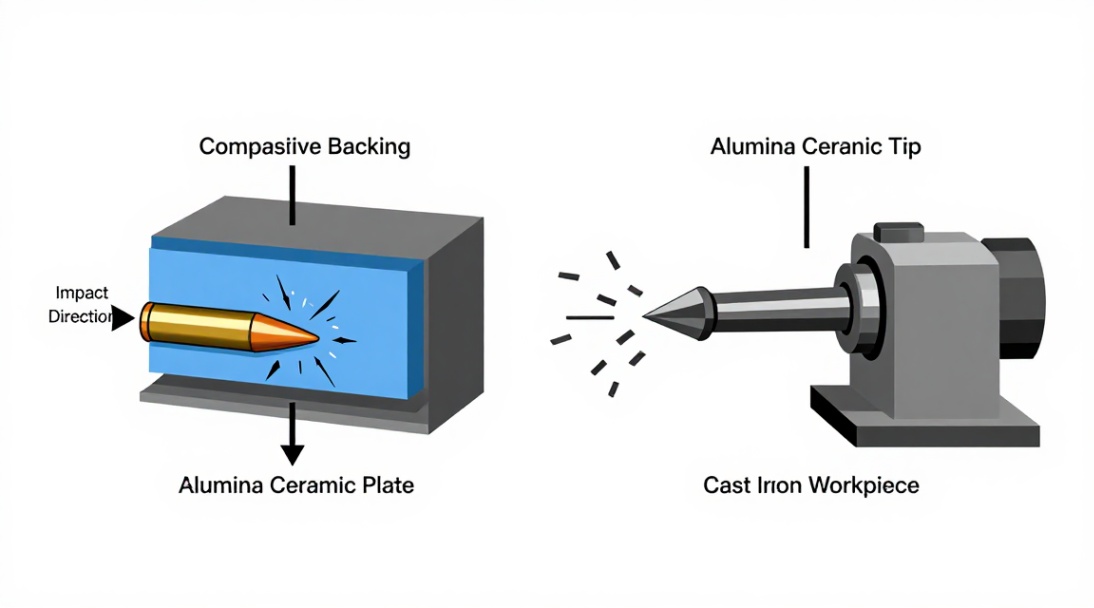
So, where does it truly shine? Look for the applications where reliability, wear resistance, and cost-effectiveness must intersect. Ballistic armor inserts often use alumina plates as a front layer to shatter a projectile, backed by a composite. Cutting tools for cast iron and non-ferrous metals are tipped with alumina-based ceramics. In your own projects, start with alumina as your baseline. If you need higher toughness, look at zirconia. If you need extreme temperature or thermal conductivity, evaluate silicon carbide or aluminum nitride. If cost is no object and you need ultimate hardness, boron carbide enters the chat. But for the vast, quiet majority of industrial challenges, the well-characterized, predictable, and economical nature of aluminum oxide ceramic will be your most dependable partner.
My advice? Prototype with the 96% grade first. It’s the fastest and most cost-effective way to validate your design. If it survives, you’ve saved a fortune. If it fails, the failure mode will tell you exactly what property you’re lacking-be it strength, toughness, or thermal shock resistance-and point you directly to the more specialized ceramic you actually need. That’s how we separate the necessary from the merely nice-to-have.
Suppiler
Synthetic-chemical focus on the research and development, production and sales of ceramic products, serving the electronics, ceramics, chemical and other industries. Since its establishment in 2015, the company has been committed to providing customers with the best products and services, and has become a leader in the industry through continuous technological innovation and strict quality management.
Our products includes but not limited to Aluminum Nitride, Aluminum Oxide, Boron Carbide, Boron Nitride, Ceramic Crucible, ect. If you are interested in any type of these, please feel free to contact us.