Next-Generation Ceramics: Unlocking Superior Properties for Industry

Aluminum Oxide Ceramic: The Workhorse of Advanced Materials
Did you know that at over 99% purity, aluminum oxide ceramic can be nearly as hard as sapphire, which is its single-crystal cousin? Yet, many design it like ordinary steel, leading to part failures. In online communities like Reddit’s r/MaterialsScience or engineering forums, a common theme emerges: ‘We chose alumina for its hardness, but it cracked under load.’ Understanding its unique nature is the first, critical step.
For over 20 years, I’ve guided teams through this process. Let’s break it down together.
1. Understanding Aluminum Oxide Ceramic: The Basics You Must Know
First, clarify the chemical composition and crystal structure. This material is primarily alpha-alumina (α-Al2O3), a dense, hexagonal close-packed structure. This structure is the root of its exceptional hardness and high wear resistance.
2. How to Evaluate Key Properties for Your Application
You cannot use every property at its maximum. Prioritize based on your need.
2.1. Is Wear Resistance Your Top Priority?
If yes, alumina excels. Its hardness (around 9 on the Mohs scale) makes it superb for wear parts like liners, nozzles, and guide rollers. Compare it to silicon carbide ceramic for even higher wear resistance in abrasive environments, but note silicon carbide is less electrically insulating.
2.2. Do You Need High-Temperature Stability?
Alumina maintains strength and shape up to 1600°C. It’s a champion for thermal stability. For extreme temperatures beyond 1800°C, you must look to materials like boron nitride ceramic with special coatings or emerging high-entropy oxides, but these are far more costly and niche.
2.3. Is Electrical Insulation Critical?
This is a core strength. Alumina’s excellent dielectric properties make it the default choice for electrical substrates, insulators, and spark plugs. For better thermal conductivity while maintaining insulation, consider aluminium nitride ceramic.
3. How to Select the Right Grade and Manufacturing Method
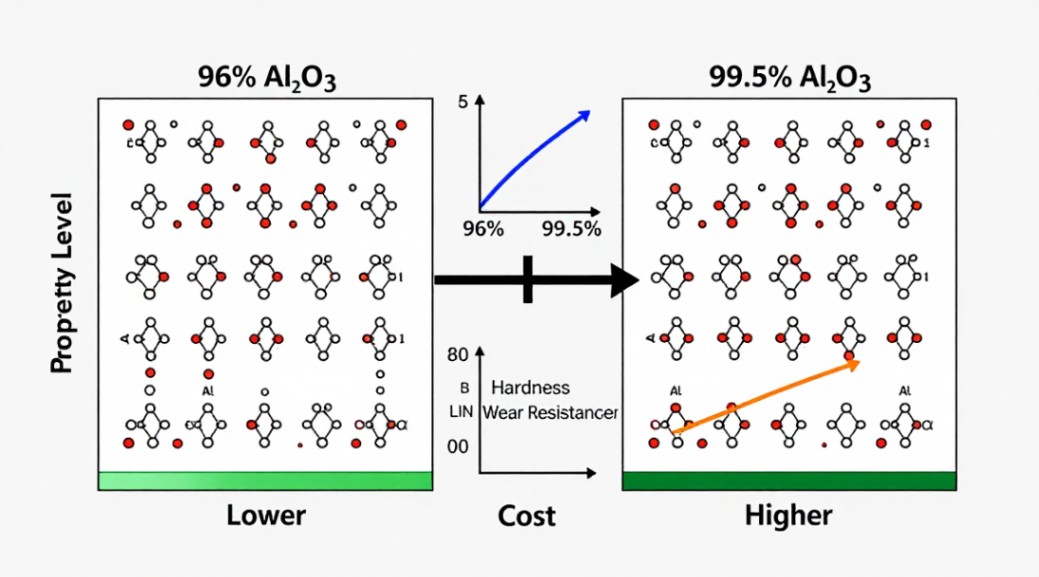
Step one: Define purity. Common grades are 96% and 99.5% alumina. Higher purity means better properties but higher cost and potentially more difficulty in sintering.
Step two: Choose the shaping process.
- Dry Pressing: Best for simple, high-volume shapes like tiles or simple substrates.
- Isostatic Pressing: Use this for more complex, uniform-density parts like rods, tubes, or intricate seals. It minimizes weak points.
- Injection Molding: The go-to method for highly complex, small-to-medium-sized components like biomedical implants or intricate pump parts. It offers excellent detail but has higher tooling costs.
4. How to Design for Alumina: Avoiding the Crack
This is where experience matters. Alumina is strong in compression but relatively weak in tension and has low fracture toughness compared to metals or zirconia.
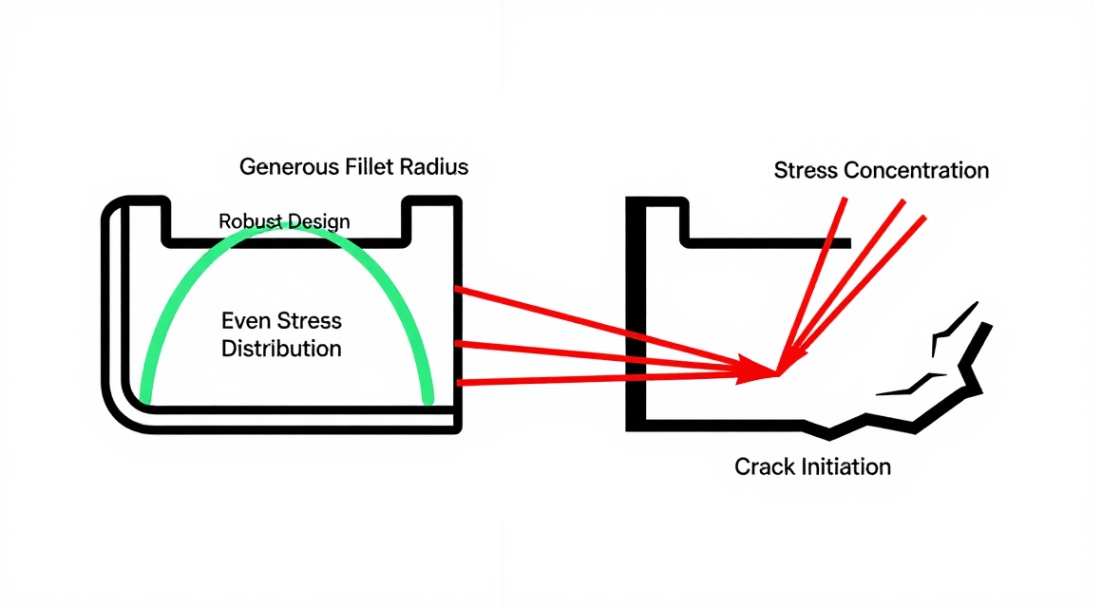
- Avoid Sharp Corners: Always use generous radii. Sharp internal corners act as stress concentrators and will initiate cracks.
- Mind the Stiffness: Its high Young’s modulus means it doesn’t bend much. Design supports to accommodate this rigidity, not fight it.
- Consider Joining Early: It’s difficult to join to metals. Plan for mechanical clamping, brazing with specialized alloys, or adhesive bonding designed for ceramics.
5. How to Machine and Finish Aluminium Oxide Components
You can only machine sintered alumina with diamond tools. It’s a grinding process, not cutting.
Step one: Use diamond-impregnated grinding wheels or drills. Coolant is mandatory to manage heat and flush away debris.
Step two: For fine finishes or tight tolerances, consider lapping or polishing. Surface roughness can be reduced to a mirror finish if needed, which is common for sealing faces.
6. When to Choose Other Ceramics: A Clear Comparison
Don’t force alumina. Make an informed choice.
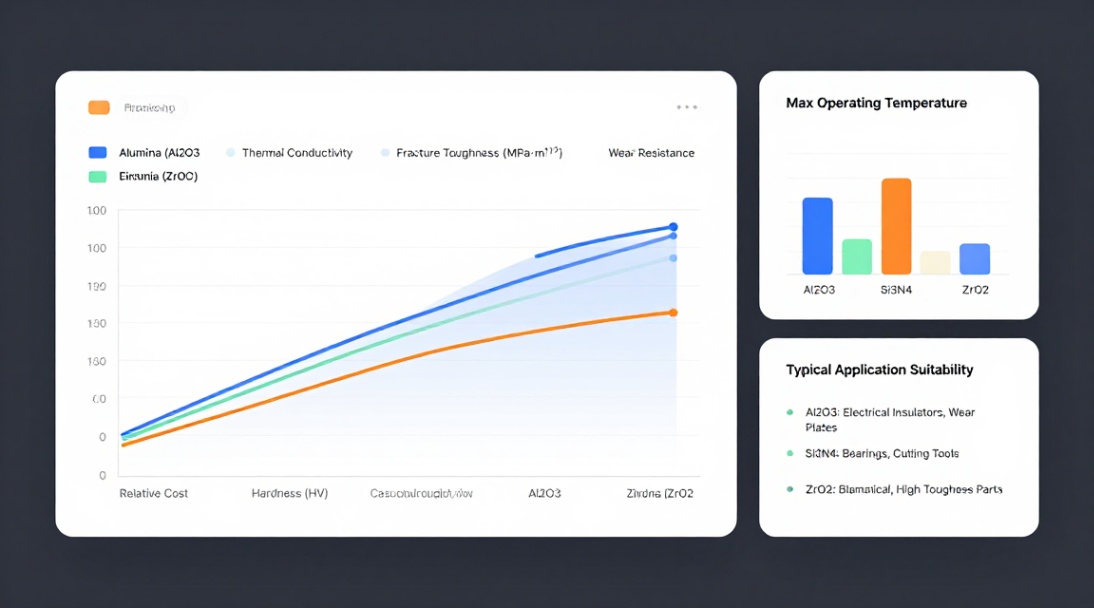
- Choose Zirconia if you need much higher fracture toughness and strength in bending applications.
- Choose Silicon Nitride Ceramic for exceptional thermal shock resistance and high strength at elevated temperatures (e.g., turbine components).
- Choose Boron Carbide Ceramic for extreme lightweight armor applications; it’s harder but more brittle.
- Choose Mullite Ceramic for exceptional creep resistance and stability in very high-temperature, low-stress environments.
Your Path Forward with Confidence
The real-world feedback I see often points to a mismatch between expectation and design. Aluminum oxide ceramic is a reliable, phenomenal material when you respect its rules. Start with a clear priority list of required properties. Prototype early, and collaborate with your ceramic component supplier during the design phase-not after. Their expertise on factors like sintering shrinkage and grain size is invaluable. With this approach, you’ll harness the full potential of this engineering workhorse.
Suppiler
Synthetic-chemical focus on the research and development, production and sales of ceramic products, serving the electronics, ceramics, chemical and other industries. Since its establishment in 2015, the company has been committed to providing customers with the best products and services, and has become a leader in the industry through continuous technological innovation and strict quality management.
Our products includes but not limited to Aluminum Nitride, Aluminum Oxide, Boron Carbide, Boron Nitride, Ceramic Crucible, ect. If you are interested in any type of these, please feel free to contact us.