Next-Generation Ceramics: Unlocking Superior Properties for Industry

The Stubborn Engineer and the Broken Punch
I once watched a senior engineer toss a brand-new silicon nitride punch into the scrap bin. It had cost $400. The job required a 0.5mm hole, repeated 10,000 times. The material chipped on cycle 847. He swapped it for an Aluminum oxide ceramic punch. It ran 12,000 cycles before surface wear forced a polish. He didn’t care about the academic numbers. He cared about the yield.
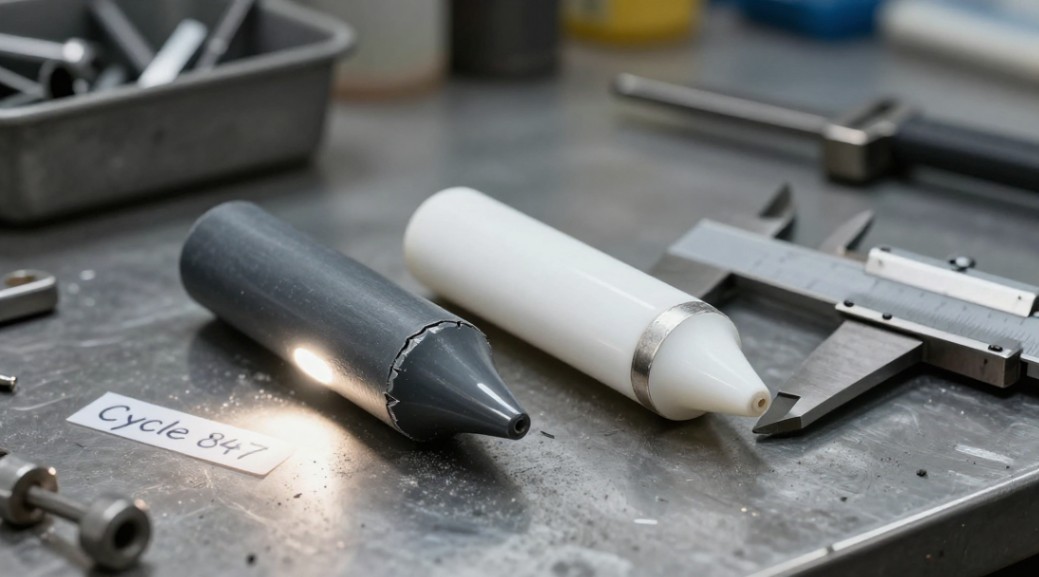
That is the reality of Aluminum oxide ceramic (Al2O3). It is rarely the absolute best on any single metric. But it is often the most reliable, most cost-effective solution. This isn’t a theory. This is a production floor truth.
1. What Exactly Is Aluminum Oxide Ceramic? (And Why Alpha Matters)
You are not buying “ceramic.” You are buying a specific crystal phase. Aluminum oxide ceramic in its engineering form is alpha-alumina. It has a hexagonal close-packed structure. This structure gives it the hardness and chemical inertness engineers rely on. Ignore purity claims below 99.5% for critical wear parts. That missing 0.5% is usually silica or calcia, which form a glassy grain boundary that softens at 1500°C. You lose hot hardness. That kills tool life.
2. The Key Properties: A Reality Check
Here is what the datasheets don’t scream loud enough. Aluminum oxide ceramic has a high melting point (over 2000°C). It is an excellent electrical insulator. It resists wear like a diamond-tipped tire. But you must respect its limits.
- Hardness: 9 on Mohs scale. It scratches almost everything.
- Compressive Strength: Extremely high. You can stand on it.
- Tensile Strength: Weak point. Never put it in tension without careful design.
- Fracture Toughness: Low. It will crack if you drop it on a concrete floor.
This last point is non-negotiable. Aluminum oxide ceramic is brittle. If your application involves cyclic thermal shock or mechanical impact, stop reading. You need a tougher material like Silicon carbide ceramic or partially stabilized zirconia.
3. How We Make It: Sintering vs. Hot Pressing vs. Isostatic Pressing
The manufacturing method dictates the final grain size and density. You cannot separate process from performance.
Sintering (Standard)
Cheapest. Good for simple shapes like tubes or insulators. Porosity sits around 3-5%. This limits strength and sealing ability.
Hot Pressing
Higher density. Near theoretical density (over 99%). Uses a graphite die and high temperature. The resulting Aluminum oxide ceramic has finer grains and better wear resistance. It is also more expensive. Use this for cutting tool inserts.
Injection Molding
For complex geometries. Think threaded bobbins or small surgical tools. Debinding is the critical step. A rushed binder removal creates voids. Voids cause stress risers. Stress risers cause field failures.
Isostatic Pressing
Best for large, uniform blanks. Used for refractory linings and large wear plates. The pressure ensures uniform density. No green body cracks.
Real talk: Skip pressureless sintered Silicon carbide-bonded silicon nitride ceramics for high-thermal-stress environments. Go with Reaction-sintered silicon carbide ceramics or fully dense Aluminum oxide ceramic.
4. Aluminum Oxide vs. The Competition: Who Wins and Who Loses?
Stop pretending every ceramic is a tool for every job. Here is the brutal comparison:
Aluminum Oxide vs. Zirconia
Zirconia has higher fracture toughness. It can take a hit. But it has lower hardness and undergoes a phase transformation at around 1200°C, which can cause catastrophic failure. Aluminum oxide ceramic maintains its structure better at high temperature. Use alumina for high-temperature corrosion resistance. Use zirconia for impact zones.
Aluminum Oxide vs. Silicon Carbide
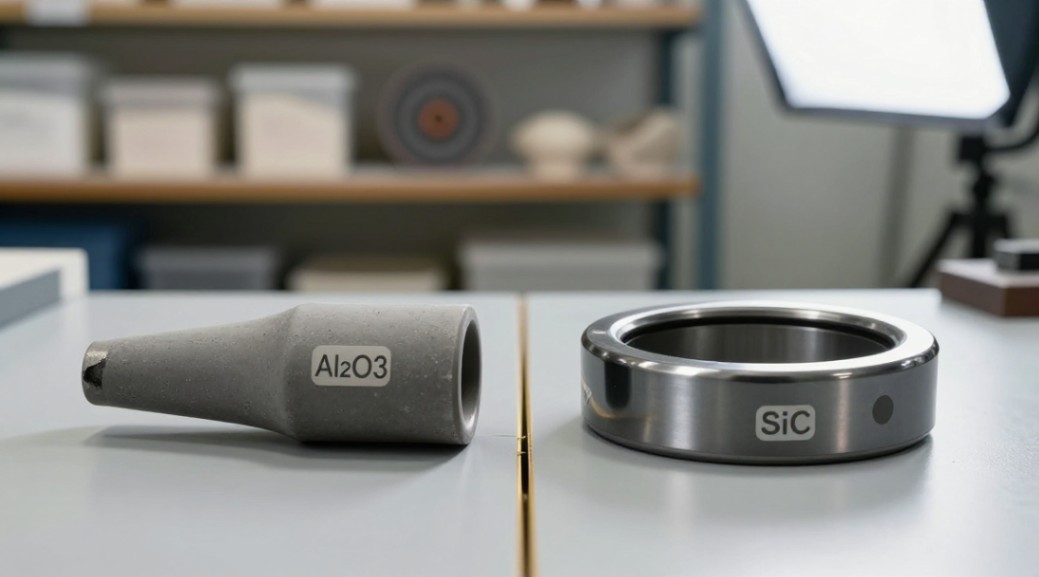
Silicon carbide ceramic is harder. It also has superior thermal conductivity (up to 200 W/mK vs. Alumina at ~30 W/mK). If you need to pull heat away from a seal face, SiC wins. But SiC is significantly more expensive and harder to machine. Aluminum oxide ceramic is the economic choice for abrasive environments where heat dissipation is not critical. For waste slurry nozzles, pick alumina. For mechanical seal faces in hot water pumps, pick Pressureless sintered silicon carbide ceramics.
Aluminum Oxide vs. Silicon Nitride
Silicon nitride ceramic has higher mechanical strength and thermal shock resistance. It is the king of bearing balls and engine components. Aluminum oxide ceramic cannot compete on toughness. But SiN is also a pain to grind and polish. The cost is 3-4x higher. For simple electrical insulators, why pay the premium? Stick with alumina.
Aluminum Oxide vs. Boron Carbide vs. Boron Nitride
Boron carbide ceramic is extremely hard (third hardest after diamond and cubic boron nitride). It is used for armor and abrasives. It is also very expensive and oxidizes above 800°C. Boron nitride ceramic has a hexagonal structure like graphite. It is soft, machinable, and has exceptional thermal shock resistance. It is used for crucibles and special coatings. Special coating for boron nitride ceramic crucibles is popular in the semiconductor industry for handling molten metals. Aluminum oxide ceramic fills the gap between these extremes. It is harder than BN, cheaper than B4C, and robust enough for 85% of industrial applications.
Aluminum Oxide vs. Mullite vs. Quartz
Mullite ceramic (3Al2O3·2SiO2) is cheaper and has superior thermal shock resistance. But it is softer and has lower temperature stability. Use it for kiln furniture. Do not use it for cutting tools. Quartz ceramic (fused silica) has extremely low thermal expansion. It survives brutal thermal shocks. It is not hard. Aluminum oxide ceramic sits in the middle: good thermal stability, good hardness, acceptable thermal shock for steady-state processes.
5. Can You Finish It? Surface Grinding, Polishing, and Lapping
Most Aluminum oxide ceramic parts leave the kiln rough. You need surface finishing for sealing surfaces or sliding contacts.
Grinding
Resin-bonded diamond wheels are the standard. Aggressive grinding creates microcraters. Use a finer grit for the final pass.
Polishing and Lapping
For mechanical seals, a polished surface (Ra < 0.1 µm) reduces leakage. Lapping with diamond slurry removes the subsurface damage layer. Do not skip this for biomedical implants. The body will not forgive a rough surface.
Counterintuitive fact: A polished Aluminum oxide ceramic surface has higher apparent hardness than a ground one. The ground surface contains microcracks that allow indentation to propagate. Polish removes these defects.
6. The Limitations: Don’t Let Good Data Fool You
I see engineers spec Aluminum oxide ceramic for everything. Stop it.
- Brittleness: It is the single biggest failure mode. A sharp impact = immediate fracture.
- Machining Complexity: You cannot drill or tap it like steel. You must shape it green (before sintering) or use diamond grinding tools. This adds cost and lead time.
- Low Fracture Toughness: Typically around 3-4 MPa·m^1/2. Compare that to zirconia at 8-12. If you need notch resistance, switch materials.
7. Market Trends and Growth Drivers: Where Alumina Shines Now
The demand for Aluminum oxide ceramic is growing in three sectors:
- Electronics: Thin-film substrates and insulating washers. The purity standard is 99.6% or higher.
- Medical Devices: Hip ball heads and dental implants. The material has excellent biocompatibility. It does not corrode. It does not ionize.
- Automotive: Oxygen sensor bodies and high-voltage battery insulators. The shift to electric vehicles is driving demand for reliable, high-temperature electrical insulation.
8. Quality Factors: What Actually Matters (Ignore the Fluff)
Four metrics separate a good supplier from a bad one:
- Purity Level: 99.5% is the baseline. 99.8% for high-wear or electrical applications.
- Grain Size: Submicron grains give higher strength. Buy fine-grained for cutting tools.
- Density: Must be >97% theoretical. Lower density means porosity, which causes water absorption and dielectric breakdown.
- Porosity: Open porosity is a death sentence for vacuum applications. Specify closed or no porosity.
The Final Decision: Your Move
Aluminum oxide ceramic will not win every fight. It is not the toughest. It is not the hardest. It is not the most thermally conductive. But it is the most balanced workhorse for 85% of industrial ceramic needs. If your application involves high-temperature electrical insulation, abrasive wear, or corrosive fluid handling, it is your cheapest path to a reliable solution. If you need impact resistance, go with a tougher Silicon nitride ceramic. If you need maximum thermal conductivity, use Aluminum nitride ceramic.
Stop guessing. Start testing. Order a prototype batch of Aluminum oxide ceramic parts from a supplier who can certify purity and density. Run your worst-case application test. The data will tell you if you made the right call.
Suppiler
Synthetic-chemical focus on the research and development, production and sales of ceramic products, serving the electronics, ceramics, chemical and other industries. Since its establishment in 2015, the company has been committed to providing customers with the best products and services, and has become a leader in the industry through continuous technological innovation and strict quality management.
Our products includes but not limited to Aluminum Nitride, Aluminum Oxide, Boron Carbide, Boron Nitride, Ceramic Crucible, ect. If you are interested in any type of these, please feel free to contact us.