Next-Generation Ceramics: Unlocking Superior Properties for Industry

A Surprising Starting Point
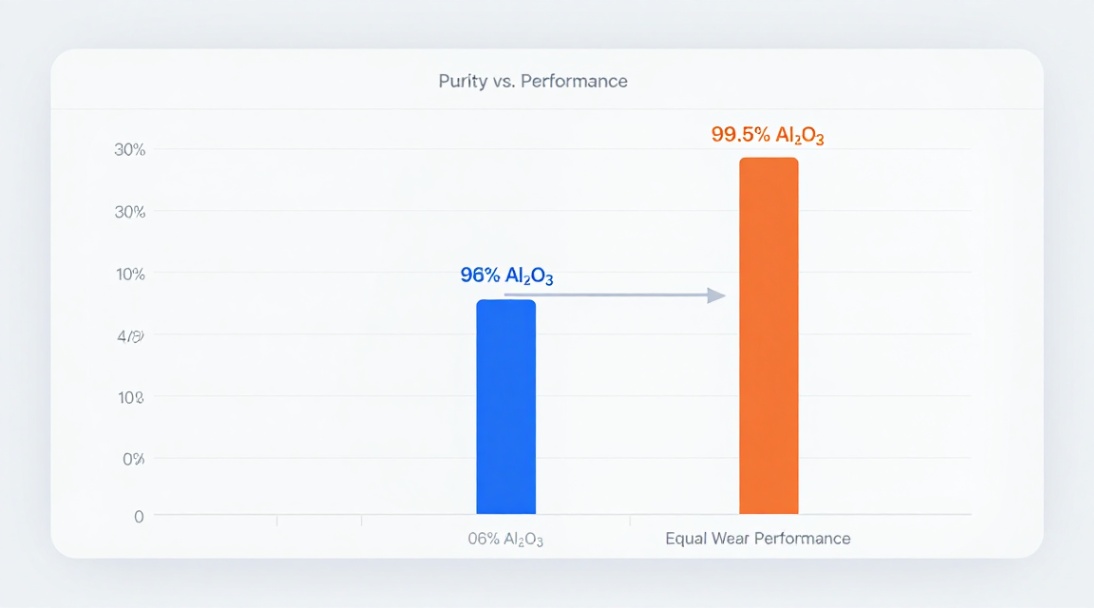
Here’s a fact that often trips up new engineers: A 99.5% alumina ceramic part can be up to 30% more expensive than its 96% counterpart, yet in many wear applications, it offers no practical performance gain. We spend money on purity we don’t need. Let’s fix that.
Step 1: Define Your Core Battle
What is the part’s primary job? This isn’t a trick question. Aluminum oxide ceramic excels in three distinct arenas. Pick one.
Wear and Abrasion
Think pump seals, liners, cutting tools. Here, hardness is king. We prioritize aluminum oxide ceramic for its exceptional hardness and wear resistance. It outlasts most metals in sliding or abrasive contact.
Electrical Insulation
This is for substrates, insulators, spark plugs. Dielectric strength and surface finish are critical. A smooth, flaw-free surface prevents arcing. This is where high purity truly shines.
Chemical and Biomedical
In corrosive environments or inside the human body, chemical inertness is non-negotiable. Aluminum oxide ceramic doesn’t react. It’s biocompatible. Perfect for labware or implant components.
Step 2: The Purity Puzzle – 96% vs. 99.5%+
This is the most common mistake. More purity isn’t automatically better. It’s about trade-offs.
- 96% Alumina: The workhorse. It has lower thermal conductivity than aluminum nitride ceramic, but it’s vastly more cost-effective for wear parts. Its slightly lower hardness is often irrelevant in practice. Use it for most industrial wear applications.
- 99.5%+ Alumina: The specialist. You get higher density, better surface finish after polishing, and superior dielectric properties. This is for high-voltage insulators, precision semiconductor tools, and critical seals where any impurity could cause failure.
Logic check: Don’t pay for 99.5% if you’re just lining a pipe for sand slurry. The 96% version will last for years.
Step 3: Match the Manufacturing Process to Your Shape
The process determines your design freedom and final properties.
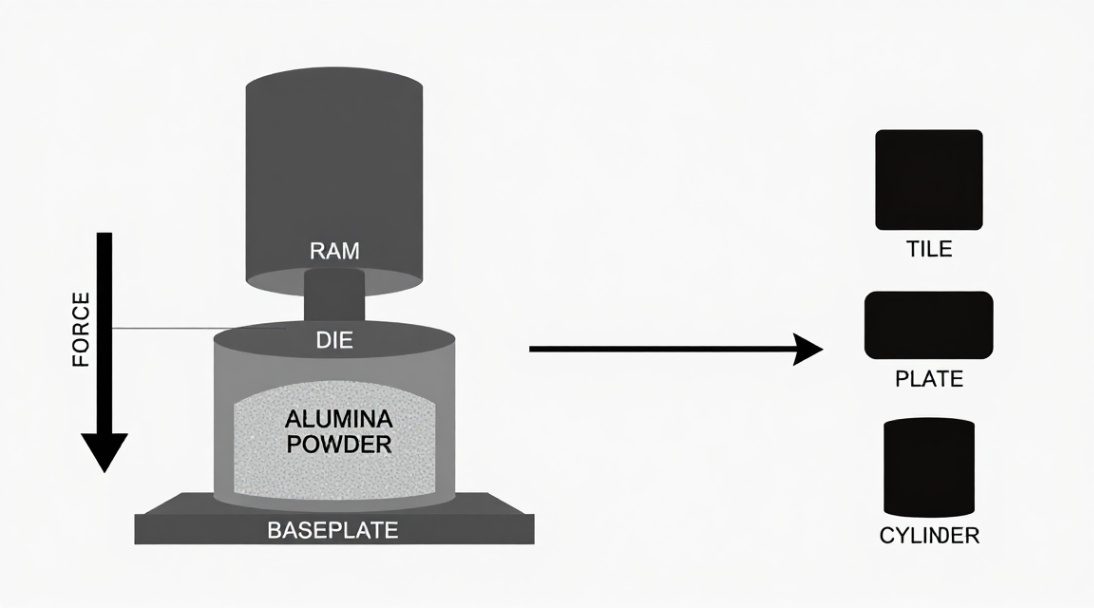
Dry Pressing
Simple, fast, cheap. It’s for simple, constant cross-section shapes like tiles, plates, and simple cylinders. Dimensional control is good, but complexity is low.
Isostatic Pressing
Uniform pressure from all sides. This gives us superior and consistent density throughout the part. It’s essential for complex, high-performance components like advanced wear parts or insulator bodies. Think of it as the quality upgrade.
Injection Molding
This is for high-volume, intricate shapes with fine details—think small, complex sensor housings or threaded components. The tooling is expensive, but per-part cost drops with volume.
Step 4: Know Its Limits (And When to Choose Another Ceramic)
Alumina is brilliant, but not universal. Its brittleness and moderate thermal conductivity are its Achilles’ heel.
- Need extreme thermal shock resistance? Look at mullite ceramic or silicon nitride ceramic.
- Need very high thermal conductivity for a heat sink? Aluminum nitride ceramic is 8-10 times better.
- Facing ballistic impact or ultra-extreme abrasion? Boron carbide ceramic or silicon carbide ceramic are harder. Reaction-sintered silicon carbide ceramics offer excellent net-shape capability for complex forms.
Selecting aluminum oxide ceramic means accepting its balance. We gain hardness and insulation. We manage brittleness with good design.
Step 5: Specify the Finish and Final Touches
The as-fired surface is rarely the final surface. Post-processing unlocks performance.
For a sealing face, we specify grinding and lapping to a Ra < 0.4 µm. For an electrical insulator, a fine polished finish is mandatory to eliminate surface flaws that could initiate a breakdown. For a wear part, a simple ground finish might be perfect. Remember, every machining step adds cost. Only specify what the function demands.
Putting It All Together: The Engineer’s Checklist
So, for your next component, run through this list. It forces a decision.
- Primary Function: Wear? Insulate? Resist corrosion?
- Environment: Temperature? Chemicals? Electrical fields?
- Mechanical Load: Impact, tension, or pure compression? (Alumina is strong in compression, weak in tension).
- Shape Complexity: Simple block or intricate geometry? This dictates the process.
- Budget: Does the application justify 99.5% alumina, or is 96% sufficient? Would a different material like silicon carbide ceramic offer a better lifetime cost?
Mastering aluminum oxide ceramic isn’t about memorizing data sheets. It’s about applying this logical selection framework. Start with the problem. Let the material’s inherent strengths and the realities of manufacturing guide you to the right grade, the right process, and the right finish. That’s how we design parts that last.
Suppiler
Synthetic-chemical focus on the research and development, production and sales of ceramic products, serving the electronics, ceramics, chemical and other industries. Since its establishment in 2015, the company has been committed to providing customers with the best products and services, and has become a leader in the industry through continuous technological innovation and strict quality management.
Our products includes but not limited to Aluminum Nitride, Aluminum Oxide, Boron Carbide, Boron Nitride, Ceramic Crucible, ect. If you are interested in any type of these, please feel free to contact us.