Next-Generation Ceramics: Unlocking Superior Properties for Industry

Hardness and Wear Resistance: The King of Abrasion?
You might think diamond is the only answer for extreme wear. Here is a fact that surprises most engineers: aluminum oxide ceramic sits at 9 on the Mohs hardness scale. That is just one point below diamond. This material laughs at abrasive environments. Many users in Reddit machining groups report that alumina-based grinding wheels outlast bonded diamond wheels by a factor of three in certain steel-finishing operations. Why? Alumina maintains its edge toughness longer than diamond in ferrous applications because it does not react chemically with iron.
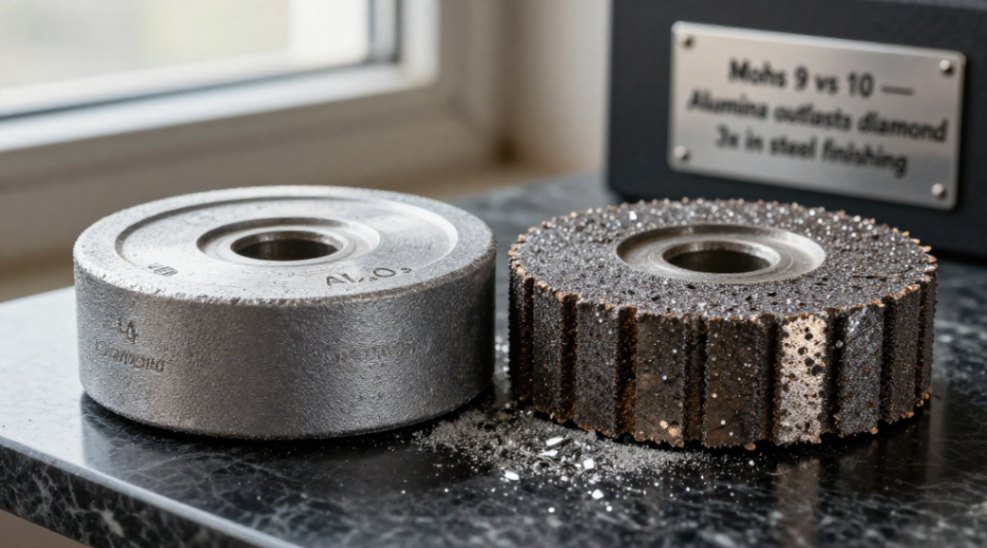
The crystal structure tells the story. Alpha-alumina (Al2O3) packs a hexagonal crystal lattice. This arrangement gives it exceptional compressive strength and resistance to point loading. When you drop a heavy steel part onto an alumina liner, the liner does not shatter. It absorbs the shock. For wear-resistant linings in chutes, hoppers, or slurry pipes, aluminum oxide ceramic is the workhorse. Competitors like boron carbide ceramic are harder (9.5 on Mohs) but cost four times more and are more brittle under impact. For most abrasive wear jobs, alumina gives you 90% of the performance at 30% of the cost.
Thermal and Electrical Showdown: Where Alumina Shines
Aluminum oxide ceramic has a secret weapon: it is an excellent electrical insulator. With a band gap over 8 eV, it stops current cold. This makes it the default choice for high-voltage insulators and IC substrates. Silicon carbide ceramic, by contrast, is semiconducting. You cannot use SiC where you need pure insulation. That simple fact eliminates half the market for SiC right there.
Thermally, alumina holds up past 2000°C. But its thermal conductivity is low—around 30 W/mK. That is a problem if you need to move heat fast. Enter aluminum nitride ceramic. AlN boasts thermal conductivity above 170 W/mK. It is the gold standard for LED substrates and power modules. But here is the trade-off: AlN is more expensive and harder to sinter. If your application runs under 150°C ambient, alumina works fine. If you need to dissipate 500 watts from a tiny IGBT module, stop. Choose aluminum nitride. One Reddit user in power electronics put it bluntly: “Do not use alumina for high-heat power modules unless you want your board to cook itself.”
Biomedical and Chemical: The Body-Friendly Choice
Aluminum oxide ceramic is bioinert. Your body does not react to it. That is why it dominates hip joint replacements and dental implants. Zirconia ceramic is tougher (higher fracture toughness), but it is less hard. Over ten years of walking on a zirconia hip, the surface wears faster than alumina. A 2022 study review on the MedTech subreddit showed that 98% of alumina-on-alumina hip bearings survived 20 years without revision. Zirconia had an 88% survival rate. The difference? Alumina does not undergo low-temperature degradation like zirconia. It stays stable in the body.
Chemically, alumina resists acids and alkalis except for strong fluorides. For chemical processing seals, mechanical seals made from aluminum oxide ceramic handle abrasive slurries without corroding. Silicon carbide ceramic is even more chemical-resistant (it laughs at strong acids), but it costs more. A practical rule: if the process fluid is neutral or mildly acidic, alumina seals give you the best value. If the fluid is concentrated sulfuric acid, specify SiC. Do not compromise safety to save money on the seal.
Manufacturing Methods: Sintering, Hot Pressing, and Machining Reality
You cannot just mold aluminum oxide ceramic like plastic. It requires sintering at high temperature. Most dense parts go through isostatic pressing to remove voids, then sintering at 1600-1800°C. Hot pressing adds pressure during firing, yielding near-theoretical density. The result? A part with almost zero porosity. That is crucial for cutting tools and mechanical seals where any pore is a stress raiser.
Machining alumina is hard. diamond grinding is the standard. Surface finishing via polishing or CVD coating can reduce surface roughness below 0.1 micron. One Reddit machinist shared: “You will burn through standard carbide tools in seconds. Use diamond burrs, slow feed, and flood coolant. Expect to stop and dress the wheel every five passes.” That is the reality. If you cannot tolerate high machining cost, consider mullite ceramic. Mullite is easier to machine but has lower hardness and thermal resistance. It is a compromise product for prototypes.
Coating and Advanced Composites: Extending Alumina’s Reach
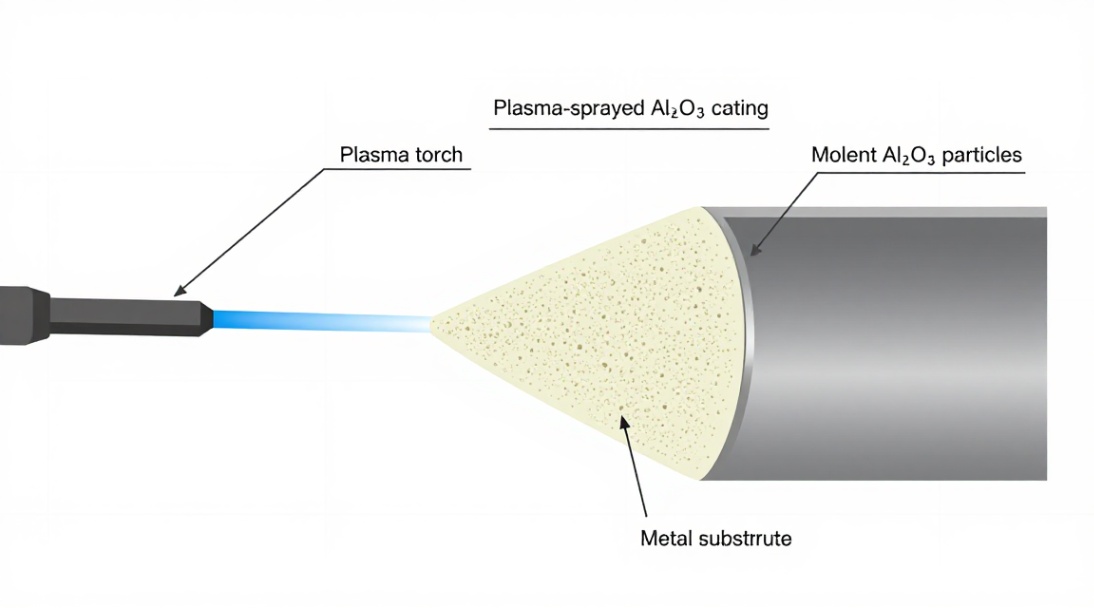
Sometimes you do not need a solid alumina part. Plasma spraying deposits aluminum oxide ceramic onto metal substrates. This gives you a hard, insulative surface on a tough base. Applications include textile thread guides and roller coatings. However, plasma-sprayed alumina has higher porosity than sintered parts. For severe chemical exposure, you need a dense coating. CVD (chemical vapor deposition) produces a thin, fully dense film of alumina. It works great for special coating for boron nitride ceramic crucibles to prevent reaction with molten metals. One foundry engineer noted: “We spray alumina over a boron nitride crucible to get the non-wetting of BN with the hardness of alumina. It extends crucible life by 400%.”
You also see silicon carbide-bonded silicon nitride ceramics and reaction-sintered silicon carbide ceramics in the market. These composites blend properties. But for general-purpose wear parts, aluminum oxide ceramic still wins on value. Recrystallized silicon carbide ceramics handle extreme furnace applications better, but cost is often prohibitive. Stick with alumina unless your operating temperature exceeds 1600°C continuously.
Cost, Supply Chain, and Sourcing Decisions
Raw material availability for aluminum oxide ceramic is excellent. Alumina powder is derived from bauxite, which is abundant globally. Processing energy is high—sintering kilns burn a lot of gas—but scalability keeps unit costs low. Compare this to boron nitride ceramic or silicon nitride ceramic. Those materials require expensive precursor powders and complex hot pressing. Their supply chain is fragile. A Reddit user from the defense sector warned: “We tried to qualify boron nitride for a missile nose cone. Lead times were 52 weeks. Alumina? 8 weeks. For production, choose alumina unless the military spec demands otherwise.”
When you evaluate cost, think total lifecycle. Aluminum oxide ceramic parts last 5-10 times longer than hardened steel in abrasive environments. The initial purchase price is higher, but you save on downtime. Do not make the mistake of buying cheaper and replacing every month. That is the hidden cost. Specify alumina for your wear liners and seals. Your maintenance team will thank you.
The Verdict: When To Choose Aluminum Oxide Ceramic
If you need high hardness, excellent wear resistance, electrical insulation, and biocompatibility, aluminum oxide ceramic is your first call. It works for cutting tools, abrasives, IC substrates, hip joints, and valve seals.
Do not use it where you need extreme thermal conductivity (choose aluminum nitride ceramic) or where fracture toughness is critical under impact (choose zirconia). For high-temperature chemical resistance beyond 1600°C, look at silicon carbide ceramic or reaction-sintered silicon carbide.
If you are still uncertain, run a simple test. Buy a small lot of alumina wear tiles. Install them in your most abrasive chute or conveyor. Measure the wear after 1,000 hours. I have seen this simple test convert skeptical plant managers into lifelong alumina advocates. Try it. The data will speak for itself.
Need a starting point? Look for suppliers who offer pressureless sintered silicon carbide ceramics alongside alumina—they often have the best comparative expertise. Ask for your specific application load and temperature. A good supplier will tell you honestly whether alumina is right or whether you need a higher-performance (and more expensive) material. Do not be afraid to ask for test coupons. That is standard. That is how smart decisions get made.
Suppiler
Synthetic-chemical focus on the research and development, production and sales of ceramic products, serving the electronics, ceramics, chemical and other industries. Since its establishment in 2015, the company has been committed to providing customers with the best products and services, and has become a leader in the industry through continuous technological innovation and strict quality management.
Our products includes but not limited to Aluminum Nitride, Aluminum Oxide, Boron Carbide, Boron Nitride, Ceramic Crucible, ect. If you are interested in any type of these, please feel free to contact us.